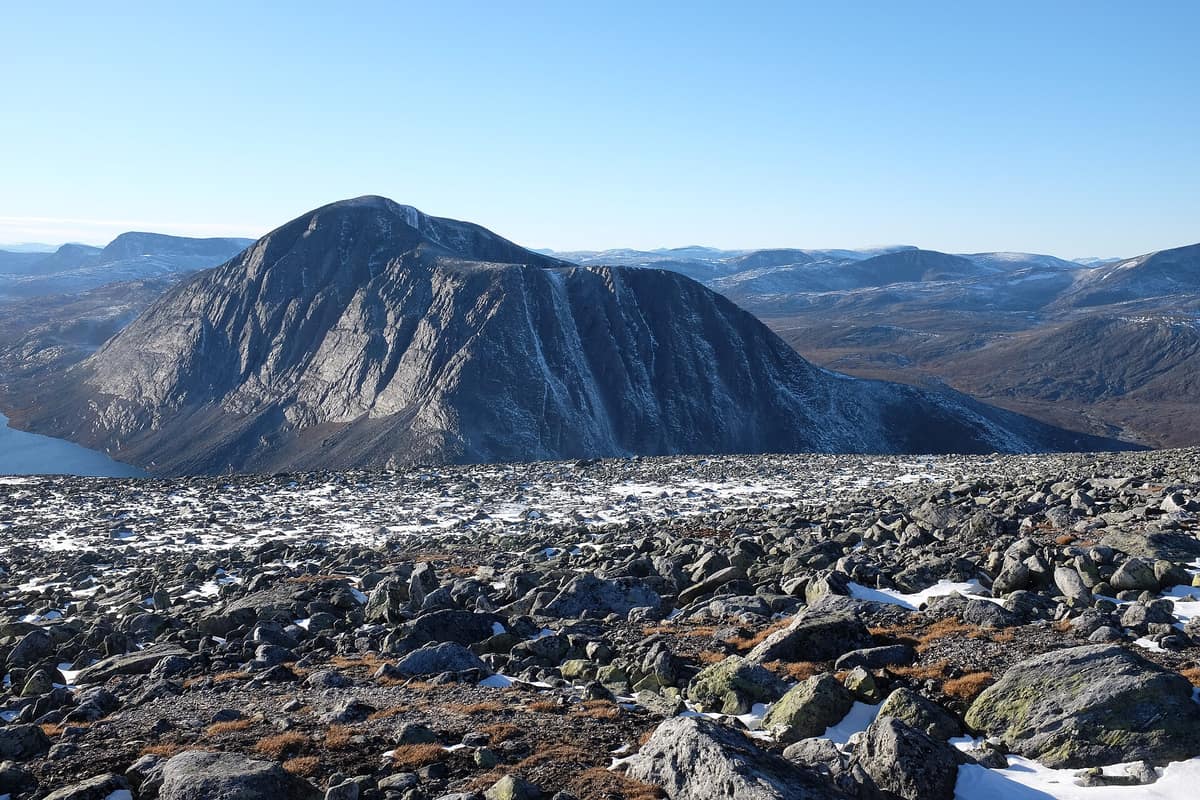
Dovrefjell-Sunndalsfjella National Park
Innlandet / Trøndelag / Møre og Romsdal (Dombås / Oppdal / Sunndalsøra) · Norway
Photo: Frankemann · CC BY-SA 4.0 · Wikimedia Commons
The ancestral realm of the muskox (Ovibos moschatus), the only place in continental Europe holding wild herds of this Ice Age giant crowned by Mount Snøhetta (2,286 m).
There is a creature in Dovrefjell that behaves unlike any other mountain herbivore. When threatened, it does not flee: it forms a defensive wall and charges. This is the muskox, found nowhere else in Norway. Yet remarkably, it is not the park's most ecologically vital resident. That status belongs to a far more elusive dweller: the wild reindeer of Snøhetta and Knutshø, the last genetically unmixed remnant of Scandinavia's ancestral mountain reindeer. Dovrefjell-Sunndalsfjella is an entire mountain wilderness dedicated to safeguarding this herd, crowned by the 2286 m summit of Mount Snøhetta.
What makes it unique
Here live Scandinavia's purest wild mountain reindeer and Norway's only wild muskoxen, both requiring a respectful distance.
The place
Nature
The landscape
The park is virtually treeless: almost the entire protected area lies above the subalpine birch limit, sprawling across high Arctic-alpine tundra between Sunndalen, Drivdalen, Dalsida, and Torbudalen. Precipitous walls drop into deep glacial troughs around north-western Sunndalen and encircling Snøhetta, while gentler rolling fells characterise the south and east, albeit with formidable relief throughout.
The mountain climate is sharply bifurcated. To the north-west, oceanic influences and prevailing westerlies bring heavy precipitation; the massif of Snøhetta forms a stark meteorological barrier, beyond which the eastern and southern sectors experience a continental climate where most rain arrives from the south-east.
Where limestone bands occur, the mountain soil proves remarkably lush: species-rich alpine calcareous grasslands, fertile fens, and a unique vascular flora. Elements of this vegetation pre-date the last glacial maximum, fostering high regional endemism. Along the river valleys, braided streams, oxbows, and open gravel flats wind through the tundra. Protection also covers quaternary glacial deposits and relict permafrost features.
Wildlife and seasons
Wild mountain reindeer are the ecological keystone. The animals of Snøhetta and Knutshø, alongside Rondane and Sølnkletten, represent the last wild descendants of prehistoric European reindeer; they have virtually no domestic reindeer genes and are exceedingly wary of humans. Across this high-fell ecosystem, reindeer, wolverine, Arctic fox, golden eagle, and common raven interact closely, with gyrfalcons nesting on high cliffs.
The muskox (moskus) was brought from north-east Greenland: modern animals descend from individuals released across Dovrefjell between 1947 and 1953. Dovrefjell is the sole place in Norway, and one of few worldwide, where free-roaming herds can be observed. There are two primary ways to see them: joining an authorised guide on a summer walking safari that typically lasts about six hours and covers 7 to 15 km, offering near-guaranteed sightings; or hiking independently along the Moskusstien, a signposted trail that minimises disturbance to the wild reindeer sanctuary of Stroplsjødalen. If you encounter a muskox, maintain a minimum safety distance of 200 m: they do not retreat, they charge.
Respecting seasonal wildlife calendars is critical. From February through July, and into August for some species, herds calve and must be granted peace. If you spot reindeer, stop and retreat immediately; disturbance forces them to expend crucial energy fleeing across scree. Arctic fox dens are strictly protected by law: never approach within 300 m. Winter backcountry infrastructure is deliberately minimal to safeguard energy reserves.
Species
With a page in the atlas
Being mentioned in a source doesn't guarantee sightings: check with the people who manage the area.
Memory and protection
History and conservation
Humans have stalked and trapped wild reindeer across these plateaux for hundreds of generations. The oldest stone hunting remains visible today exceed 1500 years in age, including mass pitfall trap lines, stone archery blinds, and converging drift fences. Between Dombås and Oppdal lie more than 1200 ancient pitfall traps in an almost unbroken chain. Before transport corridors severed the plateau, Rondane and Dovrefjell-Sunndalsfjella functioned as a single seasonal migration corridor for reindeer.
The national park was established in 2002 and expanded in 2018, incorporating the extensively restored former Hjerkinn military artillery range. The paramount management goal is conserving the undisturbed range of the Snøhetta and Knutshø reindeer, leading to seasonal road regulations and the rerouting of historic trekking paths.
Before you set off
Visiting
How to visit
Hjerkinn, situated at the high point of the E6 over Dovrefjell between Dombås and Oppdal, is the most practical trailhead: reachable by rail and road, it offers shuttle buses to Snøheim and serves as the starting point for the Norwegian Wild Reindeer Centre Pavilion (Viewpoint Snøhetta), the Besøkssenter Villrein, Kongevegen, and the St. Olav Ways (Pilegrimsleden). Kongsvoll is the departure hub for muskox safaris and the Moskusstien, and hosts the historic Kongsvoll Alpine Botanical Garden. Lesja, between Åndalsnes and Dombås, sits between two national parks: Reinheimen to the west and Dovrefjell-Sunndalsfjella to the east.
Public transit access is straightforward via train, coach, and road, with regional airports at Gardermoen and Værnes. Cycling is prohibited across the national park with very limited track exceptions, and e-bikes count as motorised transport.
Before you go
From 1 April to 20 August all dogs must be kept strictly on leads. Organised commercial wildlife watching groups require advance permission from the park board; joining an accredited local guide is strongly recommended to spot muskoxen safely while preventing habitat degradation.
Check access, rules and visiting conditions in the official information from the managing body before you set off.
Location
Where it is and how far it reaches
Boundary of Dovrefjell-Sunndalsfjella · IUCN II · © EEA, CDDA (CC-BY) The coordinate is estimated; it isn't a verified access point.
Transparency
Sources
The research data with its sources, and the official links for this place, are in the Spanish version of this page. See the Spanish version
Around it
The Reinheimen National Park lies some fifteen kilometres away and Rondane National Park about twenty; Rondane shares with Dovrefjell-Sunndalsfjella the authentic wild mountain reindeer of Scandinavia. Farther across the fells, Hardangervidda National Park and the Helagsfjället Nature Reserve also share Arctic fox and wild reindeer in high alpine habitats.
What else to explore nearby
Approximate straight-line distance between the edges of each area. It doesn't indicate access, routes or driving times.
- Reinheimen National Park
Innlandet / Møre og Romsdal (Åndalsnes / Skjåk / Lesja)
About 15 km away
One of Norway's largest roadless, unelectrified contiguous protected areas, safeguarding the mountains' most ancestral wild reindeer herds.
JFMAMJJASONDJune – September · Crowding very low
If you like this place, elsewhere in Europe
Distant places with uncommon wildlife and habitats in common. The most widespread species don't count. Sharing species doesn't imply a corridor or guaranteed presence.
- Padjelanta National Park
Swedish Lapland / Norrbotten (Jokkmokk / Kvikkjokk)
In common: Arctic fox · Caribou — high mountain, alpine meadow
Sweden's largest national park (198.000 ha), featuring vast alpine lakes Vastenjaure and Virihaure and ancestral Sami grazing lands.
JFMAMJJASONDJuly – September · Crowding very low
- Vatnajökull National Park
East and South Iceland (Skaftafell / Jökulsárgljúfur / Askja)
In common: Arctic fox · Caribou — high mountain, glacial landscape
Europe's largest ice cap outside the Arctic and the volcanoes smouldering beneath it: fire and ice on a continental scale.
JFMAMJJASONDJune – September · Crowding moderate
Entry #565 of the original atlas.