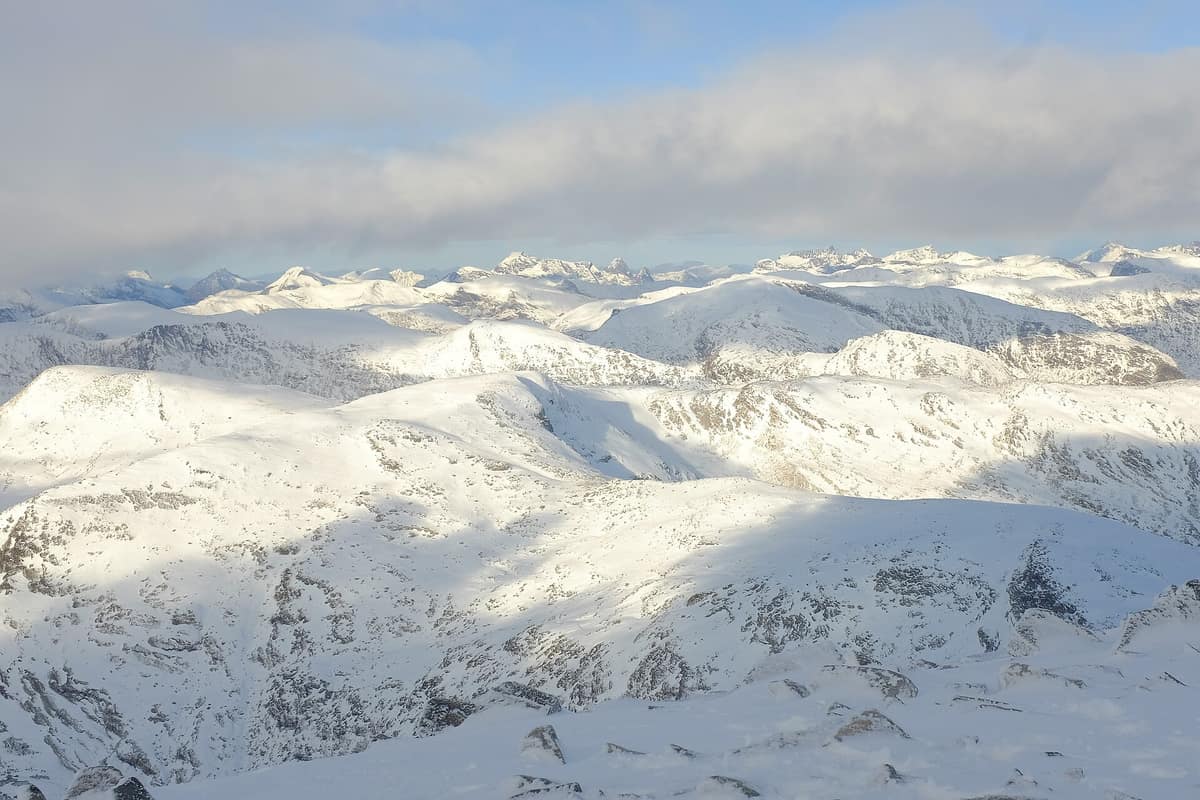
Reinheimen National Park
Innlandet / Møre og Romsdal (Åndalsnes / Skjåk / Lesja) · Norway
Photo: Frankemann · CC BY-SA 4.0 · Wikimedia Commons
One of Norway's largest roadless, unelectrified contiguous protected areas, safeguarding the mountains' most ancestral wild reindeer herds.
Rising from the floor of the Romsdalen valley, Trollveggen ascends 1,700 metres vertically, forming one of the highest sheer rock faces in Europe. Yet Reinheimen is far more than that precipice. It is Norway's third-largest national park, encompassing 1,969 km² of contiguous mountain territory, established in 2006 across Møre og Romsdal and Innlandet. One quarter is dramatic—razor-sharp peaks, knife-edge ridges, roaring torrents—while another unfolds into a sprawling rolling plateau where one of Europe's last great wild reindeer herds grazes. Here you can traverse from one world to the other within hours.
What makes it unique
A park where you retrace the steps of prehistoric reindeer hunters among pitfall traps and stone shelters, beneath one of Europe's highest vertical rock faces.
The place
Nature
The landscape
Reinheimen exhibits two contrasting faces. In the west the topography is jagged, marked by horns, crests, gorges, talus slopes, and churning glacial rivers. If you trek to Bruraskaret towards Romsdalen, you peer over a plunge of about 1,000 metres straight down Trollveggen. In the east, the terrain softens: undulating plateaus, broader valleys, and tranquil streams. The highest summits exceed 2000 metres, whereas the lowest point rests at the base of Trollveggen, around 130 metres.
This dichotomy has a geological root. Between 900 and 1,900 million years ago the foundational rocks of Reinheimen formed: sedimentary and igneous strata folded and metamorphosed into gneisses, later invaded by granitic intrusions. In the east younger, nutrient-rich rocks prevail, such as phyllite and mica schist. In the west the land has rebounded more vigorously since the Ice Age and receives heavier precipitation, granting rivers steeper gradients and formidable cutting power. In Romsdalen, colossal valley-floor boulders bear witness to prehistoric and recent rock avalanches; in autumn 2019, Veslemannen, part of the unstable Mannen rock mass, plunged into the valley.
From these heights spring the Istra, Rauma, Lora, Finna/Skjerva, Valldøla, and Tora/Føysa.
Wildlife and seasons
The wild caribou ranges across virtually the entire park. The winter herd numbers around 2000 animals, ranking among the country's most productive. It is exceedingly vulnerable to disturbance, notably in midwinter and during spring calving. A reindeer can detect human scent from several kilometres and bolt just as far: if you encounter reindeer, keep an ample distance, retreat slowly in the opposite direction, and keep your dog under firm control.
Above them dwell the predators. The wolverine breeds within the park and its buffer zones. The Arctic fox is staging a comeback: in 2004 a captive breeding and release project began, and since 2016 breeding pairs have established territories in Reinheimen. Disturbing their dens is prohibited by law.
Among birds, the deciduous wooded slopes of Tafjorden and Romsdalen shelter passerines and woodpeckers. The Western capercaillie and black grouse inhabit lower agricultural valleys, willow ptarmigan populate upland valleys, and the rock ptarmigan thrives at higher elevations. Gorges provide nesting ledges for raptors: the golden eagle, the white-tailed eagle, rough-legged buzzard, and gyrfalcon are most widespread, alongside the Eurasian eagle-owl. Lakes Leirungvatnet and Råkvatnet host breeding waterfowl, including red-listed species. More than 115 breeding bird species have been recorded across the protected territories.
Species
With a page in the atlas
Being mentioned in a source doesn't guarantee sightings: check with the people who manage the area.
Memory and protection
History and conservation
Reinheimen is exceptionally rich in archaeological vestiges of prehistoric wild reindeer hunting: pitfall trapping systems, large-scale converging drive walls, hunting blinds, and drystone hunter huts. They enjoy strict legal protection, so never disturb stones from ancient walls. Surrounding rural communities maintain deep historical bonds with the uplands: some 20,000 head of domestic livestock graze each summer across the national park and its protected landscapes, requiring respectful coexistence.
Before you set off
Visiting
How to visit
Reinheimen is best accessed through its gateways. In Lom, the Norwegian Mountain Center functions as the visitor centre for three parks—Reinheimen, Breheimen, and Jotunheimen—with museum displays on nature, culture, and mountain history. In Åndalsnes, the Norsk Tindesenter combines visitor facilities, a museum, and a climbing wall explaining mountaineering heritage in Romsdalen. In Lesja, the rural museum interprets wild reindeer and traditional upland life. At the Trollstigen Pass, a panoramic viewpoint and café interpret the national park, serving as the trailhead for several signposted routes.
Hikers have multiple day options. The Tussheim lookout lies an hour on foot from Lesja centre along a path interpreting reindeer ecology. The Billingen cultural and nature trail covers 3.1 km through woodland slopes with vistas of Reinheimen and Breheimen. The Kløvstien, a historic packhorse track from Valldal to Åndalsnes, allows either a gentle stroll or a stiff climb to Trollstigen. At Bjorli, Rånåkollen offers a marked ascent to a summit overlooking two parks, complete with a day shelter. In summer, a shuttle bus connects Norsk Tindesenter to Vengedalen, the departure point for the Romsdalseggen ridge traverse. Alternatively, you can drive the scenic Geiranger-Trollstigen highway to take in the most dramatic alpine relief.
Reinheimen is reachable via highways Rv 15 and E136, as well as the scenic Rauma railway line.
Before you go
High-altitude birds nest under razor-thin margins with short breeding windows and volatile weather, leaving them extremely susceptible to human disturbance during the breeding season. Respect wild reindeer during winter and spring, keeping dogs leashed and controlled. Consult park management regarding route conditions and hazard bulletins prior to departure.
Check access, rules and visiting conditions in the official information from the managing body before you set off.
Location
Where it is and how far it reaches
Boundary of Reinheimen · IUCN II · © EEA, CDDA (CC-BY) The coordinate is estimated; it isn't a verified access point.
Transparency
Sources
The research data with its sources, and the official links for this place, are in the Spanish version of this page. See the Spanish version
Around it
Reinheimen has three neighbours in the atlas: Dovrefjell-Sunndalsfjella National Park, about 15 km away, alongside Jotunheimen National Park and Rondane National Park, about 25 km away. Farther afield, Saltfjellet-Svartisen National Park shares the wolverine and caribou, arctic-alpine peaks, and glaciers.
What else to explore nearby
Approximate straight-line distance between the edges of each area. It doesn't indicate access, routes or driving times.
- Dovrefjell-Sunndalsfjella National Park
Innlandet / Trøndelag / Møre og Romsdal (Dombås / Oppdal / Sunndalsøra)
About 15 km away
The ancestral realm of the muskox (Ovibos moschatus), the only place in continental Europe holding wild herds of this Ice Age giant crowned by Mount Snøhetta (2,286 m).
JFMAMJJASONDJune – September · Crowding low
- Jotunheimen National Park - Home of the Giants
Innlandet / Vestland (Lom / Gjendesheim / Øvre Årdal)
About 25 km away
The 'Home of the Giants' in Norse mythology, harboring Scandinavia's two highest peaks (Galdhøpiggen 2 469 m and Glittertind) and the legendary Besseggen ridge.
JFMAMJJASONDJune – September · Crowding moderate
If you like this place, elsewhere in Europe
Distant places with uncommon wildlife and habitats in common. The most widespread species don't count. Sharing species doesn't imply a corridor or guaranteed presence.
- Vindelfjällen Nature Reserve
Västerbotten (Ammarnäs / Tärnaby)
In common: European golden plover · Wolverine · Caribou — high mountain
One of the largest nature reserves in Europe: high-alpine massifs, birch valleys, and the free-flowing Vindel River running wild to the Baltic.
JFMAMJJASONDMarch – April · June – September · Crowding very low
- Saltfjellet-Svartisen National Park
Nordland (Rana / Saltdal / Beiarn / Meløy)
In common: Wolverine · Caribou — high mountain, glacial landscape
Gigantic coastal glaciers cascading from the Svartisen ice cap nearly to fjord level, across Saltfjellet alpine plateaus on the Arctic Circle.
JFMAMJJASONDJuly – September · Crowding very low
- Pallas-Yllästunturi National Park
Finnish Lapland (Enontekiö / Kittilä / Kolari / Muonio)
In common: European golden plover · Caribou — high mountain
Finland's most visited national park (1.020 km²), a chain of tundra fell hills (tunturi) hosting the cleanest air measuring station on Earth (Sammaltunturi).
JFMAMJJASONDJune – September · December – April · Crowding moderate
- Urho Kekkonen National Park
Finnish Lapland (Saariselkä / Inari / Sodankylä)
In common: Wolverine · Caribou — high mountain
Finland’s second largest national park (2.550 km²), rounded arctic tundra fell-tops (tunturi), and wild trekking under the shadow of Sokosti (718 m).
JFMAMJJASONDJune – April · Crowding low
Entry #568 of the original atlas.