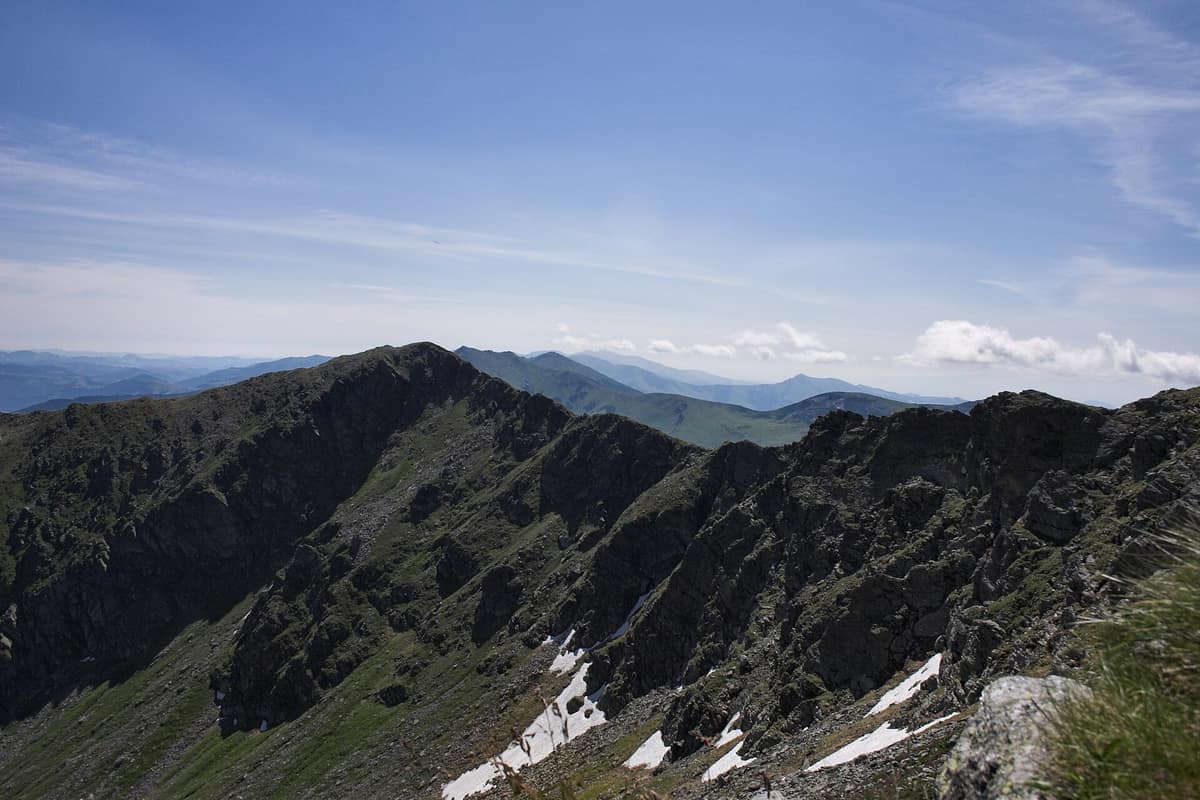
Rodna Mountains National Park
Parcul Național Munții Rodnei
Bistrița-Năsăud and Maramureș Counties (Pietrosu Rodnei) · Romania
Photo: Martin Kozák · Public domain · Wikimedia Commons
The highest glacial mountains in the Eastern Carpathians hosting the Pietrosu Rodnei scientific reserve.
A mountain massif ascending from 900 to 2300 metres, recognized since 1979 by UNESCO as a biosphere reserve. The Rodna Mountains hold the loftiest crests of the Eastern Carpathians in northern Romania, and their national park protects 47.202 hectares of mountain woodland, alpine meadows, glacial cirques, and tarns. The roof is Pietrosul Rodnei, reaching 2303 m.
What makes it unique
A glacial massif where Swiss stone pine, edelweiss, and an endemic pink, Lychnis nivalis, share space with brown bears, chamois, and marmots.
The place
Nature
The landscape
The massif is an ecological mosaic shifting with elevation. Lower reaches support beech and spruce; higher up, Swiss stone pine and Kotschy's rhododendron thickets take over; above them lie alpine grasslands of Carex curvula and Festuca airoides. Mountain pine and green alder punctuate the middle elevations, characteristic of Rodna's Central European alpine habitats.
Pietrosul Mare represents the largest mountainous complex in the entire massif, in the northern Eastern Carpathians. Pietrosul Rodnei, at 2303 m, commands the regional glacial landscape with tarns and cirques. Subterranean formations include notable caverns such as Peștera Izvorul Tăușoarelor and Peștera din Valea Cobășelului.
Wildlife and seasons
The park brochure highlights over 1100 flowering plants and the endemic Lychnis nivalis. Documented species feature edelweiss (Leontopodium alpinum), the narcissus Narcissus stellaris, and Trollius europaeus. A dedicated botanical reserve protects a wild narcissus meadow on the Saca massif.
Protected mammals include the chamois and alpine marmot, brown bear, grey wolf, Eurasian lynx, red deer, and roe deer. Wildcat, pine marten, and stone marten are present, alongside bats such as Myotis blythii and Myotis myotis.
For avifauna, the park records Annex I European directive species: the golden eagle, black stork, white-backed woodpecker, and black woodpecker, plus Eurasian pygmy owl, western capercaillie, and Ural owl. Amphibians and reptiles feature the common viper, yellow-bellied toad, and fire salamander.
Species
With a page in the atlas
Being mentioned in a source doesn't guarantee sightings: check with the people who manage the area.
Memory and protection
History and conservation
The park was initially organized in 1990 when a ministerial decree established thirteen national parks. Park management was officially formed in May 2004. Of the total surface, 3300 ha were designated a biosphere reserve in 1979.
This administration implemented more than 26 projects with 35 institutions between 2004 and 2017, engaging over 7450 volunteers in biodiversity mapping and monitoring. The NGO ECO RODNA, uniting over 1000 volunteers, teachers, and researchers, collaborates closely, alongside more than 200 international volunteers. The park has published 28 field guides covering birds, mammals, reptiles, fish, flora, and caves, and assessed the conservation status of 70 European priority species using camera traps and ultrasonic detectors.
Cultural heritage nearby includes Moisei Monastery, with its wooden church, stone church, and monastic cells, as well as the workshop of Tănase Burnar, renowned as the last artisan producing traditional Săcel unglazed ceramics.
Before you set off
Visiting
How to visit
Visits must adhere strictly to marked paths. Selected high-mountain routes may be traversed with specialized guides certified by the Ministry of Tourism, enabling visitors to observe alpine flora, glacial lakes, and wildlife. Camping is permitted solely at eight designated sites, including Lala Mica and Valea Vinului.
Road access follows the DN17D national highway between Năsăud and Rebrișoara. The municipalities of Borșa, Moisei, and Săcel in Maramureș, alongside localities in Bistrița-Năsăud, fall within park limits. Internal reserves encompass Piatra Rea, the Saca narcissus meadow, Ineu-Lala, and the Mihăiesei springs.
Before you go
Stick strictly to marked trails, carry warm waterproof gear, and take windproof clothing for exposed ridges. Check weather forecasts before ascending Pietrosu, as high-altitude conditions can deteriorate rapidly.
Check access, rules and visiting conditions in the official information from the managing body before you set off.
Location
Where it is and how far it reaches
Boundary of Parcul Național Munții Rodnei · IUCN II · © EEA, CDDA (CC-BY) The coordinate is estimated; it isn't a verified access point.
Transparency
Sources
The research data with its sources, and the official links for this place, are in the Spanish version of this page. See the Spanish version
Around it
At 2 km lies Maramureș Mountains Natural Park. In the wider region, Groșii Țibleșului Primeval Forest preserves virgin beech; Retezat National Park shares glacial landscapes, marmots, and chamois; and Tatra National Park (Slovakia) and Tatra National Park (Poland) share alpine tarns and high-mountain fauna.
If you like this place, elsewhere in Europe
Distant places with uncommon wildlife and habitats in common. The most widespread species don't count. Sharing species doesn't imply a corridor or guaranteed presence.
- Retezat National Park
Hunedoara County (Hațeg)
In common: Pinus cembra · Vipera berus · Bombina variegata — high mountain, glacial landscape, old-growth forest
The realm of the granitic and glacial Retezat, with over 80 crystal tarns and the Gemenele scientific reserve.
JFMAMJJASONDJune – October · Crowding low
- Bucegi National Park - Western Slopes
Dâmbovița, Argeș, and Prahova Counties
In common: Alpine newt · Pinus cembra · Vipera berus — high mountain, old-growth forest
Dramatic conglomerate cliffs rising toward the plateau of the Babele and Sphinx wind-sculpted rock formations.
JFMAMJJASONDJune – October · Crowding low
- Havešová Strict Nature Reserve
Prešov Region (Poloniny National Park)
In common: Vipera berus · Bombina variegata · White-backed woodpecker
Virgin beech forest with record-breaking trees exceeding 50 metres in height in the Eastern Carpathians.
JFMAMJJASONDMay – October · Crowding very low
- Northern Velebit National Park
Lika-Senj (Croatia)
In common: Eurasian pygmy owlet · White-backed woodpecker · Ural owl — high mountain, old-growth forest
Karst relief, ancient beech forests and mountain pastures in Northern Velebit.
JFMAMJJASONDMay – November · Crowding low
Entry #293 of the original atlas.