Wonderful Bridges Natural Monument
Prirodna zabelezhitelnost Chudnite Mostove
Smolyan Province (Zabardo / Chepelare) · Bulgaria
Photo: Vassia Atanassova - Spiritia · Public domain · Wikimedia Commons
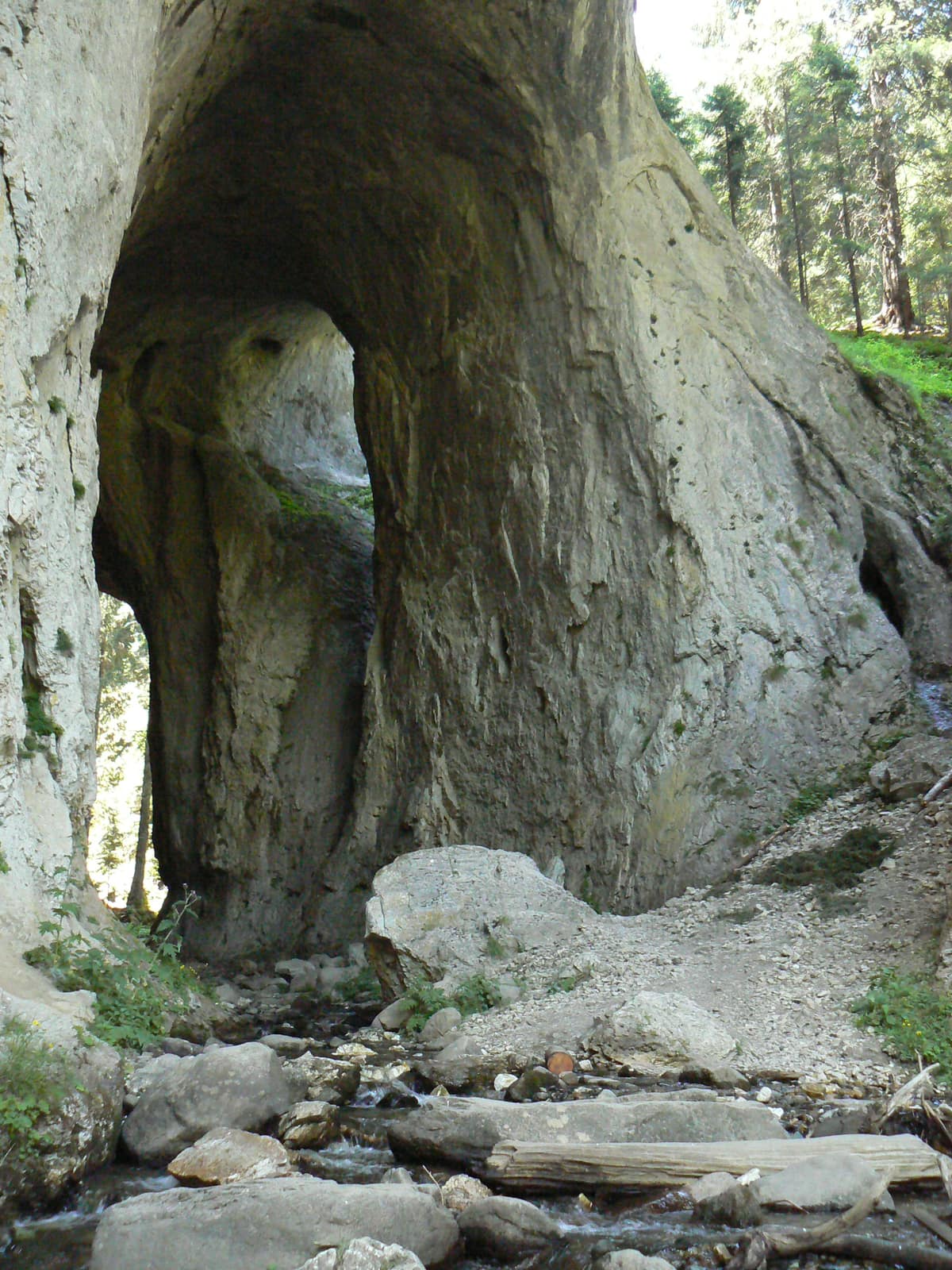
Giant karst stone arches over 45 m high created by the collapse of an ancient cave above the Erkyupriya River.
There was once a cave, and the roof fell in. That is essentially what geologists say about the Wonderful Bridges: a deep karst cavity carved through marble by a river, a violent earthquake that likely brought down the vault, and raging floodwaters that carried away the fallen rock. What remains are two natural marble arches in the Western Rhodopes, at an altitude of 1450 m, set within centuries-old Norway spruce forest. In Bulgarian they are called Chudnite Mostove, and you can walk right underneath them.
What makes it unique
A river that took thousands of years to turn a cave into two marble bridges, and disappears underground further downstream.
The place
Nature
The landscape
The arch of the larger bridge rises 45 m above the riverbed. It features three openings; the highest reaches 45 m in height and 40 in width, with the stream flowing beneath the middle arch. The marble span measures between 12 and 15 m across. Downstream stands the smaller bridge, reaching a height of 50 m. Beyond it lies a third formation, tiny and inaccessible: the mouth of a chasm where the stream vanishes underground, reaching a siphon 3 km away.
Two interconnected caves and numerous karst hollows pit the walls of the main bridge. Far from being trivial details, they provide shelter for birds and bats. It is a place to gaze upward, watching the fissures in the marble where birds build their nests.
Surrounding the arches, the woodland consists of centennial conifers, dominated by Norway spruce, and many karst caves honeycomb the surrounding area, though most are not developed for visitors.
Wildlife and seasons
Sources note nesting birds in the marble fissures and bats roosting within the cavities, without listing specific species. The experience is more about rock and shadow than a typical safari: watching the vault, listening to the rushing water, and peering into the crevices. Bats are strictly protected by law; if you approach a cavity, do not disturb them.
Species
With a page in the atlas
Being mentioned in a source doesn't guarantee sightings: check with the people who manage the area.
Memory and protection
History and conservation
The site was declared a natural monument on 18 July 1949 and today covers 38.92 hectares. It ranks among the 100 National Tourist Sites of the Bulgarian Tourist Union, listed as number 85. The law forbids painting or carving inscriptions within the monument, though the tradition of signing with charcoal beneath the bridge has long endured.
Before you set off
Visiting
How to visit
From the village of Hvoyna, a two-hundred-kilometre cross-border eco-trail passes directly by the Wonderful Bridges. Nearby stand two mountain huts, «Chudnite Mostove» and «Skalnite Mostove», run by the Studenets tourist society of Chepelare, accessible by paved road. The immediate grounds around the arches feature railings and stone steps to ease access, and you can walk beneath the vaults of the great bridge.
To grasp what you see, the Museum of Rhodope Karst in Chepelare illustrates the speleology and karst wealth of the Rhodopes and Bulgaria across five themes. It shows that the Rhodopes are the oldest landmass in the Balkans, dedicates a section to bats, and preserves a complete skeleton of a cave bear, a species that vanished some 22,500 years ago.
Before you go
Check the condition of the access road and the mountain huts before setting out. Do not write or paint on the rocks: it is strictly forbidden.
Check access, rules and visiting conditions in the official information from the managing body before you set off.
Location
Where it is and how far it reaches
Boundary of Chudnite mostove · IUCN III · © EEA, CDDA (CC-BY) The coordinate is estimated; it isn't a verified access point.
Transparency
Sources
The research data with its sources, and the official links for this place, are in the Spanish version of this page. See the Spanish version
Around it
Just over twenty kilometres away lies Smolyanski ezera. Further afield, Portitsa Gorge shares similar karst and canyon habitats.
If you like this place, elsewhere in Europe
Distant places with uncommon wildlife and habitats in common. The most widespread species don't count. Sharing species doesn't imply a corridor or guaranteed presence.
- Cilento, Vallo di Diano and Alburni National Park
Campania (Salerno / Vallo della Lucania / Palinuro / Castellabate)
In common: White-throated dipper · Golden eagle — karst and caves, gorge and canyon, old-growth forest
UNESCO Biosphere Reserve and Global Geopark uniting the karst gorges of the Calore River with the dramatic sea cliffs of Cape Palinuro.
JFMAMJJASONDApril – June · September – November · Crowding low
- Sagittario Gorge Nature Reserve
Abruzzo (Anversa degli Abruzzi / Scanno)
In common: White-throated dipper · Golden eagle — karst and caves, gorge and canyon
An awe-inspiring karst canyon carved by the Sagittario River between vertical limestone cliffs hundreds of metres high.
JFMAMJJASONDMay – October · Crowding very low
Entry #474 of the original atlas.