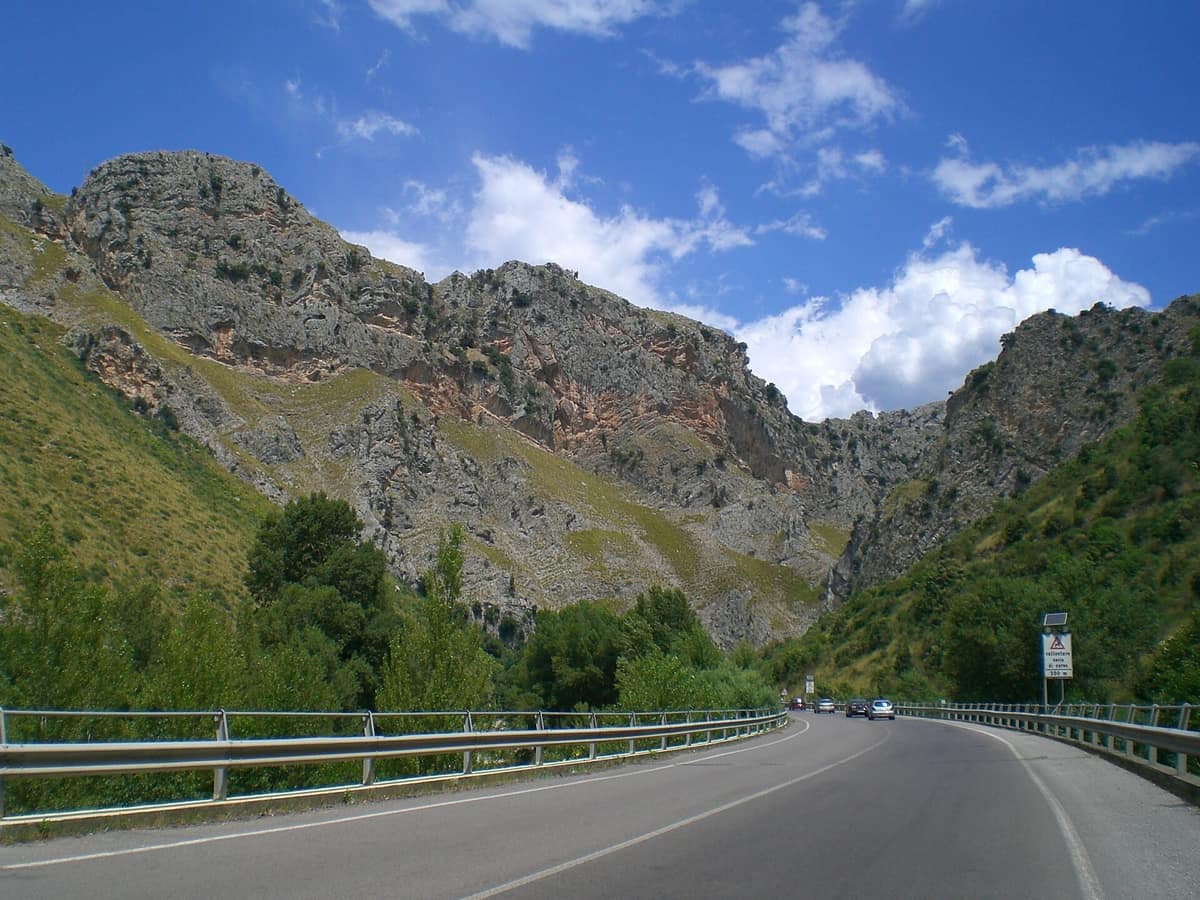
Cilento, Vallo di Diano and Alburni National Park
Parco Nazionale del Cilento, Vallo di Diano e Alburni
Campania (Salerno / Vallo della Lucania / Palinuro / Castellabate) · Italy
Photo: Geofix · CC BY-SA 3.0 · Wikimedia Commons
UNESCO Biosphere Reserve and Global Geopark uniting the karst gorges of the Calore River with the dramatic sea cliffs of Cape Palinuro.
Descending into the Sammaro Gorge feels like stepping into the interior of the earth, except that instead of fire, cool crystalline water surges forth, polishing bedrock into smooth white limestone ramparts. That vivid impression encapsulates the Cilento, Vallo di Diano and Alburni National Park: a rugged terrain where mountains meet the Tyrrhenian Sea, embracing 181.048 hectares across southern Salerno province between the Sele plain, Basilicata, and the sea.
What makes it unique
Within a single park thrive sea cliffs harbouring flowers found nowhere else, summits nearing two thousand metres cloaked in beechwoods, and gorges with otters, dominated by Monte Sacro, revered long before the advent of Christianity.
The place
Nature
The landscape
The relief is sharply defined and rugged. Lowlands are sparse, concentrated mainly along primary river valleys: the Alento on the Tyrrhenian coast and the Tanagro in the Vallo di Diano. The principal summits are Monte Cervati (1.898 m), the Monti Alburni (1.742 m), Monte Gelbison or Monte Sacro (1.705 m), and Monte Motola (1.743 m). The shoreline is low and sandy from the Sele to Agropoli and between Casal Velino and Ascea, but elsewhere rises into towering rocky cliffs riddled with caves and secluded coves.
Two geological formations govern the landscape. One is the Cilento flysch—richly coloured, layered sandstone and shale lining the Alento basin and northern coast. The other is pure karst limestone, shaping the cavernous inland massifs of Alburno-Cervati. This geological diversity underpins the park's exceptional botanical variety, organized into three large ecological sectors: the Gelbison-Cervati complex, the Monti Alburni, and the coastal Cilento.
Vegetation ascends from the shoreline to alpine crests. Along sea cliffs bloom the rare sea daffodil, the endemic Salerno sea lavender, and the Palinuro primrose—a rare coastal endemic chosen as the park's floral emblem. Inland, deciduous woodlands of downy oak, holm oak, and maple dominate, giving way above 1.000 m to extensive beech forests hosting rare Etna barberry and alpine saxifrages. Botanists have recorded around 1.800 plant species across 25 habitat types, including 254 of the 319 wild orchid species documented in Europe and the Mediterranean basin.
Wildlife and seasons
Freshwater is the lifeblood of this wild territory. Rivers support otters, while spring-fed headwaters nurture spectacled salamanders and common fire salamanders; cold, well-oxygenated reaches hold macrostigma trout and white-throated dippers. At Sorgenti del Sammaro, the Eurasian otter thrives undisturbed, with spring and autumn offering optimal conditions for exploration.
On land, the Apennine grey wolf roams upland forests and mountain ridges away from dense human settlements. Wild boar are exceptionally abundant; red deer were reintroduced in 2004 and roe deer in 2003. The European wildcat represents another secretive predator of high conservation value, alongside diverse bats such as European free-tailed bat, Schreiber's bent-winged bat, greater mouse-eared bat, long-fingered bat, and Geoffroy's bat.
Skywards soar birds of prey including golden eagle, short-toed snake eagle, peregrine falcon, lanner falcon, common raven, Eurasian eagle-owl, and tawny owl, alongside northern goshawk. Riparian corridors shelter common kingfisher, dipper, and little ringed plover, with wintering flocks of rare Audouin's gulls along the coast. In marine waters, loggerhead sea turtles visit sandy beaches around Marina di Camerota, where the last documented nesting occurred in 2020; cetaceans include the common bottlenose dolphin, sperm whale, and striped dolphin. Priority invertebrates feature the hermit beetle and Rosalia longicorn; species of community interest total 63.
Species
With a page in the atlas
Being mentioned in a source doesn't guarantee sightings: check with the people who manage the area.
Memory and protection
History and conservation
Calls to protect the Cilento from property speculation and uncontrolled mass tourism began in 1973 at an international conference held in Castellabate. The national park was officially instituted in 1991 under Italy's framework law for protected areas, led by founding president and naturalist Vincenzo La Valva. Beginning with around 36.000 hectares, it progressively expanded to its current 181.048 hectares.
Gelbison derives from Arabic meaning «mountain of the idol», hinting that the summit was sacred long before Basilian monks founded the mountaintop sanctuary in the tenth century. UNESCO recognized the park as a Biosphere Reserve in June 1997 and inscribed it as a World Heritage Site alongside the archaeological sites of Paestum, Velia, and the Certosa di Padula. The Natura 2000 network encompasses 118.316 hectares, representing 65 % of the national park.
Before you set off
Visiting
How to visit
Given the park's immense scale, access points depend on your destination. Convenient gateways include Capaccio-Paestum or Sapri for the coastal Cilento, and Sala Consilina or Monte San Giacomo for the Vallo di Diano.
Two signature hikes capture the park's dual nature. The Monte Sacro trail follows the Torna torrent through dense woodland, sandstone beds, pools, and small cascades, passing Fiumefreddo spring—where crisp water flows beside an effigy of the Virgin Mary—to reach the summit of Gelbison; recommended from April to October. Along the slopes appear distinctive geolithological sites including olistostromes, foliated marls, and stone streams. The second route explores the Sorgenti del Sammaro: boardwalks and footbridges shadow the river through the deep limestone canyon, designated geosite 73.
Key cultural and natural institutions include the Alburni Natural History Museum in Corleto Monforte and the Paleontological Museum in Magliano Vetere. The Magliano Nuovo–Postiglione trail crosses the medieval bridge of Magliano Nuovo and traces the full length of the Gole del Calore. In Casaletto Spartano flow the Capelli di Venere waterfalls, Morigerati preserves a WWF oasis with caves where the Bussento River resurfaces, and Petina hosts an astronomical observatory in Aresta.
Before you go
Check with park authorities regarding seasonal museum opening times and the accessibility of trails before departing.
Check access, rules and visiting conditions in the official information from the managing body before you set off.
Location
Where it is and how far it reaches
Boundary of Parco nazionale del Cilento e Vallo di Diano · IUCN II · © EEA, CDDA (CC-BY) The coordinate is estimated; it isn't a verified access point.
Transparency
Sources
The research data with its sources, and the official links for this place, are in the Spanish version of this page. See the Spanish version
Around it
The Parco Nazionale del Pollino lies twenty-eight kilometres away.
What else to explore nearby
Approximate straight-line distance between the edges of each area. It doesn't indicate access, routes or driving times.
- Pollino National Park
Calabria / Basilicata (Castrovillari / Rotonda / Morano Calabro)
About 28 km away
Italy's largest national park (192.000 ha), exclusive sanctuary of the Bosnian pine (Pinus heldreichii) and a UNESCO Global Geopark.
JFMAMJJASONDMay – October · Crowding very low
If you like this place, elsewhere in Europe
Distant places with uncommon wildlife and habitats in common. The most widespread species don't count. Sharing species doesn't imply a corridor or guaranteed presence.
- Sagittario Gorge Nature Reserve
Abruzzo (Anversa degli Abruzzi / Scanno)
In common: Salamandrina terdigitata · White-throated dipper · Golden eagle — karst and caves, gorge and canyon
An awe-inspiring karst canyon carved by the Sagittario River between vertical limestone cliffs hundreds of metres high.
JFMAMJJASONDMay – October · Crowding very low
Entry #531 of the original atlas.