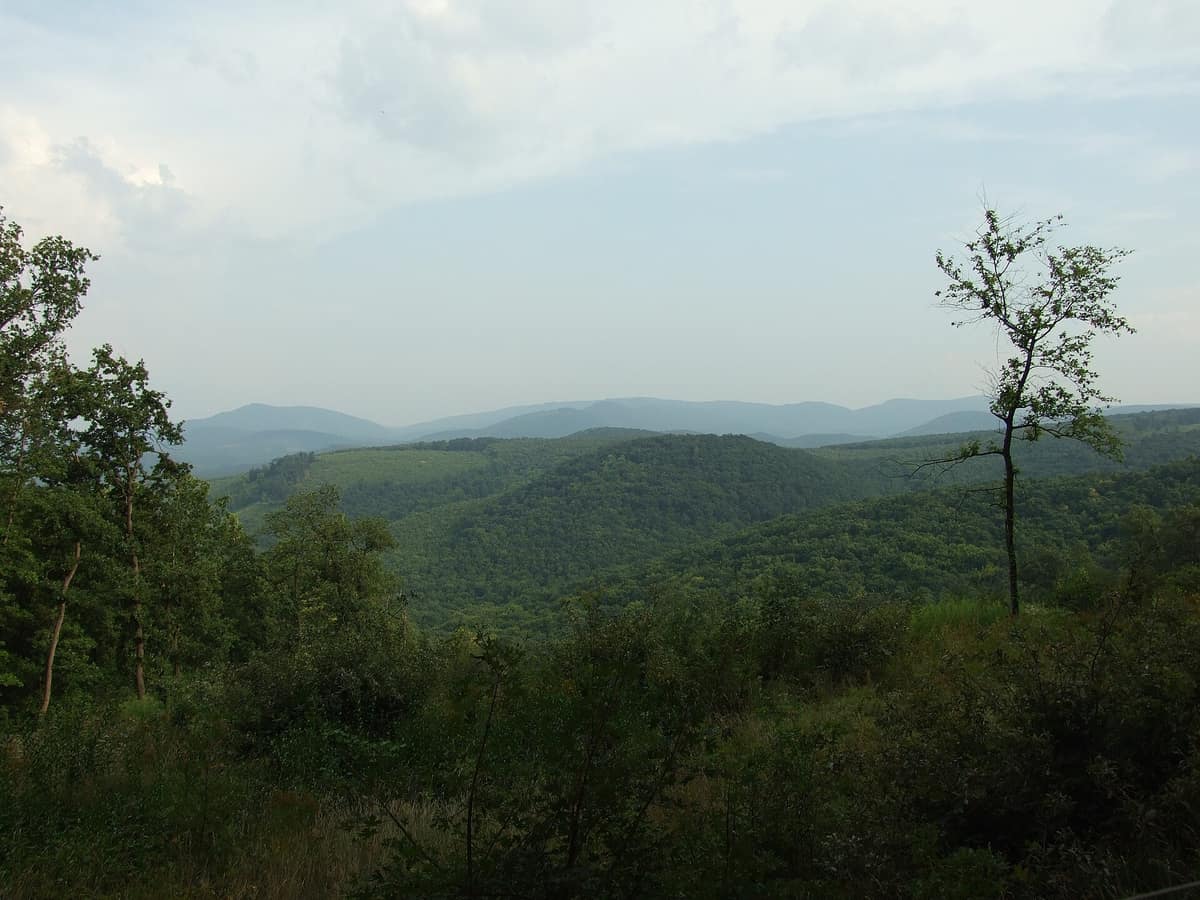
Danube-Ipoly National Park
Duna-Ipoly Nemzeti Park
Pilis, Visegrád, Börzsöny and Ipoly Valley (Hungary) · Hungary
Photo: Aktron · CC BY-SA 3.0 · Wikimedia Commons
Mountain woodlands and the Ipoly river valley in the Hungarian national park.
This national park is named after two rivers, yet the second remains largely unfamiliar. The Danube needs no introduction; the Ipoly, by contrast, resembles a quiet stream for most of the year until floods arrive: between its low-water trickle and peak flood discharge lies a difference of nearly nine hundred times, unmatched in the Carpathian Basin by any river save the Tisza. Danube-Ipoly National Park brings together the Pilis, Visegrád, and Börzsöny ranges, the reach of the Ipoly valley between Hont and Balassagyarmat, and portions of Szentendre Island, precisely where rivers, mountains, and plains converge.
What makes it unique
Three contrasting landscapes in one—river valley, volcanic hills, and open plain—anchored by the capricious, free-flowing Ipoly.
The place
Nature
The landscape
The park's defining signature is the dramatic interface between volcanic and sedimentary uplands and the dynamic alluvium and shifting gravel banks of the river corridors. The Danube Bend (Dunakanyar) stands as the finest testament to this intimate bond between watercourse and mountain crests.
Each massif tells a distinct geological story. The Börzsöny is volcanic, crowned by Csóványos at 938 m; roughly 300 to 350 springs feed its crystal-clear streams. The Pilis consists predominantly of Dachstein limestone and main dolomite, originally laid down in Late Triassic coastal lagoons. The Visegrád Hills are built of andesitic volcanic rocks, deeply dissected by erosion into dramatic ravines such as Holdvilág-árok, Salabasina-árok, and Rám-szakadék.
The flora reflects a rich biogeographical transition where sub-Mediterranean and continental climatic zones overlap. Szentendre Island preserves inland sand dunes harbouring strictly protected sand saffron and sand iris; the Pilis shelters a unique relict endemic, and near the town of Szentendre grows the rare Szentendre rose, known from only two other localities globally. On the floodplain meadows of the Ipoly blooms the meadow clematis, réti iszalag.
Wildlife and seasons
Along the Ipoly, seasonal life revolves around inundation. Spring floods draw vast concentrations of waterfowl, easily watched from observation towers, while summer brings trail and cycling routes across traditionally mown meadows. Along the near-pristine river section between Hont and Balassagyarmat, rare and protected species nest undisturbed, including the corncrake and whooper swan.
The mountains harbour their own specialists. In early July, common crossbills arrive in the Börzsöny from the higher Carpathians, heralding the height of summer. In deep, secluded forests the elusive Eurasian lynx roams, while the Eurasian otter thrives along watercourses. Notable raptors and large birds include the saker falcon, eastern imperial eagle, and black stork. Karst caverns shelter the lesser horseshoe bat, alongside the strictly protected and disturbance-sensitive common bent-wing bat. Ponds and backwaters sustain the European pond turtle, while ichthyological treasures include Petényi's barbel, the schraetzer in the middle Ipoly, and brown trout in the clean mountain brooks of the Börzsöny. The middle Ipoly valley also hosts the endemic Hungarian moth Dioszeghyana schmidtii.
The park safeguards more than seven hundred protected and strictly protected species.
Species
With a page in the atlas
Being mentioned in a source doesn't guarantee sightings: check with the people who manage the area.
Memory and protection
History and conservation
In April 1991, the Hungarian Parliament approved a resolution on international environmental commitments concerning the Danube, paving the way for the creation of a national park. Government decree 34/1997 placed 60 314,3 hectares under legal protection, combining newly designated lands with pre-existing reserves.
The Ipoly wetland complex, covering over 2300 hectares, was designated a Ramsar site in 2001. The park management actively grazes the lowland meadows with its own livestock herd, safeguarding the native Hungarian grey cattle breed. Strázsa Hill on the western fringe of the Pilis served as a military firing range for over a century, which inadvertently kept its habitats untouched by development.
Pressure arises chiefly from the metropolis: park authorities have noted mounting ecological strain caused by surging visitor numbers at trailheads closest to Budapest.
Conservation networks
Before you set off
Visiting
How to visit
The park authority promotes Danube-Ipoly primarily as a walking and ecotourism destination. In the Ipoly valley, the Ipoly-híd trail links two interpretive routes—Dejtár and Drégelypalánk—spanning roughly fifteen kilometres on foot or by bicycle depending on river levels. It has no fixed stations: waymarkers displaying the Ipoly Híd Túra emblem guide the way. An observation tower stands at Ipolyvece, and near Nagy-sziget island a raised hide offers panoramic wetland views.
The Páskom-legelő trail departs from Dejtár, featuring six stops across three kilometres through the largest unbroken reedbed in the valley; the Apródok útja climbs from Drégelypalánk to the castle over 8 stops, rewarding hikers with sweeping vistas.
In the Börzsöny, the Királyrét educational path covers 2.9 km across nine stops, interpreting forest ecology, woodland lakes, heritage forest railways, and ancient iron mining. The walk takes about an hour and a half, beginning at the Lynx House visitor centre at the gateway to the High Börzsöny. Királyrét is accessible by rail to Kismaros and onward by narrow-gauge forest railway or bus; in April, breeding amphibians gather en masse, while September brings the spectacular red deer rut.
Before you go
Park authorities publish dedicated public transport guides from Budapest toward both the Börzsöny and the Pilis to minimize private car travel: make use of them. Confirm which visitor centres and exhibits are open before travelling.
Check access, rules and visiting conditions in the official information from the managing body before you set off.
Location
Where it is and how far it reaches
Boundary of Duna–Ipoly Nemzeti Park · IUCN V · © EEA, CDDA (CC-BY) The coordinate is estimated; it isn't a verified access point.
Transparency
Sources
The research data with its sources, and the official links for this place, are in the Spanish version of this page. See the Spanish version
If you like this place, elsewhere in Europe
Distant places with uncommon wildlife and habitats in common. The most widespread species don't count. Sharing species doesn't imply a corridor or guaranteed presence.
- Vârghiș Gorge
Harghita and Covasna Counties (Baraolt / Vârghiș)
In common: Miniopterus schreibersii · Rhinolophus hipposideros · Eurasian otter
Limestone gorge reserve with over 120 caves of major chiropterological importance (Peștera Merești).
JFMAMJJASONDMay – October · Crowding low
Entry #35 of the original atlas.