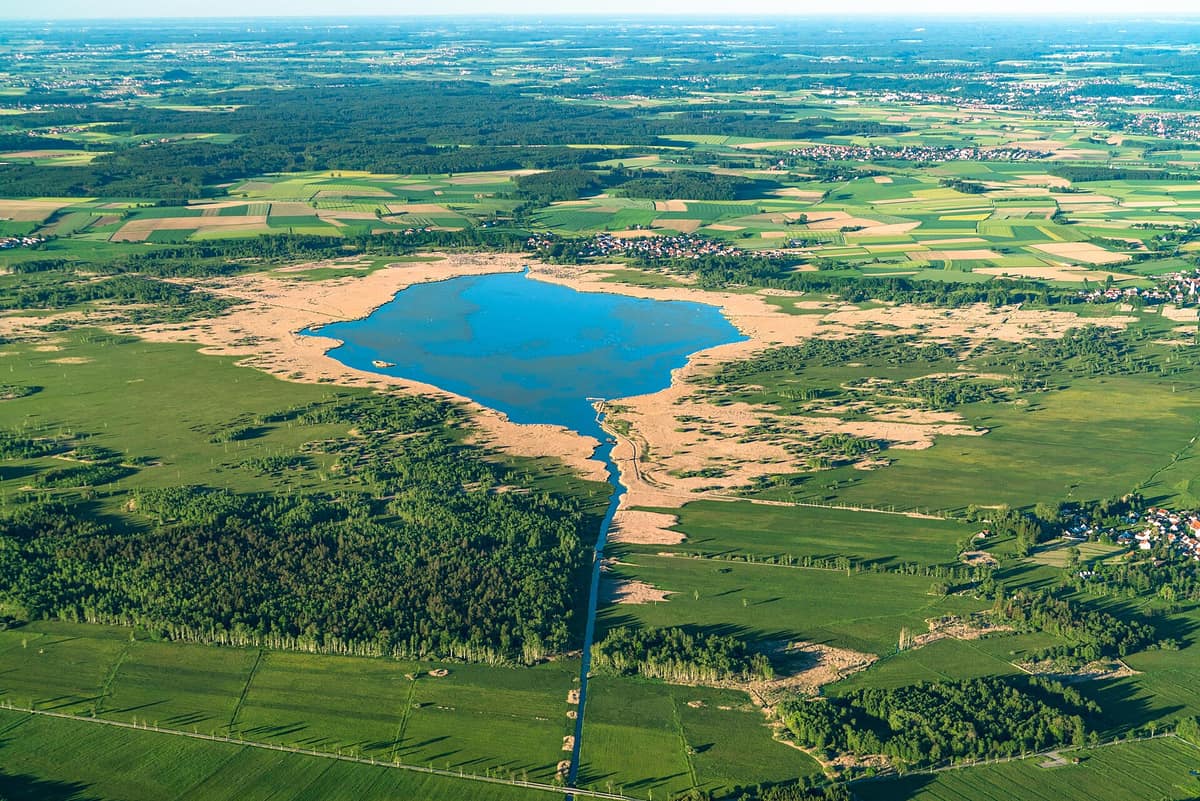
Federsee Nature Reserve
Federsee - Naturschutzgebiet
Baden-Württemberg (Bad Buchau) · Germany
Photo: Armin Appel · CC BY-SA 4.0 · Wikimedia Commons
The largest contiguous mire wetland in south-western Germany, with a 1.6 km wooden boardwalk traversing the extensive reedbed.
Fifteen thousand years ago a glacier halted just south of modern Bad Buchau, leaving behind a morainic wall of gravel, sand, and clay as it melted. Behind this ridge, trapped meltwater filled a terminal drainage basin, creating the Federsee. Today the lake is merely the central vestige of that vast original waterbody: about 1.4 km² marooned within south-western Germany's largest continuous mire, spanning 33 km². All around stretches a wild mosaic of reedbeds, wet litter meadows, raised peat bogs, and mire woods attracting over 270 bird species.
What makes it unique
A small open lake framed by a vast peat bog, where Ice Age relict plants still thrive and south-west Germany's specialized wetland birds gather.
The place
Nature
The landscape
The story of Federsee is one of continuous shrinkage. The shallow lake basin silted up naturally over millennia, fostering extensive peat accumulation across the dried shallows. In the eighteenth century it still covered 10 km²; two artificial water level lowerings, about 200 years ago, curtailed it to its present footprint. This ancient landscape also explains prehistoric human presence: the Federsee stilt settlements form part of the UNESCO Prehistoric Pile Dwellings World Heritage Site.
Today the landscape unfolds in distinct ecological zones. The open lake, dense tall reeds, traditional Streuwiesen—unfertilised late-mown wet meadows—and bog forests form a protected sanctuary designated as a European Reserve, nature reserve, and bird protection area. Around 700 species of higher vascular plants have been catalogued. Among them are glacial relicts: Karl's sceptre, creeping willow, cranberry, bog rosemary, and dwarf birch, surviving because the open moorland retains a harsh, cold local microclimate. For Karl's sceptre, the Federsee basin represents the extreme south-western outpost of its global distribution.
Wildlife and seasons
The ornithological diversity is hard to overstate: over 270 bird species, alongside 12 bat species and roughly 600 species of butterflies and moths. The Federsee safeguards more than 80% of south-west Germany's breeding sedge warbler population and over 50% of its western marsh harriers and whinchats. The spined loach and the Ural ant are found nowhere else in south-western Germany except here.
Three main stations allow observation. Along the boardwalk reedbeds one listens for bearded reedlings and reed warblers, with chances of spotted crake and Eurasian bittern. From the observation tower you can watch marsh harriers quartering before roosting and starlings settling into the reeds. At the lakehead viewing platform common terns and up to seventeen duck species congregate beside flowering white water lilies. Roe deer browse near the start of the Federseesteg, where meadow grasses support high insect diversity.
Spring represents the botanical climax. Around 10 wild orchid species occur, coming into magnificent bloom in late May right along the footpaths; the premier location is the Banngebiet Staudacher clearing. Traditional late mowing without slurry fertilization protects these orchids and fragile wet-meadow plants. The Eurasian beaver has also left its engineering mark: creating new pools and backwaters for waterfowl, dragonflies, and amphibians, with recorded activity documented in the Federseemoor since 2002.
Species
With a page in the atlas
Being mentioned in a source doesn't guarantee sightings: check with the people who manage the area.
Memory and protection
History and conservation
The mire is undergoing stepwise ecological restoration: following works on the southern and northern moors, re-wetting is planned for the western Betzenweiler Ried. The Federseemoor functions as a vital regional refugium for species that have vanished across modern agricultural landscapes.
Before you set off
Visiting
How to visit
Almost all explorations begin from the Federsee car park. The Federseesteg is a comfortable 1.5 km timber boardwalk crossing meadows and reedbeds to a floating lake platform; it is fully accessible for strollers, wheelchairs, and walking frames. The Wackelwald is a 600 m nature trail featuring 8 interpretive stations focused on woodland songbirds, woodpecker cavity trees, and squirrels.
To encircle the lake, the Federsee-Rundweg offers a 16 km cycling and walking route along the boundary of the reserve, equipped with 14 stations. It is mostly level on gravel and asphalt, featuring observation towers and scenic rests; from station 10 near Brackenhofen, clear days reveal the distant Alps. The southern bog archaeological trail runs for 9 km across 11 stations chronicling twelve thousand years of prehistoric human history.
The NABU Nature Centre exhibition provides excellent orientation before setting out, with staff advising on current wildlife sightings. Guided ranger walks run regularly.
Before you go
Year-round path compliance is mandatory throughout the protected reserve. Playing audio bird recordings is strictly prohibited everywhere in the Federseemoor, including from the boardwalk. Check the visitor centre opening hours and boardwalk accessibility conditions before setting out.
Check access, rules and visiting conditions in the official information from the managing body before you set off.
Location
Where it is and how far it reaches
Boundary of Federsee · IUCN IV · © EEA, CDDA (CC-BY) The coordinate is estimated; it isn't a verified access point.
Transparency
Sources
The research data with its sources, and the official links for this place, are in the Spanish version of this page. See the Spanish version
Around it
Other major wetland reserves share marsh harriers with Federsee: Aiguamolls de l'Empordà Natural Park, which also shares the bittern, and Weerribben-Wieden National Park, also harbouring Eurasian bittern.
If you like this place, elsewhere in Europe
Distant places with uncommon wildlife and habitats in common. The most widespread species don't count. Sharing species doesn't imply a corridor or guaranteed presence.
- Aiguamolls de l'Empordà Natural Park
Catalonia (Girona / Castelló d'Empúries / Sant Pere Pescador)
In common: Eurasian bittern · Western marsh harrier — wetland
Coastal wetland and fluvial marsh reserve at the mouths of the Muga and Fluvià rivers on the Costa Brava.
JFMAMJJASONDMarch – May · September – November · Crowding low
Entry #177 of the original atlas.