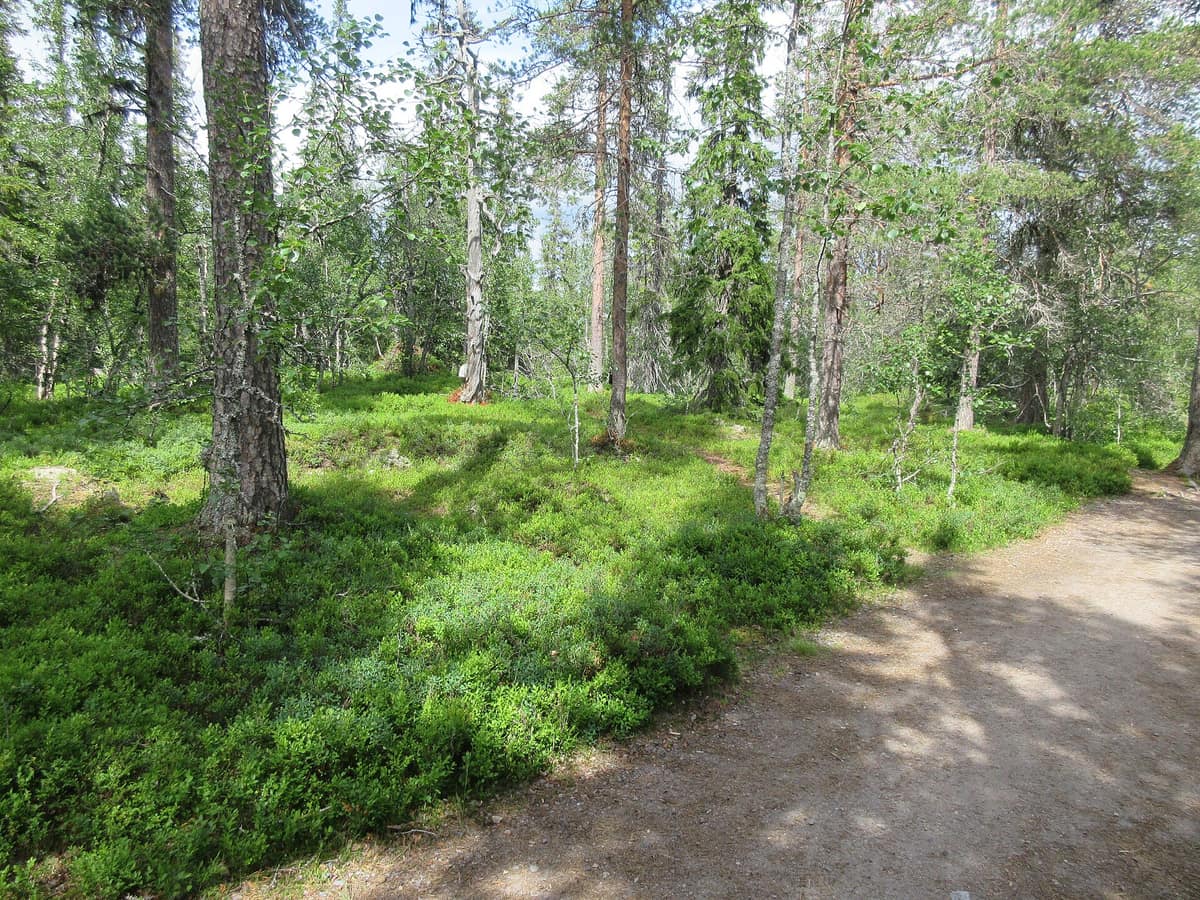
Fulufjället National Park
Dalarna (Särna / Älvdalen) · Sweden
Photo: Bysmon · CC BY-SA 4.0 · Wikimedia Commons
Home to Old Tjikko (the planet's oldest known clonal tree at nearly 9,550 years old) and the Njupeskär waterfall (93 m).
There are mountains that rise up and mountains that remain. Fulufjället belongs to the second kind: a sandstone plateau from 900 to 1,000 metres high, dotted with rounded summits and abruptly sheared on the south and east to plunge some 600 metres down to the Fuluälven valley. It lies far from the sea in Dalarna, about 25 km west of Särna, giving it a continental climate where snow lingers between 175 and 200 days a year.
The national park was established in 2002, covers 385 km², and is the largest in Sweden outside Norrbotten County. Here you find a 93-metre waterfall and, up on the high plateau, a spruce celebrated as the oldest tree on Earth.
What makes it unique
Old Tjikko is a 9,550-year-old spruce clone surviving on the plateau by continuously sprouting new shoots from its root system.
The place
Nature
The landscape
The story began 900 million years ago when this part of the Baltic Shield lay near the equator. The climate was arid, and wind swept immense quantities of dune sand into the sea, where it compacted into horizontal sandstone beds. This rock, completely unlike Sweden's prevalent granites and gneisses, is threaded with diabase intrusions, which resist erosion and break down into fertile soils where vegetation flourishes.
Even during the harshest Pleistocene glaciations, the ice sheet barely moved across the massif; the most prominent erosion occurred during the Tertiary under a tropical climate. The result is a plateau little modified by glaciers, notched by chasms like Njupeskär, where water has carved a sheer canyon through sandstone strata.
The highest peak on the Swedish side is Brattfjället at 1,042 metres, followed by Storhön at 1,039. Across the heights, heathlands of dwarf shrubs, graminoids, and lichens are unique in the Scandes because they are never grazed by domestic reindeer.
A single night in 1997 demonstrated the sheer power of water here. An extraordinary thunderstorm unloaded Sweden's heaviest 24-hour rainfall on record, stripping streamside vegetation bare. Today the erosional scars in the Göljån valley are an attraction, though the trail is challenging in parts.
Wildlife and seasons
The high plateau is a realm of lichens: expansive carpets of reindeer moss and fönsterlav (Cladonia stellaris), undamaged by reindeer grazing. The park hosts 395 moss species and 421 lichen species, and around the waterfall rare mosses, lichens, and vascular plants thrive in the constant mist.
Prominent large mammals include the brown bear, which dens on the slopes, and the Eurasian lynx, which roams the terrain, while the moose spends summers on high ground before retreating to lower valleys with less snow. The Eurasian beaver, once exterminated by hunting, has reclaimed its original population in park waterways.
Among birds, the park's emblem is the Siberian jay. Willow warblers, meadow pipits, and northern wheatears nest across the plateau, and with luck you may spot European golden plover, dotterel, snow bunting, and Lapland longspur. Willow ptarmigan is relatively common, whereas the rock ptarmigan frequents only the highest windswept summits. Forested slopes shelter ring ouzel, raven, and the golden eagle. June is prime time for birdwatching as migrants arrive, while the finest hiking season extends from June to September.
Species
With a page in the atlas
Being mentioned in a source doesn't guarantee sightings: check with the people who manage the area.
Memory and protection
History and conservation
Those who walked this plateau before you left enduring traces: the plateau rim preserves Iron Age burial cairns. A stone circle high up, known as the «altarringen», was likely built to trap falcons, and almost-white gyrfalcons were hunted here until the nineteenth century. Until relatively recently, summer shielings operated on the slopes, where cattle were turned out to graze.
The park was zoned into four distinct management areas to accommodate local traditions. Most of the plateau constitutes an untamed wilderness zone free from activities that alter natural processes.
Before you set off
Visiting
How to visit
The main gateway, Njupeskärsentrén, lies about 25 km west of Särna, and there are six further entrances; only Gördalen has public transport (an on-demand bus), while the others require your own vehicle. At the main entrance stands the naturum visitor centre, offering exhibitions, talks, activities, guided walks, and trail advice, and serving as the trailhead for summer hikes.
Njupeskär waterfall drops 93 metres, with 70 metres in uninterrupted free fall. The Njupeskär trail leads directly to the cascade, where a boardwalk and viewing platform provide close-up views.
The Siberian Jay trail begins at the naturum and is fully accessible. In total, the park network features 140 kilometres of marked trails and fifteen shelter huts. Plateau day-shelters are equipped with wood stoves, firewood, axes, and saws, though overnight stays are not permitted.
Before you go
Wild camping is permitted anywhere on the plateau, but not right next to shelters or trailheads. Picking plants, mosses, lichens, and wood-decay fungi is forbidden. There are no rubbish bins on the plateau: carry all waste back with you. The park directly borders Fulufjellet National Park across the Norwegian boundary.
Check access, rules and visiting conditions in the official information from the managing body before you set off.
Location
Where it is and how far it reaches
Boundary of Fulufjället · IUCN II · © EEA, CDDA (CC-BY) The coordinate is estimated; it isn't a verified access point.
Transparency
Sources
The research data with its sources, and the official links for this place, are in the Spanish version of this page. See the Spanish version
If you like this place, elsewhere in Europe
Distant places with uncommon wildlife and habitats in common. The most widespread species don't count. Sharing species doesn't imply a corridor or guaranteed presence.
- Vindelfjällen Nature Reserve
Västerbotten (Ammarnäs / Tärnaby)
In common: Gyrfalcon · Brown bear — high mountain, old-growth forest
One of the largest nature reserves in Europe: high-alpine massifs, birch valleys, and the free-flowing Vindel River running wild to the Baltic.
JFMAMJJASONDMarch – April · June – September · Crowding very low
Entry #573 of the original atlas.