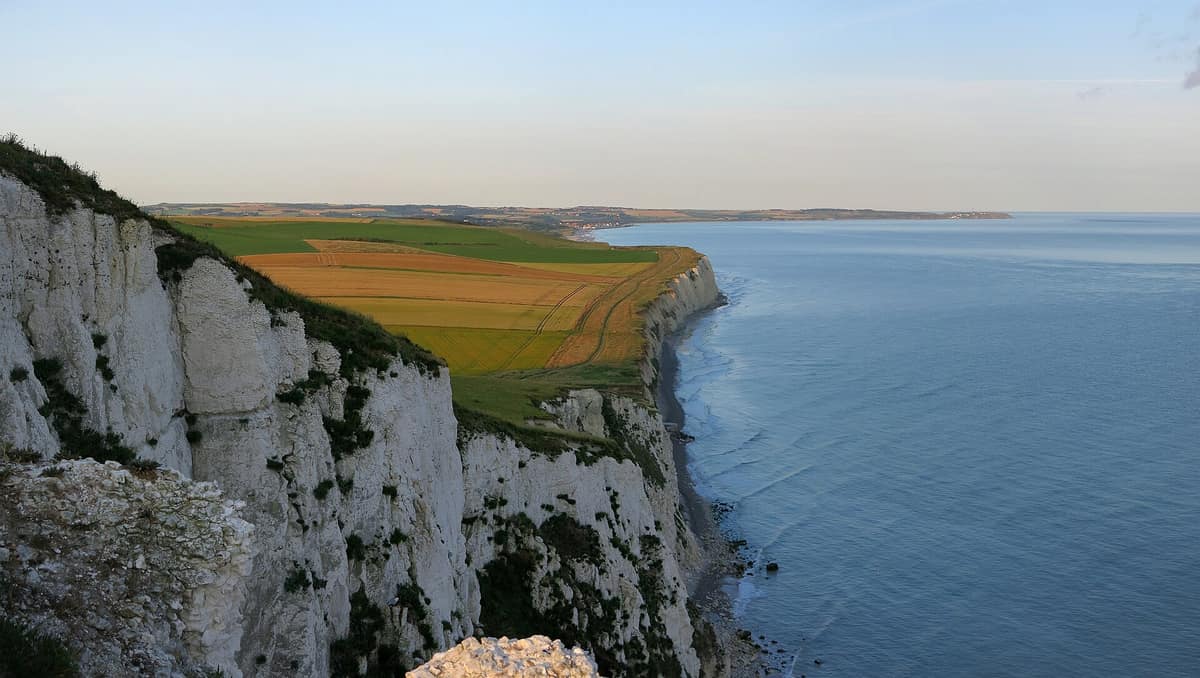
Grand Site of the Two Capes: Cap Blanc-Nez and Cap Gris-Nez
Grand Site des Deux-Caps - Côte d'Opale
Pas-de-Calais (Wissant / Audresselles / Escalles) · France
Photo: Jörg Braukmann · CC BY-SA 4.0 · Wikimedia Commons
Monumental white chalk cliffs (134 m) looking directly across the Strait of Dover towards the English cliffs.
Twelve kilometres of dynamic coastline separate two headlands, embracing the sweeping bay of Wissant. In Pas-de-Calais, the Grand Site de France of the Two Capes unites Cap Blanc-Nez, made of pure white chalk, and Cap Gris-Nez, built of grey Jurassic sandstone and clay, treating them as a coherent coastal entity: 23 km of dramatic coastline encompassing soaring sea cliffs, dune systems, sandy beaches, and farmland forming the coastal frontage of the Caps et Marais d'Opale Regional Nature Park. On clear days, the white cliffs of Dover stand out sharply across the narrow strait.
What makes it unique
Here, twelve kilometres apart, coexist a white cliff of Cretaceous chalk and a grey cliff of Jurassic clay, beneath northern France's busiest avian flyway.
The place
Nature
The landscape
Geology dictates the scenery. Cap Gris-Nez, the geologically older headland, dates back some 160 million years; Cap Blanc-Nez was laid down 70 million years later. Between them unfolds an undulating succession of grey Jurassic marl and sandstone bluffs, sheer white Cretaceous chalk precipices, coastal dunes, and wide bays cradled between the promontories. At the foot of the white chalk cliffs lie fossilized remnants of an ancient Quaternary shoreline buried beneath the modern marine plain.
Winds shape the vegetation. Maritime scrub species including sea buckthorn, wild privet, and boxthorn grow prostrate and stunted, sculpted by prevailing gale-force sea spray—a physical phenomenon known as anemomorphosis. Atop Cap Blanc-Nez lies a botanical feature unique along the entire Hauts-de-France coastline: the only maritime chalk downland cliff. Its chalk grassland shelters exceptional flora, including the rare early gentian and wild sea cabbage, ancestor of all cultivated brassicas. The Grand Site records that 80% of regional plant and animal species are represented along this coastal strip.
Wildlife and seasons
Bird migration forms the paramount natural drama of the year. In spring and autumn, millions of migratory birds navigate over this headland corridor, a flyway of pan-European ecological significance. The narrow strait funnels migrants, making Cap Gris-Nez an international observation post during both passages, where the GON naturalist network coordinates migration counts from the cliff-top watchpoint.
Outside peak migration periods, the cliffs support thriving breeding colonies. Fissures and ledges within the chalk provide nesting sites for Western jackdaws, common house martins, northern fulmars, common kestrels, terns, and European herring gulls, while Cap Blanc-Nez hosts the largest mainland European breeding colony of black-legged kittiwakes. Across the upland downlands flit meadow pipits and European stonechats. With binoculars, seals or harbour porpoises are frequently spotted off the headlands. In spring, wild orchids bloom across the cliffs, including early purple, green-winged, and common spotted orchids.
Species
With a page in the atlas
Being mentioned in a source doesn't guarantee sightings: check with the people who manage the area.
Memory and protection
History and conservation
The Pas-de-Calais Department achieved formal Grand Site de France designation on 29 March 2011, encompassing five classified and four registered cultural sites across roughly 6,431 hectares alongside five Natura 2000 designated reserves. Visitor pressure leaves visible scars: trampling degrades chalk turf to bare rock and diminishes rare flora. In 2005 the site was extensively redeveloped, eliminating informal cliff-top car parks at Blanc-Nez and the Plan d'Escalles.
Military history crowns the capes. An obelisk erected between 1920 and 1922 atop Blanc-Nez honours the Dover Patrol of the First World War, while the tip of Gris-Nez was chosen in 1805 for the primary coastal semaphore station of Napoleon's planned optical telegraph network across the Channel.
Before you set off
Visiting
How to visit
Start your visit at the Maison du Site des Deux-Caps in the hamlet of Haringzelle at Audinghen: it features an interpretive discovery space and hires traditional and electric bicycles for day or half-day excursions.
The classic walking route connects the two headlands, tackled from Wissant as two separate twelve-kilometre return walks. Walking toward Gris-Nez you skirt the CROSS maritime surveillance centre monitoring one of the world's busiest shipping straits, enjoying the closest views of the English coast. Walking toward Blanc-Nez the tides dictate logistics: at low water you can walk along the beach beneath the cliffs, while at high tide the coastal path GR120/E9 climbs to over 130 metres, rewarding walkers with a 360° panorama stretching from Wissant Bay to Dunkirk. For a linear route, take public bus line 427 for the return.
Interpretive walking trails explore cultural heritage: the fishermen's trail through Audresselles interprets the traditional flobart beach-launched wooden boat, while the painters' path in Wissant celebrates the impressionist art colony drawn here since 1880 by the exceptional marine light.
Before you go
Always check local tide tables before setting out. Sections of the GR coastal path traverse the beach and become impassable at high tide; park authorities urge visitors to stay off the foreshore for two hours either side of high water. Stay strictly on waymarked cliff paths: pedestrian trampling is the primary existential threat to fragile chalk grasslands.
Check access, rules and visiting conditions in the official information from the managing body before you set off.
Location
Where it is and how far it reaches
Boundary of Cap gris nez · IUCN IV · © EEA, CDDA (CC-BY) The coordinate is estimated; it isn't a verified access point.
Transparency
Sources
The research data with its sources, and the official links for this place, are in the Spanish version of this page. See the Spanish version
Around it
The Two Capes have no catalogued immediate neighbours in the atlas, but share peregrine falcons and grey seals with distant coastal headlands: Pointe du Raz in Cap Sizun and Lundy.
If you like this place, elsewhere in Europe
Distant places with uncommon wildlife and habitats in common. The most widespread species don't count. Sharing species doesn't imply a corridor or guaranteed presence.
- Lundy Island
England (Devon / Bristol Channel / Ilfracombe)
In common: Grey seal · Peregrine falcon — wild coast
Granite plateau 5 km in length in the Bristol Channel, the first designated Marine Conservation Zone in the United Kingdom.
JFMAMJJASONDMay – September · Crowding low
Entry #441 of the original atlas.