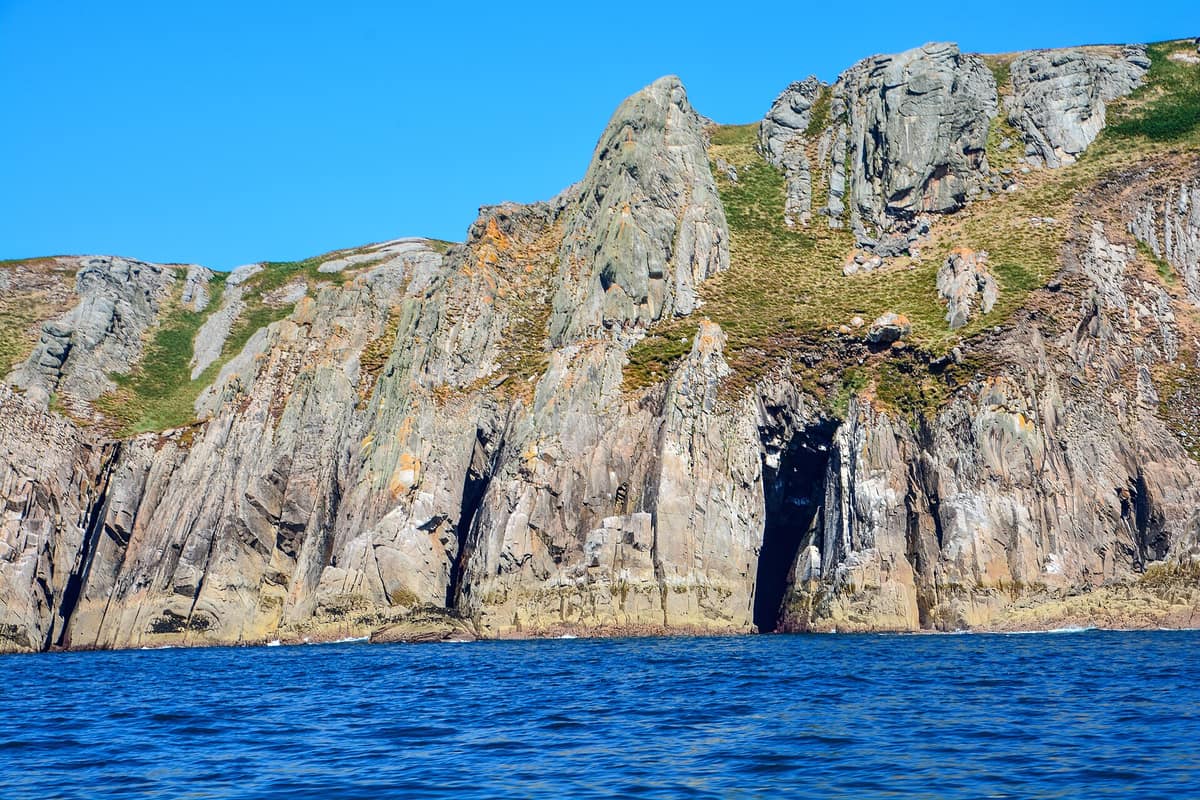
Lundy Island
Lundy
England (Devon / Bristol Channel / Ilfracombe) · United Kingdom
Photo: Lewis Clarke · CC BY-SA 2.0 · Wikimedia Commons
Granite plateau 5 km in length in the Bristol Channel, the first designated Marine Conservation Zone in the United Kingdom.
Lundy means "puffin island", and the name is no embellishment. This granite rock, around 5 km long and barely 1 km wide, rises 19 km off the north Devon coast at the mouth of the Bristol Channel, forming the largest island in that waterway. Here ocean and channel meet, the wind blows almost constantly, and fog settles in frequently. What looks like a harsh place is in truth a sanctuary: thousands of seabirds nest on its cliffs and seals breed in its sheltered coves.
What makes it unique
An island 5 km long where its sole endemic plant, the Lundy cabbage, coexists with seabirds nesting by the thousands and a marine reserve that was England’s first.
The place
Nature
The landscape
The island is predominantly Paleocene granite, with slate at its southern tip. Up top lies a plateau; below, sheer cliffs plunging into the sea. It is a rugged place and often cloaked in mist, which is why it has witnessed many shipwrecks and why it retains lighthouses: two active ones, built in 1897, and an older tower no longer in service.
The climate is mild but far from gentle. Winters are cool and damp, summers mild and humid, with wind and fog recurring throughout the year. Here grows a botanical rarity: the Lundy cabbage (Coincya wrightii), the island’s sole endemic plant. Two endemic invertebrates also live exclusively on it: a flea beetle and a weevil.
Beneath the surface, the landscape transforms. Along the more sheltered eastern shore lie sandbanks and reefs, and Lundy’s waters shelter many rare species: seaweeds, branching sponges, seafans, and cup corals.
Wildlife and seasons
Between April and July, the western cliffs teem with breeding seabirds: ten species return to raise young here. Puffins, guillemots, kittiwakes, Manx shearwaters, and razorbills are all protected on the island. Atlantic puffins nest between April and July, with key vantage points at Jenny’s Cove and St. Phillip's Stone. Manx shearwaters arrive to breed from April to September before flying to South America for the winter. The sea cliffs also host nesting razorbills, common murres, black-legged kittiwakes, and northern fulmars, alongside smaller resident populations of peregrine falcon and raven.
The recent history of these colonies is a true success story. Rats, and perhaps commercial fishing for sandeels—the puffins’ staple food—had decimated their numbers. Since rats were eradicated in 2006, seabird populations have surged: in 2023 there were 1.355 puffins and 25.000 Manx shearwaters, representing 95 % of England’s breeding population. In addition, since 2014 the European storm petrel has recolonised the island.
Because Lundy lies along major migratory flyways, it also attracts vagrant birds, especially from North America: its island list totals 317 species.
On land live introduced mammals: a feral pony breed, the Lundy pony, Soay sheep, sika deer, feral goats, and rabbits. Along the water’s edge resides the grey seal. Pups are usually born between September and November; if you spot a lone pup, do not approach. Seals can be seen around Landing Bay, Brazen Ward, and North End, and binoculars help avoid disturbing them.
Out at sea, three cetaceans are regularly observed from the cliff tops: bottlenose dolphin, common dolphin, and harbour porpoise, particularly off the south-eastern coast. Minke whale, Risso’s dolphin, and long-finned pilot whale appear more rarely. The basking shark visits Lundy in summer and can be spotted from May; with it come ocean sunfish and leatherback sea turtles, primarily off the eastern coast during warmer months.
Species
With a page in the atlas
Being mentioned in a source doesn't guarantee sightings: check with the people who manage the area.
Memory and protection
History and conservation
The name is Scandinavian and stems from Old Norse lundi, meaning "puffin". Its Beacon Hill cemetery preserves four inscribed stones dating from the fifth or sixth century. In 1969 millionaire Jack Hayward purchased the island and donated it to the National Trust; today it is managed by the Landmark Trust.
The surrounding sea has enjoyed protection since 1971 and became England’s first statutory Marine Nature Reserve in 1986. In January 2010 it was designated a Marine Conservation Zone, spanning a rectangle of 31 km² around the island. The island itself is a Site of Special Scientific Interest.
Before you set off
Visiting
How to visit
Access is by sea. The Lundy ferry sails at least three times a week from Bideford or Ilfracombe, and the crossing takes about two hours. On the island, the warden leads guided walks to Jenny’s Cove during the breeding season to view the seabird colonies from the cliff rim.
If you wish to see puffins, plan between April and July. If you prefer seals, September and November are the pupping months. And if you are looking for cetaceans and basking sharks, summer is your season.
Before you go
Puffins, guillemots, kittiwakes, Manx shearwaters, and razorbills are protected on the island. Do not approach a lone seal pup and use binoculars rather than walking up to the seals. Check sailing schedules before you travel.
Check access, rules and visiting conditions in the official information from the managing body before you set off.
Location
Where it is and how far it reaches
Boundary of Lundy · © OpenStreetMap contributors (ODbL) The coordinate is estimated; it isn't a verified access point.
Transparency
Sources
The research data with its sources, and the official links for this place, are in the Spanish version of this page. See the Spanish version
Around it
Lundy has no atlas sites in immediate proximity, but shares grey seals, puffins, and marine coastlines with several islands. The Isle of Lunga (Treshnish Isles) is another puffin and seabird haven, while Mingulay and Great Blasket Island / An Blascaod Mór share grey seals and puffins with Lundy. The Sept-Îles Nature Reserve is another premier seabird refuge.
If you like this place, elsewhere in Europe
Distant places with uncommon wildlife and habitats in common. The most widespread species don't count. Sharing species doesn't imply a corridor or guaranteed presence.
- St Kilda Archipelago - Hirta and Dùn
Scotland (Outer Hebrides / Hirta)
In common: Northern fulmar · Atlantic puffin · Grey seal — wild coast, marine
The only Dual (Cultural and Natural) UNESCO World Heritage Site in the UK, with sheer sea cliffs and sea stacks hosting the world's largest gannet colony (Stac an Armin 196 m).
JFMAMJJASONDJune – August · Crowding very low
- Isle of Mykines (Faroe Islands)
Faroe Islands (Vágar Region / Mykines)
In common: Northern fulmar · Atlantic puffin — wild coast, marine
The "Puffin Island", the westernmost outpost of the Faroe Islands, with sheer basalt sea cliffs where hundreds of thousands of Atlantic puffins (Fratercula arctica) nest.
JFMAMJJASONDJune – August · Crowding moderate
- Great Blasket Island / An Blascaod Mór
Ireland (County Kerry / Dingle Peninsula / Dunquin)
In common: Atlantic puffin · Grey seal — wild coast, marine
The largest of the Blasket archipelago islands (evacuated in 1953), famed for rich Gaelic literature, wild sea cliffs, and beaches with hundreds of grey seals.
JFMAMJJASONDMay – September · Crowding low
Entry #627 of the original atlas.