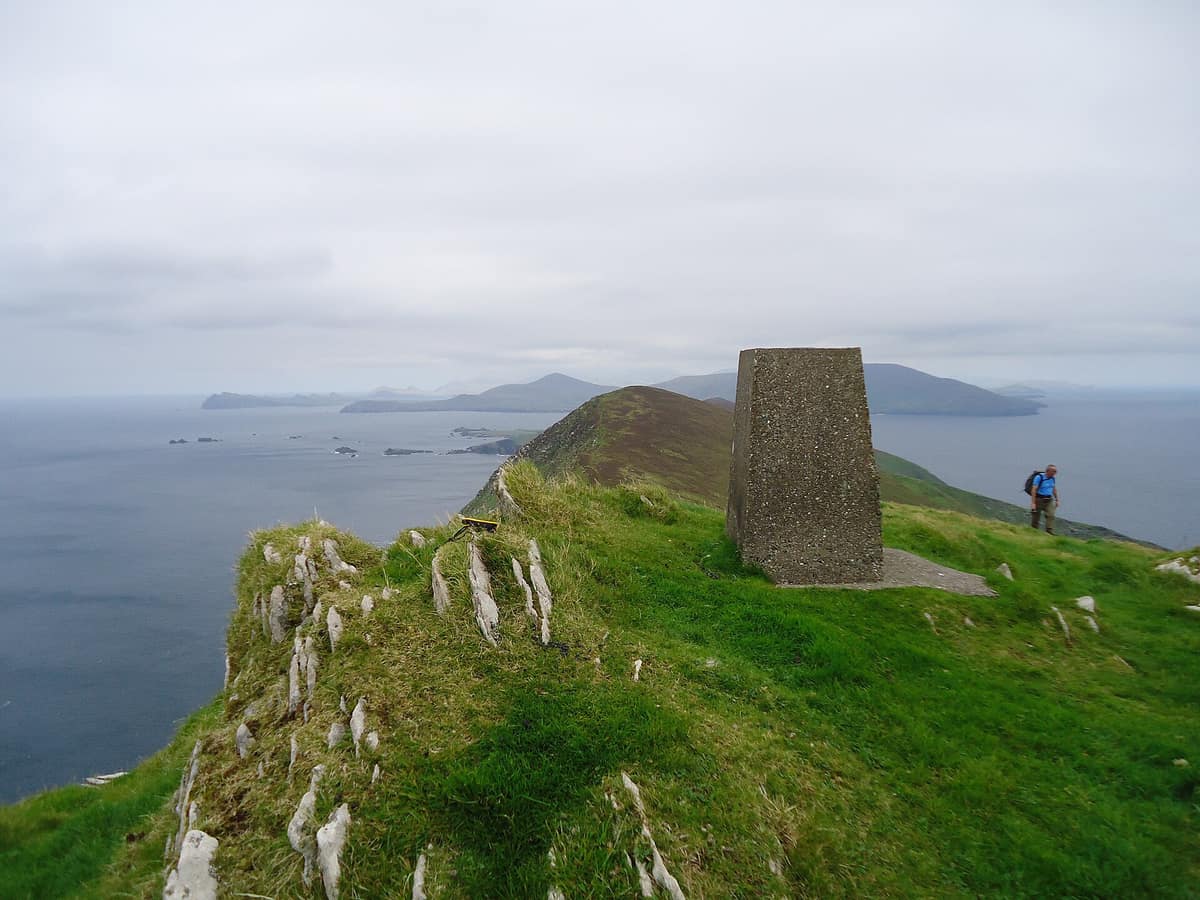
Great Blasket Island / An Blascaod Mór
Great Blasket Island
Ireland (County Kerry / Dingle Peninsula / Dunquin) · Ireland
Photo: Michael Earnshaw · CC BY-SA 2.0 · Wikimedia Commons
The largest of the Blasket archipelago islands (evacuated in 1953), famed for rich Gaelic literature, wild sea cliffs, and beaches with hundreds of grey seals.
In April 1947, ferocious Atlantic storms severed the island's contact with the mainland for weeks. Such was daily life on Great Blasket, out on the western extremity of the Dingle Peninsula: Ireland's westernmost settlement, a native Irish-speaking community that the sea could isolate at will. The island was finally evacuated in 1953. Today its abandoned stone village endures against the Atlantic, backdropped by wild, untamed moorland. An Blascaod Mór is the largest of the Blasket Islands, celebrated for the grey seals hauling out across its white beaches.
What makes it unique
An uninhabited island since 1953 that gave the world extraordinary Irish-language writers and now thrives as a protected wilderness with grey seals and porpoises.
The place
Nature
The landscape
The island stretches six kilometres southwestward, rising to 346 m at the summit of An Cró Mór. The ruins of the village cluster along the sheltered northeastern flank, where simple stone cottages were built. Behind this deserted settlement, the island unfolds as raw wilderness, completely devoid of public services or paved roads.
The entire territory forms part of the Blasket Islands Special Area of Conservation, protecting reefs, vegetated sea cliffs, European dry heaths, and submerged or partially submerged sea caves.
Wildlife and seasons
What draws most visitors arriving by sea are the seals. The Blaskets represent a premier breeding station for the grey seal in Ireland, and the species is a designated primary qualifying interest of the Special Area of Conservation, alongside the harbour porpoise. The archipelago additionally sustains at least 13 breeding seabird species.
Because passenger ferries only operate during summer months under favourable sea conditions, this is the sole window in which you can experience the island.
Species
With a page in the atlas
Being mentioned in a source doesn't guarantee sightings: check with the people who manage the area.
Memory and protection
History and conservation
Great Blasket was intermittently inhabited for centuries. During the 1840s roughly 150 people lived here, mostly in modest drystone cottages on the northeastern slopes. Lacking firewood, they burned heather, peat, and turf scraws. By 1953 the Irish government decided it could no longer guarantee the safety and medical welfare of a dwindling population.
From that isolated island society arose legendary authors who recorded their traditional lives and folk heritage: Tomás Ó Criomhthain's An tOileánach (1929), Muiris Ó Súilleabháin's Fiche Bliain ag Fás (1933), and Peig Sayers's Machnamh Seanamhná (1939).
In 2009 the Office of Public Works acquired most island properties, including the ruined village, and has operated guided heritage tours since 2010.
Before you set off
Visiting
How to visit
Arrival is exclusively by passenger ferry from Dunquin or Dingle, with no permanent pier: the final landing is completed by small inflatable tender. Ferries run through summer months in calm weather, with crossings taking twenty minutes to an hour depending on the departure harbour. A typical island visit lasts about an hour and a half.
Walking tracks criss-cross the island, and the Office of Public Works (OPW) offers complimentary guided tours through the historic village. The island is not wheelchair-accessible and is recommended strictly for mobile visitors capable of rough-ground walking.
On the mainland, the companion Blasket Centre sits on the tip of the Dingle Peninsula, 16 km from Dingle along the R559, featuring a museum, archives, workshops, and Gaelic language facilities.
Before you go
Ferry sailings are strictly weather-dependent: always reconfirm departures before travelling. The visitor season operates from May to September.
Check access, rules and visiting conditions in the official information from the managing body before you set off.
Location
Where it is and how far it reaches
Boundary of An Blascaod Mór · © OpenStreetMap contributors (ODbL) The coordinate is estimated; it isn't a verified access point.
Transparency
Sources
The research data with its sources, and the official links for this place, are in the Spanish version of this page. See the Spanish version
Around it
Great Blasket has no immediate neighbouring sites in the atlas; it shares coastal wildlife with Schleswig-Holstein Wadden Sea National Park (harbour porpoise and grey seal), Lundy, Lunga and the Treshnish Isles, and Sept-Îles (Atlantic puffin and grey seal).
If you like this place, elsewhere in Europe
Distant places with uncommon wildlife and habitats in common. The most widespread species don't count. Sharing species doesn't imply a corridor or guaranteed presence.
- Schleswig-Holstein Wadden Sea National Park
Schleswig-Holstein (Sylt / Halligen / Husum / Tönning)
In common: Common porpoise · Grey seal — wild coast, marine
Central Europe's largest national park: intertidal mudflats, dyked islets (Halligen) and millions of migratory waders on passage.
JFMAMJJASONDApril – May · August – October · Crowding moderate
- Lundy Island
England (Devon / Bristol Channel / Ilfracombe)
In common: Atlantic puffin · Grey seal — wild coast, marine
Granite plateau 5 km in length in the Bristol Channel, the first designated Marine Conservation Zone in the United Kingdom.
JFMAMJJASONDMay – September · Crowding low
- Isle of Lunga (Treshnish Isles)
Scotland (Inner Hebrides / Isle of Mull)
In common: Atlantic puffin · Grey seal — wild coast, marine
Small basalt islet where puffins nest mere inches from walkers’ boots showing virtually no fear of humans.
JFMAMJJASONDMay – August · Crowding low
- Sept-Îles Nature Reserve
Brittany (Côtes-d'Armor — Perros-Guirec)
In common: Atlantic puffin · Grey seal — wild coast, marine
France's largest colony of northern gannets and the puffin's last refuge on the French coast.
JFMAMJJASONDApril – July · Crowding low
Entry #624 of the original atlas.