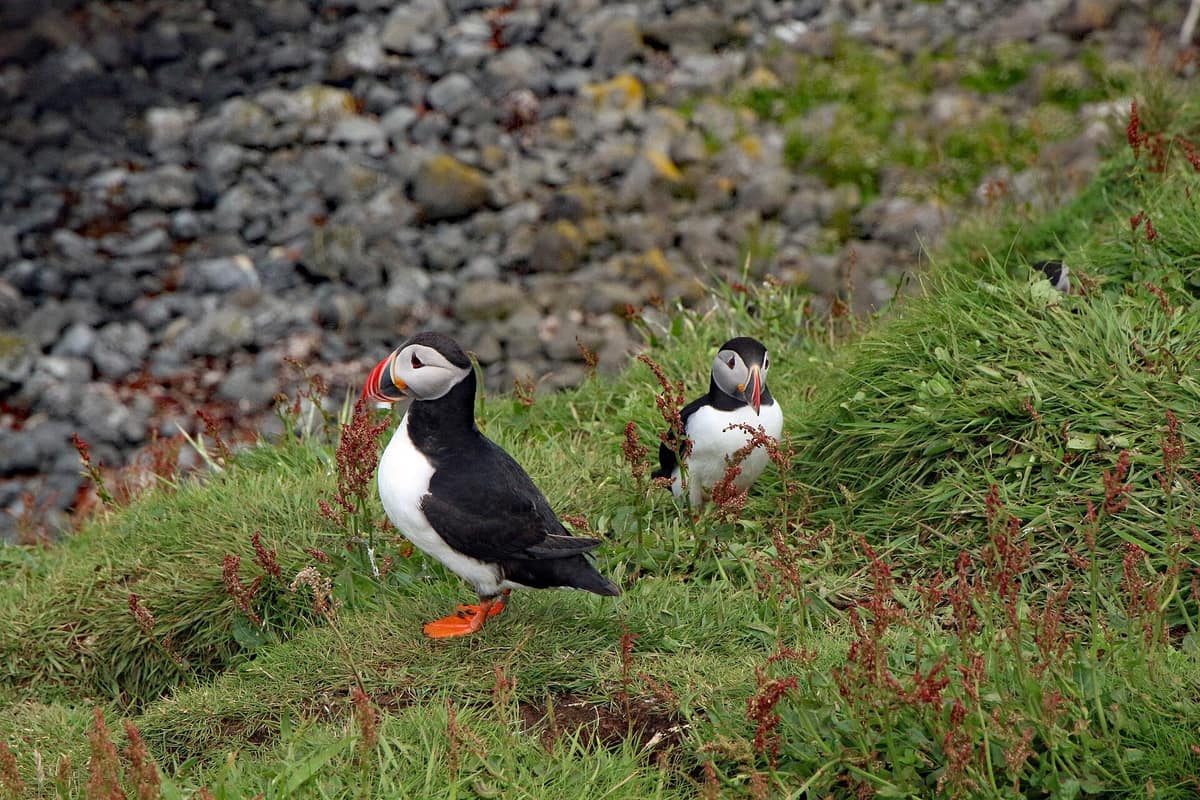
Isle of Lunga (Treshnish Isles)
Lunga (Treshnish Isles)
Scotland (Inner Hebrides / Isle of Mull) · United Kingdom
Photo: PaulT (Gunther Tschuch) · CC BY-SA 4.0 · Wikimedia Commons
Small basalt islet where puffins nest mere inches from walkers’ boots showing virtually no fear of humans.
You step ashore onto a green island, walk for a few minutes, and suddenly puffins are right at your feet. Lunga is the largest of the Treshnish Isles, an archipelago of remote, uninhabited volcanic islets and skerries west of the Isle of Mull in the Inner Hebrides. No one has lived here since the nineteenth century; seabirds and seals hold sway. Lunga is the largest and most accessible island of the group, which is why most summer day-trip landings take place here.
What makes it unique
In few places across Scotland can you encounter puffins at such close quarters: a short walk from the landing site and you are right among their burrows.
The place
Nature
The landscape
The Treshnish Isles form a chain of volcanic islands stretching over 11 km between Coll and Mull. Lunga, the largest, lies around 7 km west of Gometra, 12 km south-east of Coll, and 5 km north-west of Staffa. All the islands are volcanic in origin.
Across this basalt rock grow maritime grassland, coastal heath, and peat bogs with sea thrift, sea campion, and bird’s-foot trefoil. On Lunga primroses, orchids, and tormentil bloom as well. A curious detail: rabbits keep the turf well grazed, preventing it from growing coarse and allowing many wildflowers to flourish. Along the archipelago’s coastline lies a wave-cut rock platform shaped by ice, pre-dating the Devensian glaciation, which is particularly evident on Bac Mòr, the island known as the Dutchman’s Cap due to its shape.
Beside Lunga rises Harp Rock, a sea stack separated from the island by a deep chasm. Beneath the waves, the rocky reefs surrounding the islands provide habitat for encrusting fauna and kelp communities.
Wildlife and seasons
The Treshnish Isles hold the largest breeding seabird colony in the Mull, Coll, and Tiree area. Here nest Atlantic puffins, common murres, razorbills, European shags, black-legged kittiwakes, northern fulmars, Manx shearwaters, and European storm petrels.
Take note of where each species gathers. Puffins breed in turf burrows that must be respected. On Harp Rock in summer, dense crowds of guillemots, razorbills, shags, and kittiwakes congregate. The European storm petrel is more secretive: it nests in rock crevices on boulder beaches and within the drystone walls of ruined cottages.
There are seals as well. The islands support the largest grey seal breeding colony in the Mull, Coll, and Tiree region, representing 3 % of the United Kingdom’s population. The northern wave-cut platform and beach on Lunga serve as primary pupping grounds, and pup production remains stable at around 1.000 a year. In autumn, dedicated boat trips run specifically for seal watching.
In winter, barnacle geese arrive: they breed in Greenland and spend the cold months at several locations along western Scotland. Among more elusive wildlife are a small number of corn crakes and two nationally scarce plants: thyme broomrape and oysterplant.
Species
With a page in the atlas
Being mentioned in a source doesn't guarantee sightings: check with the people who manage the area.
Memory and protection
History and conservation
The name Lunga likely derives from Old Norse lungr-øy, meaning "longship island". It was inhabited until the nineteenth century and still preserves remains of traditional blackhouses. Farmers from neighbouring Mull grazed sheep and cattle here until grazing ceased entirely around 1995. On the nearby Cairn na Burgh islands stand ruined castles dating from the early thirteenth century.
The Hebridean Trust purchased the archipelago in 2000 to safeguard its wildlife, archaeology, and recreational value, and in June 2023 the islands passed into the care of the National Trust for Scotland. Lunga is a Site of Special Scientific Interest, Special Protection Area, and Special Area of Conservation, and the Treshnish Isles form part of the Loch na Keal National Scenic Area, one of 40 in Scotland. Management priorities include monitoring and controlling non-native species such as American mink and rats. Minor localised footpath erosion occurs around the Lunga landing site.
Before you set off
Visiting
How to visit
Access is by boat, almost exclusively in summer. Excursions depart from Ulva Ferry, Tobermory, Ardnamurchan, and Tiree, as well as from Iona. Boats land predominantly on Lunga; from the shoreline, a short walk brings you up close with the puffins. Some visitors also arrive independently by yacht or sea kayak.
Ashore, beyond the birds, you can explore the ruined village, abandoned in 1857, in the north-east of the island.
Before you go
Keep at least two metres away from puffins to safeguard their burrows. Seabirds are vulnerable to disturbance and avian influenza: cleaning your boots helps prevent disease transmission. Confirm sailing dates and landing conditions with your boat operator before heading out.
Check access, rules and visiting conditions in the official information from the managing body before you set off.
Location
Where it is and how far it reaches
Boundary of Lunga · © OpenStreetMap contributors (ODbL) The coordinate is estimated; it isn't a verified access point.
Transparency
Sources
The research data with its sources, and the official links for this place, are in the Spanish version of this page. See the Spanish version
Around it
Lunga shares its rugged coastline and seabird fauna with other atlas islands. The Deserted Isle of Mingulay and the Sept-Îles Nature Reserve also feature razorbills, grey seals, and puffins. Great Blasket Island / An Blascaod Mór shares grey seals and puffins, while the Vestmanna Bird Cliffs share razorbills and puffins.
If you like this place, elsewhere in Europe
Distant places with uncommon wildlife and habitats in common. The most widespread species don't count. Sharing species doesn't imply a corridor or guaranteed presence.
- Deserted Isle of Mingulay
Scotland (Outer Hebrides / Barra)
In common: Razorbill · Atlantic puffin · Grey seal — wild coast, marine
Deserted Outer Hebrides island abandoned in 1912, featuring 200 m sheer granite sea cliffs crowded with thousands of razorbills and guillemots.
JFMAMJJASONDJune – August · Crowding none
- Sept-Îles Nature Reserve
Brittany (Côtes-d'Armor — Perros-Guirec)
In common: Razorbill · Atlantic puffin · Grey seal — wild coast, marine
France's largest colony of northern gannets and the puffin's last refuge on the French coast.
JFMAMJJASONDApril – July · Crowding low
- Great Blasket Island / An Blascaod Mór
Ireland (County Kerry / Dingle Peninsula / Dunquin)
In common: Atlantic puffin · Grey seal — wild coast, marine
The largest of the Blasket archipelago islands (evacuated in 1953), famed for rich Gaelic literature, wild sea cliffs, and beaches with hundreds of grey seals.
JFMAMJJASONDMay – September · Crowding low
Entry #619 of the original atlas.