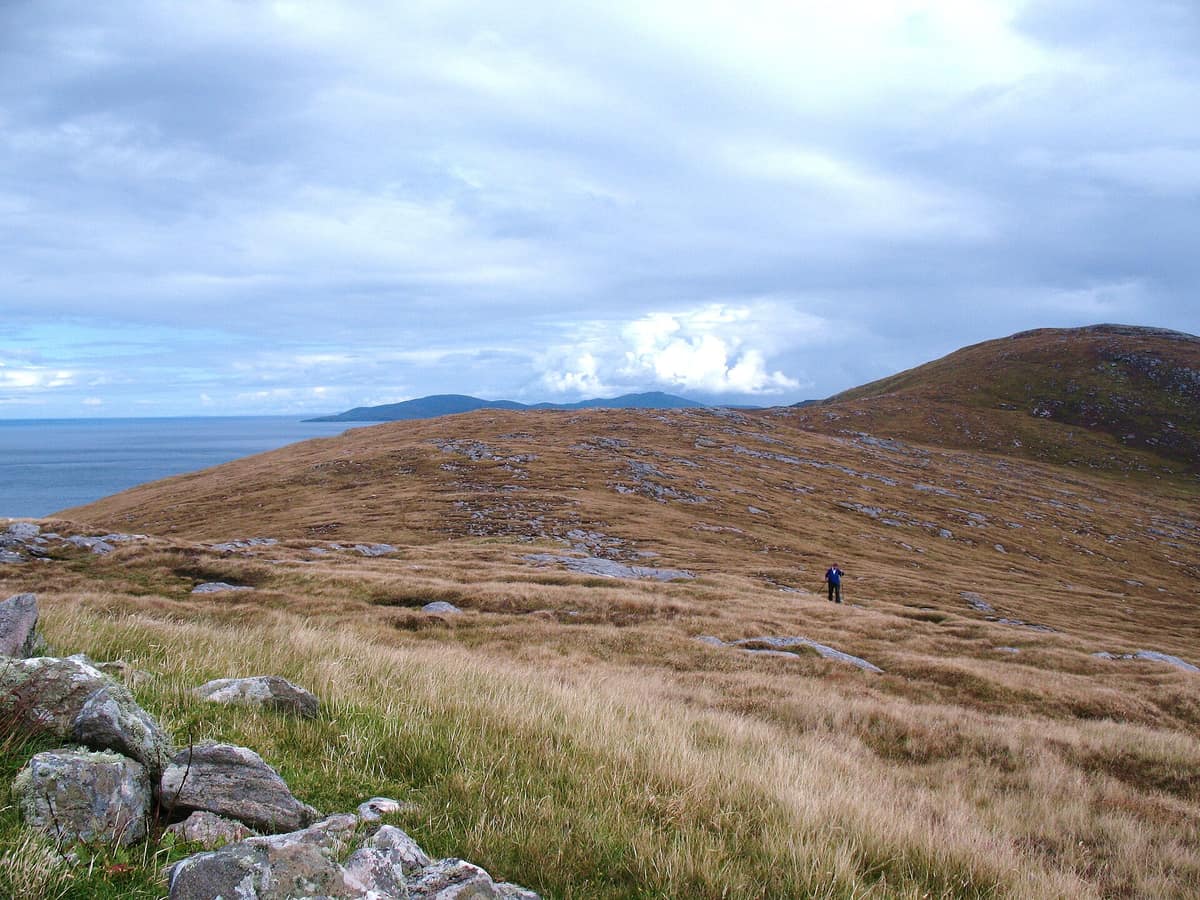
Deserted Isle of Mingulay
Mingulay
Scotland (Outer Hebrides / Barra) · United Kingdom
Photo: Gordon Hatton · CC BY-SA 2.0 · Wikimedia Commons
Deserted Outer Hebrides island abandoned in 1912, featuring 200 m sheer granite sea cliffs crowded with thousands of razorbills and guillemots.
Mingulay has known over a century of profound human silence. For at least two thousand years communities endured here, until clearances and voluntary evacuations began in 1907 and by 1912 the island was completely abandoned. Today it represents the second largest of the Bishop's Isles, lying 22 kilometres south of Barra in the Outer Hebrides, entirely reclaimed by seabirds: thousands of common guillemots, razorbills, and puffins breed across its sheer cliffs. Accessible solely by sea, the island has been cared for by the National Trust for Scotland since the year 2000.
What makes it unique
Mingulay's soaring western sea cliffs rank among western Scotland's premier seabird citadels, on an evocative island evacuated little over a hundred years ago.
The place
Nature
The landscape
The island is forged from ancient Lewisian gneiss intercut with granite pegmatite veins. In Mingulay Bay, retreating Pleistocene glaciers deposited boulder clays and erratics, while higher ground consists of blanket peat, skeletal podzols, and windswept bedrock. On the storm-battered west coast, the dramatic cliffs of Builacraig soar 213 metres straight out of the Atlantic, scarred by Bagh na h-Aoineig, a colossal sea-cleft long reputed as the tallest vertical sea chasm in the British Isles.
Three towering sea stacks guard this oceanic frontage: Arnamul, Lianamul, and Gunamul. Gunamul is pierced by a spectacular natural rock arch through 150-metre sea cliffs, navigable by small vessels only on rare calm summer days. The highest summits are Càrnan at 273 metres, Macphee's Hill at 224, and Hecla at 219.
Maritime vegetation reflects typical Outer Hebridean moorland: ling heather, cross-leaved heath, bog mosses, rushes, and bracken. A lone stunted aspen of 2 metres clings to a sheltered crag above the bay, the island's only tree. Sea holly, remarkably scarce in the Western Isles, has grown here since at least the nineteenth century, while summer wildflowers carpet the abandoned village ruins.
Wildlife and seasons
Mingulay and neighboring Berneray host the second largest colony of razorbills in Great Britain. Breeding censuses record around 9,514 pairs of razorbills—representing 6,3 % of the European population—alongside 11,063 pairs of common guillemots and 2,939 pairs of black-legged kittiwakes. Oceanic cliffs also support 11,626 nesting pairs of northern fulmars and 2,072 pairs of Atlantic puffins, supplemented by European shags, European storm-petrels, Arctic and common terns, and great skuas.
During high summer, visitors can watch puffins at close quarters above Mingulay Bay from the designated trail. Hikers must stay strictly on the path to avoid collapsing nesting burrows; temporary fencing was erected during avian influenza outbreaks to minimize disturbance, though excellent vantage points remain accessible.
Builacraig offers an elevated vantage point to spot minke whales, basking sharks, and dolphins. The grey seal is abundant: numbers have multiplied since human departure. The sweeping white sand beach hosts large haul-outs, and up to a thousand seals utilize the sheltered sands during winter.
Species
With a page in the atlas
Being mentioned in a source doesn't guarantee sightings: check with the people who manage the area.
Memory and protection
History and conservation
The island's total lack of a sheltered natural harbour left islanders isolated for weeks on end during winter storms, a hardship that ultimately compelled the final abandonment.
Today only two stone structures remain standing: the Victorian schoolhouse and the chapel house; the school was restored by the National Trust in 2013 to provide temporary bunkhouse accommodation for visiting researchers. Mingulay and Berneray were notified as a Site of Special Scientific Interest in 1983 and form a designated BirdLife Important Bird Area.
Mingulay preserves a rich Gaelic oral tradition. It is renowned for its wealth of Gaelic folklore, waulking songs, and poetry; the famous "Mingulay Boat Song" is not a traditional folk air but was composed by Sir Hugh S. Roberton in 1938.
Before you set off
Visiting
How to visit
Mingulay is accessible solely by boat, with most day charters departing from Castlebay on Barra. The National Trust for Scotland collaborates with two licensed local boat operators from Barra. Disembarking onto the rocky shoreline requires transferring to a small dinghy and demands agile footwork: the landing beach experiences heavy Atlantic surf, with emergency alternative landings at Aneir and Skipisdale.
Once ashore, the terrain is pathless, steep, and peat-boggy. Keep to waymarked sheep tracks to avoid stepping on hidden burrowing seabirds.
Before you go
Always plan your crossing around boat operators' advice: sea states dictate landings and surf can make shore access impossible. Dress in sturdy waterproof boots and foul-weather gear, and respect protective fences and waymarked trails through puffin breeding grounds.
Check access, rules and visiting conditions in the official information from the managing body before you set off.
Location
Where it is and how far it reaches
Boundary of Miùghalaigh · © OpenStreetMap contributors (ODbL) The coordinate is estimated; it isn't a verified access point.
Transparency
Sources
The research data with its sources, and the official links for this place, are in the Spanish version of this page. See the Spanish version
Around it
Mingulay shares razorbills, puffins, and grey seals with the Treshnish Isles - Lunga and the Sept-Îles Nature Reserve. The Vestmanna Bird Cliffs share dense colonies of razorbills and puffins, while Great Blasket Island echoes its abandoned island heritage, puffins, and grey seals.
If you like this place, elsewhere in Europe
Distant places with uncommon wildlife and habitats in common. The most widespread species don't count. Sharing species doesn't imply a corridor or guaranteed presence.
- Isle of Lunga (Treshnish Isles)
Scotland (Inner Hebrides / Isle of Mull)
In common: Razorbill · Atlantic puffin · Grey seal — wild coast, marine
Small basalt islet where puffins nest mere inches from walkers’ boots showing virtually no fear of humans.
JFMAMJJASONDMay – August · Crowding low
- Sept-Îles Nature Reserve
Brittany (Côtes-d'Armor — Perros-Guirec)
In common: Razorbill · Atlantic puffin · Grey seal — wild coast, marine
France's largest colony of northern gannets and the puffin's last refuge on the French coast.
JFMAMJJASONDApril – July · Crowding low
- Great Blasket Island / An Blascaod Mór
Ireland (County Kerry / Dingle Peninsula / Dunquin)
In common: Atlantic puffin · Grey seal — wild coast, marine
The largest of the Blasket archipelago islands (evacuated in 1953), famed for rich Gaelic literature, wild sea cliffs, and beaches with hundreds of grey seals.
JFMAMJJASONDMay – September · Crowding low
Entry #617 of the original atlas.