Sept-Îles Nature Reserve
Réserve naturelle nationale des Sept-Îles
Brittany (Côtes-d'Armor — Perros-Guirec) · France
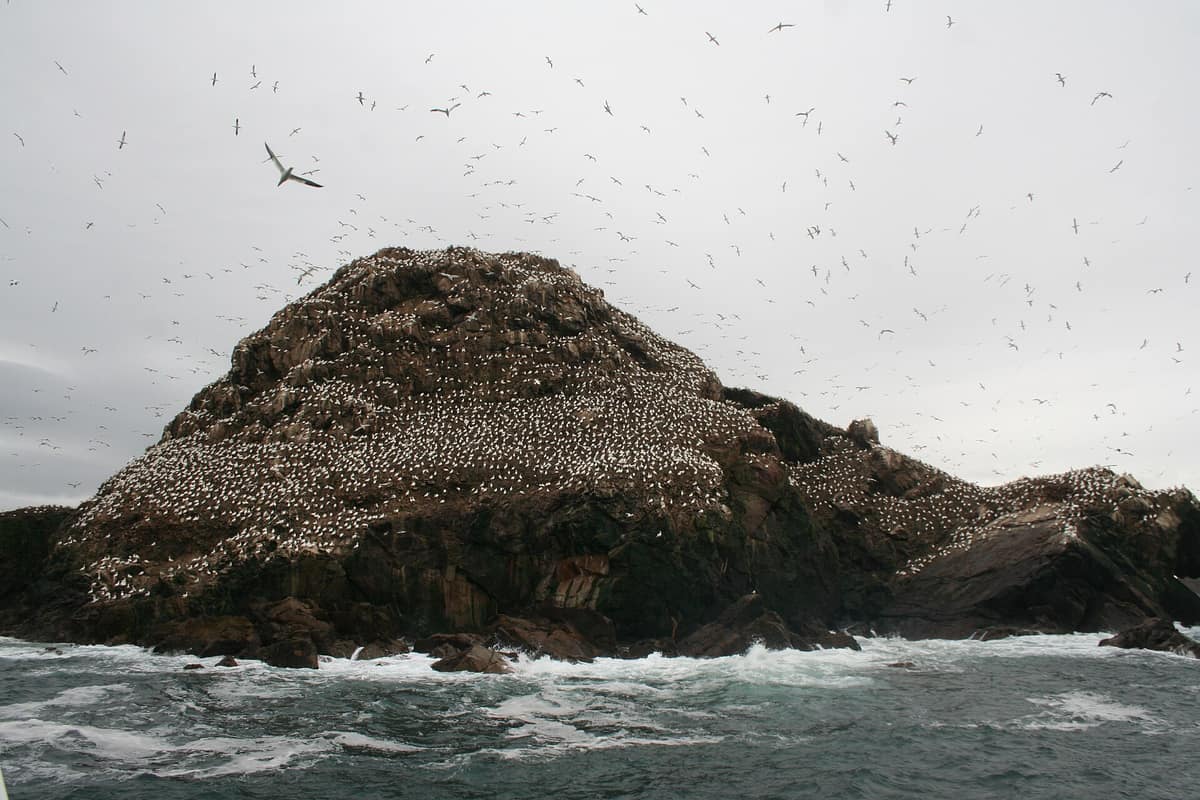
Photo: Mario Modesto Mata · CC BY-SA 3.0 · Wikimedia Commons
France's largest colony of northern gannets and the puffin's last refuge on the French coast.
In 1910 the shooters arrived: a railway company organized excursions to shoot puffins. In two years they plummeted from 20 000 to 2 000 birds. A handful of defenders managed to get hunting banned, and in 1912 France's first private ornithological reserve was born. This is the Sept-Îles reserve, off Perros-Guirec in Brittany: a granite archipelago where today around 23.000 pairs of 27 species nest and where hunting has given way to observation.
What makes it unique
Rouzic is the only place in France where the northern gannet breeds, with 21 880 pairs.
The place
Nature
The landscape
Picture rocks, open sea, and little else. The reserve sits on a granitic rocky platform and has only 71 ha of land compared to around 19 629 ha of sea. Since the 2023 expansion, it also includes Tomé Island and the Triagoz archipelago.
Île aux Moines is the only island with permanent fresh water, so it was inhabited intermittently and preserves an eighteenth-century lighthouse and fort. The Conservatoire du littoral has owned this island since 1993, and that is where the main settlement of bird colonies is located.
Beneath the water lies a second world. The expansion protects sensitive marine habitats such as maërl beds, eelgrass meadows, and kelp forests, as well as grey seals.
Wildlife and seasons
This is a city of birds, and the calendar dictates everything. The northern gannet is present from January to September; its colony on Rouzic is the only breeding site in France. The Atlantic puffin and the razorbill nest from March to July and February to July, respectively, which is why boat excursions still encounter them on the islets until mid-July. The Manx shearwater completes the quartet: during the breeding season, Rouzic hosts nearly all of France's puffins and almost all of its Manx shearwaters and razorbills.
Other cliff dwellers include herring and lesser black-backed gulls, European shags, common murres, northern fulmars, common terns, Eurasian oystercatchers, and black-legged kittiwakes. And in the water lives a sedentary colony of around thirty grey seals.
The most strictly protected area is the tranquility zone: 130 ha for the gannets, where all human activity is prohibited from 1 April to 31 August.
Species
With a page in the atlas
Being mentioned in a source doesn't guarantee sightings: check with the people who manage the area.
Memory and protection
History and conservation
The reserve has been protected since 1912 and has been a national nature reserve since 1976. In 1939 the first group of gannets settled here, and a recent study places 99,9 % of the country's population here, along with 98 % of the puffins. It has also been a special protection area for birds under the European Natura network since September 1996.
The danger has not disappeared. In 2022, an outbreak of avian flu killed 80 % of gannet chicks. The 2023 expansion specifically aims to protect sensitive habitats and threatened species, managed by the LPO. And in Perros-Guirec, the puffin is one of the city's two emblems.
Conservation organisations
Before you set off
Visiting
How to visit
Almost everything is seen from the water. The archipelago is accessible year-round from Perros-Guirec. In July and August, the LPO departs three times a week: accompanied by an LPO guide, the boat takes you to see the gannets of Rouzic, grey seals, and, until mid-July, puffins, razorbills, and guillemots. It lasts about two hours and does not land on the islands. Boat trips depart from the Trestraou ferry terminal in Perros-Guirec, not from Île Grande station.
On land, the LPO station on Île-Grande, the Maison de la Réserve, features interactive exhibits on the Sept-Îles ecosystem and marine conservation. In July and August it organizes four weekly birdwatching outings; off-season it focuses on viewpoints along the Côte de Granit Rose. There are also low-tide outings to discover foreshore biodiversity: boots are essential. School groups can take boat excursions from April to June and in September.
If you want to walk, the customs trail through the protected moorlands of Ploumanac'h borders the Côte de Granit Rose.
Before you go
From 1 April to 31 August you cannot enter the gannet tranquility zone. Excursions have fixed schedules: three weekly departures only in July and August, setting out from Trestraou.
Check access, rules and visiting conditions in the official information from the managing body before you set off.
Location
Where it is and how far it reaches
Boundary of Archipel des sept iles · © EEA, CDDA (CC-BY) The coordinate is estimated; it isn't a verified access point.
Transparency
Sources
The research data with its sources, and the official links for this place, are in the Spanish version of this page. See the Spanish version
Around it
Further away, other seabird colonies share the main species found on Sept-Îles. Noss National Nature Reserve shares gannet, common murre, and puffin. Vestmanna Bird Cliffs has razorbill, common murre, and puffin, and Lunga (Treshnish Isles) adds the grey seal to razorbill and puffin.
If you like this place, elsewhere in Europe
Distant places with uncommon wildlife and habitats in common. The most widespread species don't count. Sharing species doesn't imply a corridor or guaranteed presence.
- Fair Isle Bird Sanctuary
Scotland (Shetland Islands)
In common: Northern gannet · Razorbill · Common murre — wild coast, marine
The isolated island midway between Orkney and Shetland, historic mecca for migratory vagrant birds and traditional knitwear.
JFMAMJJASONDMay – October · Crowding very low
- Isle of Noss National Nature Reserve
Scotland (Shetland Islands / Bressay)
In common: Northern gannet · Common murre · Atlantic puffin — wild coast, marine
Red sandstone sea cliffs rising 180 m at the Noup of Noss, where over 150.000 seabirds nest.
JFMAMJJASONDMay – August · Crowding very low
- Hornstrandir Nature Reserve
Westfjords (Ísafjörður)
In common: Razorbill · Common murre · Atlantic puffin — wild coast
An arctic peninsula abandoned in the fifties, without roads, where the arctic fox lives without hunting and without fear.
JFMAMJJASONDJune – August · Crowding none
Entry #1055 of the original atlas.