Isle of Noss National Nature Reserve
Noss National Nature Reserve
Scotland (Shetland Islands / Bressay) · United Kingdom
Photo: Unukorno · CC BY 4.0 · Wikimedia Commons
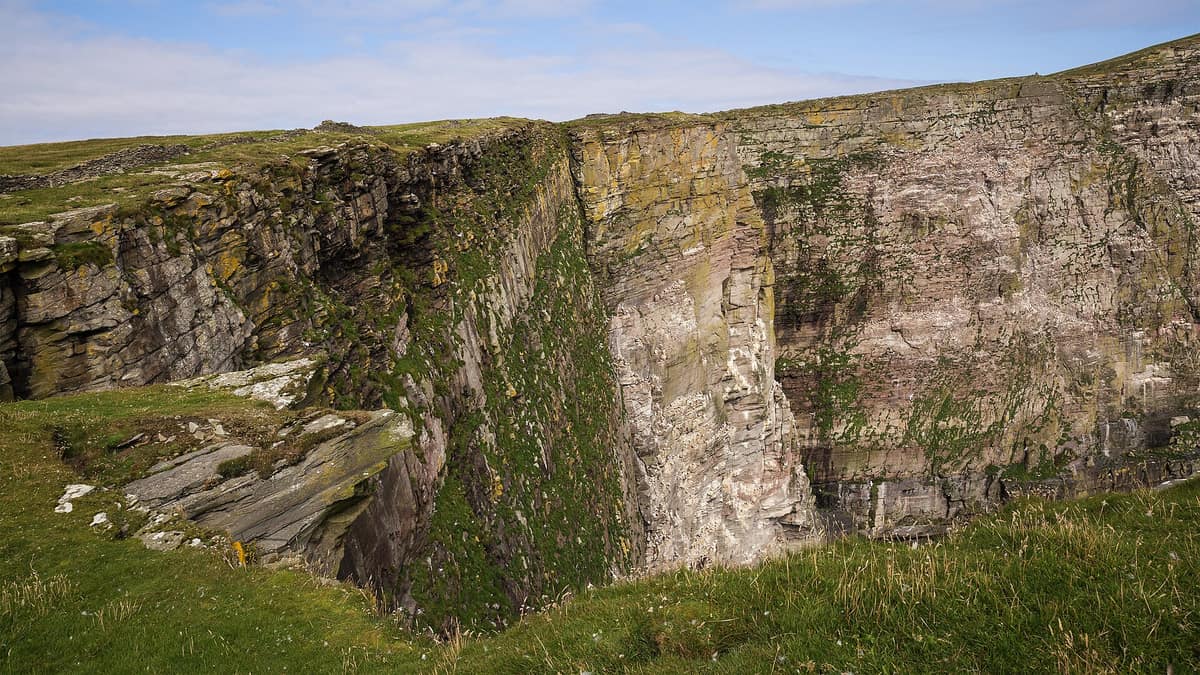
Red sandstone sea cliffs rising 180 m at the Noup of Noss, where over 150.000 seabirds nest.
To set foot on Noss you must cross open water twice. First, from Lerwick, the roll-on ferry across to Bressay; then, NatureScot’s small rigid inflatable ferry boat that bridges the narrow Noss Sound in three swift minutes. On the other side awaits a compact island, once settled and now devoid of permanent human residents, whose sheer red sandstone precipices soar to 180 metres, sheltering one of the most accessible major seabird colonies in the entire North Atlantic.
What makes it unique
A roughly four-hour coastal walk along sea cliffs up to 180 metres high teeming with seabirds.
The place
Nature
The landscape
The Old Red Sandstone of Noss has weathered into stacked horizontal ledges, creating ideal breeding tiers for seabirds. Clustered upon these rock ledges nest northern gannets, Atlantic puffins, common guillemots, European shags, black-legged kittiwakes, razorbills, northern fulmars and great skuas. The vertiginous sea cliffs of the Noup of Noss, known among mountaineers as the "Great Wall of Noss", were scaled for the first recorded time by Jo Moran in 1963.
The name of the island derives from the Old Norse nǫs, meaning "nose". Key island landmarks include a seasonal visitor centre, the historical Pony Pund built for breeding Shetland ponies, the dramatic sea stack Holm of Noss, and the towering Noup sea cliff. In high summer, the cliff-top maritime turf blazes with roseroot, red campion and sea campion. Botanists have catalogued 137 vascular plants, including two nationally scarce species: small adder’s-tongue fern and Scottish scutch.
Wildlife and seasons
In early spring, northern gannet, great skuas, atlantic puffin, fulmars and black-legged kittiwake arrive in strength. From mid-May through mid-July is the premier window to witness active breeding seabirds. The sheer sea cliffs shelter gannets, common murre and northern fulmar, while the territorial great skua nest across the inland peaty heath.
The avian community has witnessed profound historical shifts. Four species commenced breeding here during the twentieth century (gannet, fulmar, great skua and European storm petrel), while six species ceased nesting, among them the peregrine falcon and white-tailed sea eagle. In total, 201 bird species have been recorded; breeding waders include dunlin, common snipe, Eurasian oystercatcher and common ringed plover, accompanied by open-country songbirds like skylark, meadow pipit, rock pipit and northern wheatear.
Along the rocky shoreline you may spot marine mammals and eurasian otter; otters show themselves frequently, alongside modest numbers of grey and harbour seals. On calm days you can listen for harbour porpoises, with ten cetacean species documented offshore, the harbour porpoise being by far the most frequent.
Species
With a page in the atlas
Being mentioned in a source doesn't guarantee sightings: check with the people who manage the area.
Memory and protection
History and conservation
Noss supported 20 permanent inhabitants in 1851, but has lacked any resident community since 1939. The primary historical settlement was at Gungstie on the western shore, built during the 1670 decade and utilized today as seasonal warden quarters; Setter, situated to the southeast, remained inhabited until the 1870 decade and now lies in romantic ruins. The island has functioned as a working sheep farm since 1900 and achieved National Nature Reserve status in 1955. It is further designated as a Special Protection Area (SPA) and Site of Special Scientific Interest (SSSI).
NatureScot maintains rigorous biosecurity protocols to minimize the spread of avian influenza by human visitors.
Before you set off
Visiting
How to visit
From the landing slipway, a short stroll brings you to the visitor centre, where coastal waymarks interpret island natural and human history. The complete circular island circuit takes about four hours; hiking to the cliff-top viewpoint and back requires roughly two and a half hours. Walking the coastal path in an anti-clockwise direction offers the most dramatic, progressively unfolding views of the seabird cities.
The inflatable passenger ferry operates on a seasonal summer timetable and is skippered by reserve wardens.
Before you go
Plan your timing carefully: you must take the ferry to Bressay, drive or walk to the Noss Sound crossing point, and return before evening. Adhere to NatureScot biosecurity guidelines and check that the small inflatable boat service is running before setting out.
Check access, rules and visiting conditions in the official information from the managing body before you set off.
Location
Where it is and how far it reaches
Boundary of Noss · © OpenStreetMap contributors (ODbL) The coordinate is estimated; it isn't a verified access point.
Transparency
Sources
The research data with its sources, and the official links for this place, are in the Spanish version of this page. See the Spanish version
Around it
Noss shares gannets, common guillemots and puffins with the Sept-Îles Nature Reserve; and gannets and puffins with Alderney, Mykines and Skellig Michael.
If you like this place, elsewhere in Europe
Distant places with uncommon wildlife and habitats in common. The most widespread species don't count. Sharing species doesn't imply a corridor or guaranteed presence.
- Sept-Îles Nature Reserve
Brittany (Côtes-d'Armor — Perros-Guirec)
In common: Northern gannet · Common murre · Atlantic puffin — wild coast, marine
France's largest colony of northern gannets and the puffin's last refuge on the French coast.
JFMAMJJASONDApril – July · Crowding low
- Isle of Mykines (Faroe Islands)
Faroe Islands (Vágar Region / Mykines)
In common: Northern gannet · Atlantic puffin — wild coast, marine
The "Puffin Island", the westernmost outpost of the Faroe Islands, with sheer basalt sea cliffs where hundreds of thousands of Atlantic puffins (Fratercula arctica) nest.
JFMAMJJASONDJune – August · Crowding moderate
Entry #612 of the original atlas.