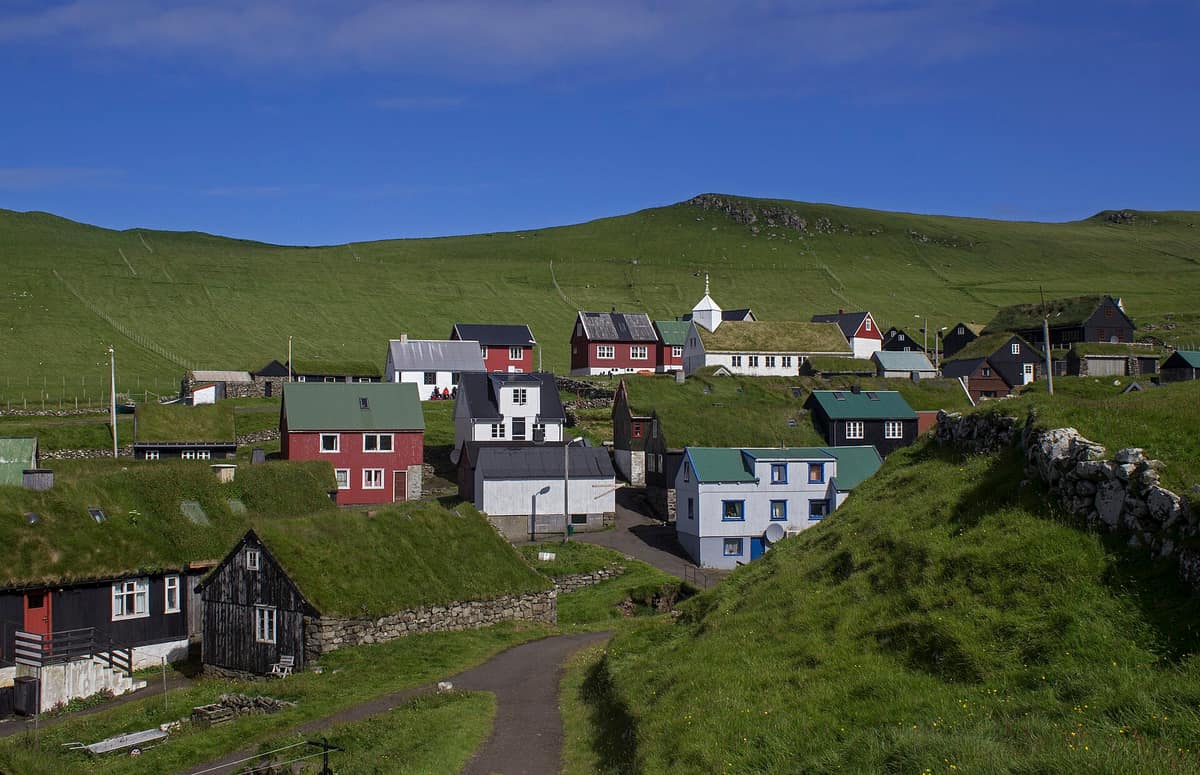
Isle of Mykines (Faroe Islands)
Mykines
Faroe Islands (Vágar Region / Mykines) · Faroe Islands
Photo: Stefan Wisselink · CC BY 2.0 · Wikimedia Commons
The "Puffin Island", the westernmost outpost of the Faroe Islands, with sheer basalt sea cliffs where hundreds of thousands of Atlantic puffins (Fratercula arctica) nest.
In mid-August, a young puffin ventures for the first time outside the turf burrow where it spent its initial weeks of life. That single moment captures the essence of Mykines: an island measuring just over 10 km², the westernmost in the Faroe Islands, which every summer comes alive with seabirds and travellers arriving to admire them. There is a solitary settlement, also called Mykines, featuring over forty houses and around fifteen permanent residents, though that figure swells dramatically in summer. There are no cars. And virtually everyone journeys here for the same reason: the puffins.
What makes it unique
It is the only breeding station for the northern gannet in the Faroe Islands, and hosts one of the largest puffin colonies in the entire archipelago.
The place
Nature
The landscape
Mykines is built of solid basalt. Together with Suðuroy, it preserves the oldest geological strata across the archipelago. To the east open two vast U-shaped glacial valleys, Borgardalur and Kálvadalur, while to the north the secluded valley of Korkadalur shelters striking basalt columns celebrated as the stone forest. The heads of these valleys converge into the central uplands, crowned by Knúkur at 560 m, the highest summit on the island. From there, the terrain slopes gently towards the western shoreline, where the village nestles.
To the west, separated by a narrow sound, lies the islet of Mykineshólmur, linked to the main island by a footbridge. Upon it perches the lighthouse, the island’s most iconic landmark. Walking all the way out to the lighthouse is currently prohibited: the á Rógvu viewpoint marks the furthest accessible point.
Wildlife and seasons
Mykines is home to tens of thousands of seabirds, predominantly Atlantic puffins, northern fulmars, European storm petrels, and black-legged kittiwakes. In addition, northern gannets, common murres, and razorbills nest along the cliffs. The island is designated as a Ramsar wetland, and among its scant terrestrial mammals are mountain hares introduced by humans and an endemic house mouse subspecies, the Mykines mouse.
The seasonal calendar revolves around the puffins. You can observe them from late April through early September, with the peak onshore viewing window spanning mid-May to late August, as these pelagic wanderers only touch land to rear young. In late April or early May they arrive and begin clearing out burrows, excavation tunnels that can extend more than a metre deep into the grassy slopes. The chicks, known as pufflings, hatch in July, remain underground for several weeks, and generally fledge in mid-August. If you encounter an adult puffin standing before you with small fish crosswise in its bill, it is carrying food to its chick: if it freezes, you are blocking the entrance to its burrow.
Species
With a page in the atlas
Being mentioned in a source doesn't guarantee sightings: check with the people who manage the area.
Memory and protection
History and conservation
Fossil pollen analyses indicate that as early as the year 625 barley and oats were cultivated on Mykines, likely brought by the earliest Norse or Celtic settlers. In 1595 a sudden squall claimed the lives of all able-bodied men working offshore from the island, between 200 and 300 souls aboard five fishing boats. The Mykineshólmur lighthouse was constructed in 1909, coinciding with the completion of the first suspension footbridge connecting it to the island.
Before you set off
Visiting
How to visit
To hike across the open moorland and coastal slopes of Mykines where puffins congregate, visitors must be accompanied by an accredited local guide and pay a conservation hiking fee to landowners. Those who remain within the village public pathways do not require a guide or permit. The most frequented guided route climbs towards Óli Rami and the memorial monument, where hikers encounter puffins at close quarters for the first time. It continues to the á Rógvu viewpoint, opening up panoramic vistas over the í Lamba breeding colony, the outer bird cliffs, and the lighthouse. The return leg skirts the northern edge of the hamlet, overlooking sea cliffs, before concluding at the Kumlar viewpoint beside the bay.
If you prefer quieter walks, guides can lead you further inland towards the Norðara Nesgjóv and Knúkur viewpoints or out towards the basalt stone forest.
Access is via passenger ferry from Sørvágur or by scheduled helicopter service from Vágar airport. The ferry operates regular daily crossings from May to August, with limited autumn, winter, and April connections. For six months of the year, the helicopter represents the residents’ sole link to the outside world.
Before you go
Outside the village perimeter, hiking is permitted solely between 10:00 and 17:00, allowing seabirds and grazing sheep undisturbed rest. Stay strictly on waymarked trails: puffins nest in subterranean burrows directly beneath your feet. Walk quietly and maintain at least two metres distance from the birds. Reaching into burrows, handling puffins, or pointing camera lenses down into nesting tunnels is strictly outlawed. The footpath connecting to the lighthouse is closed from May to September to protect sensitive breeding areas. Pitching tents across open land without prior permission from landowners is forbidden, and all rubbish must be packed out and returned to the main island.
Check access, rules and visiting conditions in the official information from the managing body before you set off.
Location
Where it is and how far it reaches
Boundary of Mykines · © OpenStreetMap contributors (ODbL) The coordinate is estimated; it isn't a verified access point.
Transparency
Sources
The research data with its sources, and the official links for this place, are in the Spanish version of this page. See the Spanish version
Around it
The Vestmanna Bird Cliffs lie roughly twenty-five kilometres away. Further afield, St Kilda, Alderney, the Sept-Îles Nature Reserve, and Skellig Michael share northern gannets and Atlantic puffins with Mykines.
If you like this place, elsewhere in Europe
Distant places with uncommon wildlife and habitats in common. The most widespread species don't count. Sharing species doesn't imply a corridor or guaranteed presence.
- Fair Isle Bird Sanctuary
Scotland (Shetland Islands)
In common: European storm petrel · Northern gannet · Northern fulmar — wild coast, marine
The isolated island midway between Orkney and Shetland, historic mecca for migratory vagrant birds and traditional knitwear.
JFMAMJJASONDMay – October · Crowding very low
- St Kilda Archipelago - Hirta and Dùn
Scotland (Outer Hebrides / Hirta)
In common: Northern gannet · Northern fulmar · Atlantic puffin — wild coast, marine
The only Dual (Cultural and Natural) UNESCO World Heritage Site in the UK, with sheer sea cliffs and sea stacks hosting the world's largest gannet colony (Stac an Armin 196 m).
JFMAMJJASONDJune – August · Crowding very low
- Sept-Îles Nature Reserve
Brittany (Côtes-d'Armor — Perros-Guirec)
In common: Northern gannet · Atlantic puffin — wild coast, marine
France's largest colony of northern gannets and the puffin's last refuge on the French coast.
JFMAMJJASONDApril – July · Crowding low
Entry #603 of the original atlas.