Fair Isle Bird Sanctuary
Fair Isle
Scotland (Shetland Islands) · United Kingdom
Photo: Julian Paren · CC BY-SA 2.0 · Wikimedia Commons
The isolated island midway between Orkney and Shetland, historic mecca for migratory vagrant birds and traditional knitwear.
Between Mainland Shetland and North Ronaldsay in Orkney lies a 768-hectare block of rock: Fair Isle, the southernmost island of the Shetland archipelago. It is a legendary migratory landfall, with 390 bird species recorded, and an international mecca for birdwatching.
What makes it unique
Here extreme isolation has endowed the island with its own endemic wren, a distinct subspecies found nowhere else on Earth.
The place
Nature
The landscape
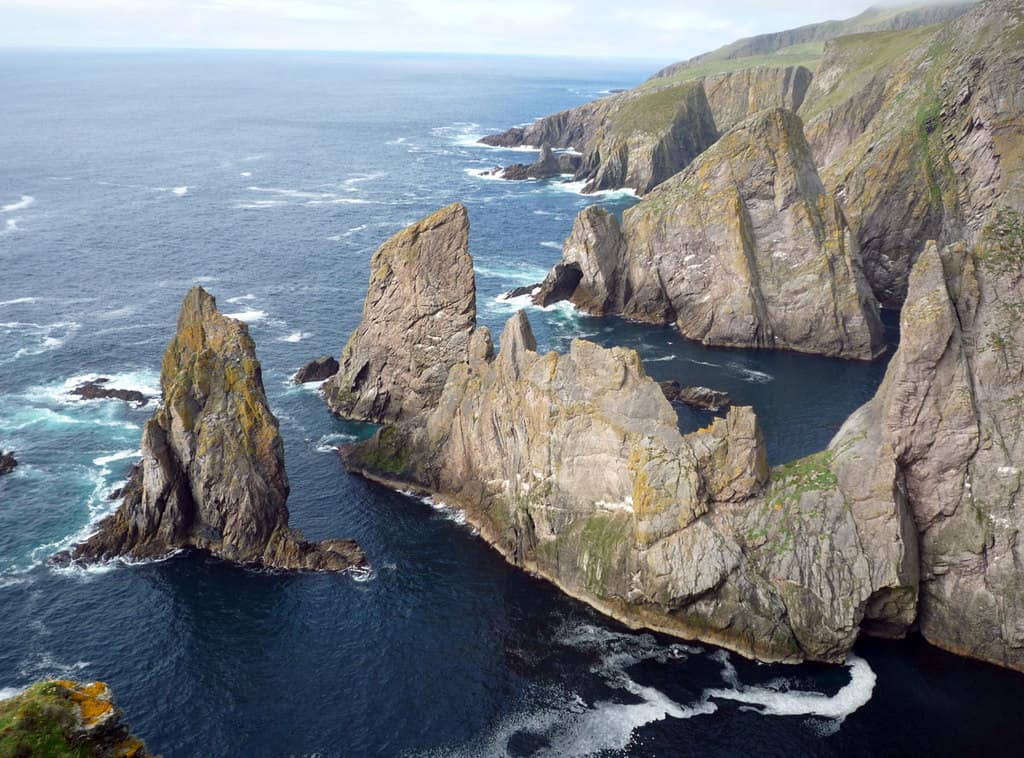
Fair Isle is a blend of crofted green pastures, windswept heather moorland, and dramatic sandstone cliffs, where the sea is never far away. It is fashioned almost entirely of 385-million-year-old Old Red Sandstone sedimentary rocks. The bedding strata dip steeply towards the east-south-east, and this geological angle accounts for its wealth of coastal rock formations: there are over 20 sea stacks, primarily along the western and northern coasts, and between 30 and 35 natural arches, ranging from textbook monumental spans to narrow geos cleaving the headlands.
The highest summit, Ward Hill, reaches 217 metres. A stone boundary wall, the Hill Dyke, bisects the island, separating the cultivated crofts and pastures of the south from the unpopulated common grazing moors of the north. Fair Isle is designated as one of Shetland's seven National Scenic Areas, and almost the entire island forms an SSSI, SPA, and SAC.
In 1969, fossil remains of primitive Devonian plants were unearthed, making the island the only locality in Britain yielding a fossil flora of that geological age.
Wildlife and seasons
The Fair Isle year is marked by birds. In late March, Atlantic puffins return to occupy old rabbit burrows, remaining until mid-August. Several pairs breed just minutes on foot from the bird observatory, making them effortless to see in summer. From May to mid-August they are the premier wildlife attraction, celebrated during evening ranger walks.
Other seabirds recount a more sobering trajectory. The northern fulmar did not nest here prior to 1903; its population peaked at over 43,000 pairs in 1996 before falling to 26,629 pairs in 2025. The northern gannet began breeding in 1975 and has expanded in the opposite direction: in 2025 nearly 7,000 pairs were censused. The European shag has crashed from more than 1,500 pairs in the sixties to just 68, driven by food shortages—specifically lesser sandeels—during the breeding period. The common murre numbered over 39,000 birds in the late nineties, a tally that has since halved; the razorbill has dropped from over 5,000 individuals to 2,535. Black guillemots nest beneath boulder scree on the east coast, easily spotted in calm sea conditions, with around 200 breeding adults.
At night, between mid-July and early September, European storm petrels are ringed, and island visitors can attend.
Between April and June and from August to October, observatory wardens conduct daily migratory bird censuses. From mid-September the first yellow-browed warblers appear, sometimes becoming the island's most abundant bird later that month; in October, north-westerly winds bring large flocks of bean geese, pink-footed geese, and whooper swans. Each evening you can contribute your personal sightings to the daily bird log convened in the observatory lounge.
With patience, the Fair Isle wren, Britain's least numerous endemic passerine subspecies, sings around the stone ruins of The Haven, where a pair regularly nests. Between 2011 and 2017 an average of 39 singing males was recorded, largely occupying sheltered maritime cliff crags.
At sea, most cetacean encounters occur between May and October. Buness, Meoness, and North Light cliffs make superb vantage points on calm days, frequently producing harbour porpoise, minke whale, and killer whale. The grey seal breeds in modest numbers, seen at North Haven and South Harbour, pupping from October onward on isolated pebble beaches.
Species
With a page in the atlas
Being mentioned in a source doesn't guarantee sightings: check with the people who manage the area.
Memory and protection
History and conservation
Between 1905 and 1911, ornithologist William Eagle Clarke visited the island eight times, recording 207 bird species—amounting to half the official British list of the day. In 1948 George Waterston purchased the island and the bird observatory was established as an independent trust within former naval huts at North Haven. Today Fair Isle serves as one of four key monitoring stations within the UK Seabird Monitoring Programme.
Before you set off
Visiting
How to visit
Exploring Fair Isle is accomplished on foot and alongside the resident ranger. Supported by NatureScot, a complimentary ranger service operates for all visitors from April to late October, offering guided interpretive walks open to observatory residents and day visitors alike. Five themed routes explore birds, island history, archaeology, and coastal geomorphology. The bird observatory additionally runs guided excursions from May to October, and private tours of South Lighthouse can be arranged.
There are 24 active crofts in the southern half, meaning that your journey traverses a living, inhabited island cultural landscape.
Before you go
Scheduled travel requires travelling through Shetland: the ferry Good Shepherd IV links North Haven with Grutness in summer taking two and a half hours, while passenger flights operate year-round. All journeys are weather-dependent; fog or gale-force winds can disrupt transport with little advance notice. The island can be visited throughout the year, though conditions dictate logistics. Confirm ferry and flight timetables well before travelling.
Check access, rules and visiting conditions in the official information from the managing body before you set off.
Location
Where it is and how far it reaches
Boundary of Fair Isle · © OpenStreetMap contributors (ODbL) The coordinate is estimated; it isn't a verified access point.
Transparency
Sources
The research data with its sources, and the official links for this place, are in the Spanish version of this page. See the Spanish version
Around it
Fair Isle shares prominent seabird species with other atlas destinations. It coincides with Handa Island Nature Reserve for great skua, common murre, and puffin; with Hermaness National Nature Reserve for great skua and puffin; and with Sept-Îles Nature Reserve and Vestmanna Bird Cliffs for common murre and Atlantic puffin.
If you like this place, elsewhere in Europe
Distant places with uncommon wildlife and habitats in common. The most widespread species don't count. Sharing species doesn't imply a corridor or guaranteed presence.
- Isle of Mykines (Faroe Islands)
Faroe Islands (Vágar Region / Mykines)
In common: European storm petrel · Northern gannet · Northern fulmar — wild coast, marine
The "Puffin Island", the westernmost outpost of the Faroe Islands, with sheer basalt sea cliffs where hundreds of thousands of Atlantic puffins (Fratercula arctica) nest.
JFMAMJJASONDJune – August · Crowding moderate
- Sept-Îles Nature Reserve
Brittany (Côtes-d'Armor — Perros-Guirec)
In common: Northern gannet · Common murre · Razorbill — wild coast, marine
France's largest colony of northern gannets and the puffin's last refuge on the French coast.
JFMAMJJASONDApril – July · Crowding low
- Hornstrandir Nature Reserve
Westfjords (Ísafjörður)
In common: Northern fulmar · Common murre · Razorbill — wild coast
An arctic peninsula abandoned in the fifties, without roads, where the arctic fox lives without hunting and without fear.
JFMAMJJASONDJune – August · Crowding none
Entry #622 of the original atlas.