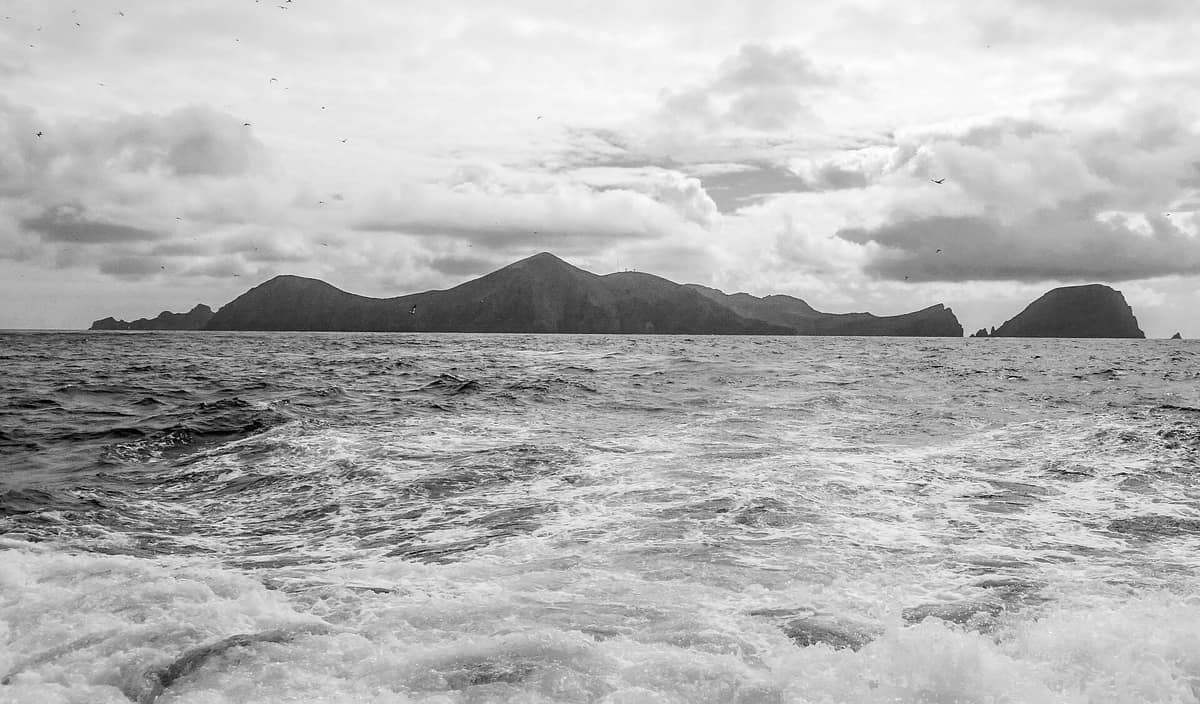
St Kilda Archipelago - Hirta and Dùn
St Kilda
Scotland (Outer Hebrides / Hirta) · United Kingdom
Photo: Kingy64 · CC BY-SA 4.0 · Wikimedia Commons
The only Dual (Cultural and Natural) UNESCO World Heritage Site in the UK, with sheer sea cliffs and sea stacks hosting the world's largest gannet colony (Stac an Armin 196 m).
If you stand on Dùn on a bustling summer day, tens of thousands of puffins wheel around your head in every direction. St Kilda is an isolated oceanic outpost in the North Atlantic, situated 65 kilometers west-northwest of North Uist. It shelters one of the greatest northern gannet colonies on the planet and the preserved ruins of an isolated community that lived here for at least four thousand years, until its final 36 residents were evacuated on 29 August 1930. Today it holds dual World Heritage status for both its natural and cultural significance.
What makes it unique
An extinct volcano sculpted into sea cliffs where seventeen species of seabirds nest, alongside an abandoned stone village that emptied overnight.
The place
Nature
The landscape
What rises before you are the battered remnants of a tertiary ring volcano composed of weathered granites and gabbros, rising abruptly from a submerged continental shelf. Ocean swells and gale-force winds did the rest. Hirta, the largest island, boasts the highest sheer sea cliffs in the United Kingdom: the northern precipice of Conachair, the island's 430 m high summit, plummets vertically into the sea in a breathtaking wall of 427 meters. Seen from offshore, the sweep of Village Bay is deceiving, appearing like a quiet hamlet sheltered by rolling emerald slopes.
Around Hirta stand dramatic sea stacks: Stac an Armin, towering 196 meters, and Stac Lee at 172 meters, the highest in Britain. The jagged islet of Dùn, sheltering the bay from southwesterly gales, was once connected to Hirta by a natural arch.
The climate is intensely oceanic and humid, with snow settling on the ground only about twelve days each year. Sweeping waves dominate: five-meter ocean swells are frequent, making small-boat landings challenging or impossible at any time of year. There are no trees. Salt-laden gales produce maritime grassland where, nevertheless, more than 130 flowering plants thrive, alongside 162 species of fungi and 160 bryophytes, including an endemic dandelion, Taraxacum pankhurstianum, identified in 2012.
Wildlife and seasons
The sheer avian census explains the overwhelming roar. The colony of northern gannets numbers 30.000 breeding pairs, representing 24 percent of the global population. Roughly 49.000 pairs of Leach's storm petrels breed here, up to 90 percent of the European breeding total, alongside 136.000 pairs of Atlantic puffins, nearly 30 percent of all puffins nesting in the United Kingdom. Dùn holds the largest concentration of northern fulmars in Britain, and until 1828 St Kilda was their only nesting station in the UK. Guillemots, razorbills, great skuas, Arctic skuas, and European shags also crowd the ledges.
The spectacle alters completely between day and night. By day the amphitheater echoes with cries: guillemots, kittiwakes, gannets, skuas, and puffins. At dusk Manx shearwaters and Leach's petrels return under cover of dark, lending the island an eerie acoustic presence. Using night-vision cameras, ecologists revealed great skuas actively hunting petrels in pitch darkness, an uncommon foraging strategy for seabirds.
On land live two endemic sub-species found nowhere else on Earth: the St Kilda wren and the St Kilda field mouse. Grey seals haul out and pup around Hirta today, though they did not do so prior to the human evacuation of 1930. Primitive feral sheep roam the terrain: the Neolithic Soay sheep runs wild on the island of Soay and has been studied on Hirta for decades, while the Boreray sheep is one of Britain's rarest heritage breeds. The last great auk recorded in Britain was killed on Stac an Armin in July 1840.
The most favorable season spans June to August when Atlantic sea conditions are calmest.
Species
With a page in the atlas
Being mentioned in a source doesn't guarantee sightings: check with the people who manage the area.
Memory and protection
History and conservation
For thousands of years, life on St Kilda revolved around harvesting seabirds. The staple diet consisted of birds, especially gannets and fulmars, collected as eggs and nestlings from dizzying cliffs. Every morning following prayers, adult men gathered on The Street to decide daily chores in an informal parliament without a chairman. To signal the mainland in emergencies, islanders lit beacon bonfires atop Conachair. Mysterious stone ruins include 20 horned structures in Gleann Mòr, with no architectural equivalents in Europe and of unknown ancient purpose.
The medieval village was abandoned in 1834 when a newly planned street of cottages arose between the spring Tobar Childa and the bay. Evacuation arrived nearly a century later: on 29 August 1930, the 36 surviving islanders voted to leave because their isolated subsistence lifestyle was no longer viable.
A new conservation chapter opened thereafter. Lord Dumfries acquired the archipelago to preserve it as a bird sanctuary, bequeathing it to the National Trust for Scotland upon his death in 1956. In 1957 the archipelago was proclaimed a National Nature Reserve; in 2005 St Kilda joined the select two dozen sites worldwide recognized with dual World Heritage status for both nature and culture. BirdLife International designates the islands an Important Bird Area for their seabird colonies. Village restoration has been driven largely by dedicated work parties of summer volunteers.
Before you set off
Visiting
How to visit
You do not simply travel here: you navigate. All access requires chartered boat expeditions and tender transfers ashore, with crossings from the Outer Hebrides taking anywhere between three and six hours depending on weather and swell. Consequently, day trips typically last an entire day, or two, beginning with a tender landing at the Village Bay slipway.
From the pier, a surfaced path ascends steeply toward the village and slopes beyond; overall island walking paths are rugged and unpaved. Take your time climbing and look up: from the crests of Hirta, you will see Dùn and vertical crags teeming with nesting birds.
Down in the village, every stone conveys island history. One restored blackhouse on The Street, number 3, now operates as a seasonal museum. Cleitean, traditional dry-stone storage cells roofed with living turf, stand everywhere across the valley: 1.260 on Hirta and 170 on the outlying islands. Constructed of dry-stone slabs under turf domes, they allow maritime gales to blow clean through while shedding heavy rains.
Before you go
The archipelago is an exceptionally fragile island ecosystem. Anyone planning to land must obtain prior permission from the National Trust for Scotland to prevent biosecurity risks from introducing alien rodents or seeds. The Trust maintains rigorous monitoring of seabird colonies.
Ocean conditions dictate all itineraries: in heavy swell, landing by tender becomes hazardous or impossible. Hirta is inhabited year-round by radar base personnel, joined in summer by wardens, volunteers, and researchers. Bird colonies should be appreciated respectfully from designated paths.
Check access, rules and visiting conditions in the official information from the managing body before you set off.
Location
Where it is and how far it reaches
Boundary of Sgìre Bòidhchid Nàiseanta Hiort · © OpenStreetMap contributors (ODbL) The coordinate is estimated; it isn't a verified access point.
Transparency
Sources
The research data with its sources, and the official links for this place, are in the Spanish version of this page. See the Spanish version
Around it
St Kilda has no immediate neighbors in the atlas, but shares immense pelagic seabird colonies with distant oceanic outposts. Mykines in the Faroes shares northern gannet, fulmar, and Atlantic puffin; Kalsoy and Friðland á Hornströndum in Iceland match its fulmars and puffins; and Alderney in the Channel Islands shares northern gannets and puffins.
If you like this place, elsewhere in Europe
Distant places with uncommon wildlife and habitats in common. The most widespread species don't count. Sharing species doesn't imply a corridor or guaranteed presence.
- Isle of Mykines (Faroe Islands)
Faroe Islands (Vágar Region / Mykines)
In common: Northern gannet · Northern fulmar · Atlantic puffin — wild coast, marine
The "Puffin Island", the westernmost outpost of the Faroe Islands, with sheer basalt sea cliffs where hundreds of thousands of Atlantic puffins (Fratercula arctica) nest.
JFMAMJJASONDJune – August · Crowding moderate
- Fair Isle Bird Sanctuary
Scotland (Shetland Islands)
In common: Northern gannet · Northern fulmar · Atlantic puffin — wild coast, marine
The isolated island midway between Orkney and Shetland, historic mecca for migratory vagrant birds and traditional knitwear.
JFMAMJJASONDMay – October · Crowding very low
- Sept-Îles Nature Reserve
Brittany (Côtes-d'Armor — Perros-Guirec)
In common: Northern gannet · Atlantic puffin · Grey seal — wild coast, marine
France's largest colony of northern gannets and the puffin's last refuge on the French coast.
JFMAMJJASONDApril – July · Crowding low
- Lundy Island
England (Devon / Bristol Channel / Ilfracombe)
In common: Northern fulmar · Atlantic puffin · Grey seal — wild coast, marine
Granite plateau 5 km in length in the Bristol Channel, the first designated Marine Conservation Zone in the United Kingdom.
JFMAMJJASONDMay – September · Crowding low
Entry #618 of the original atlas.