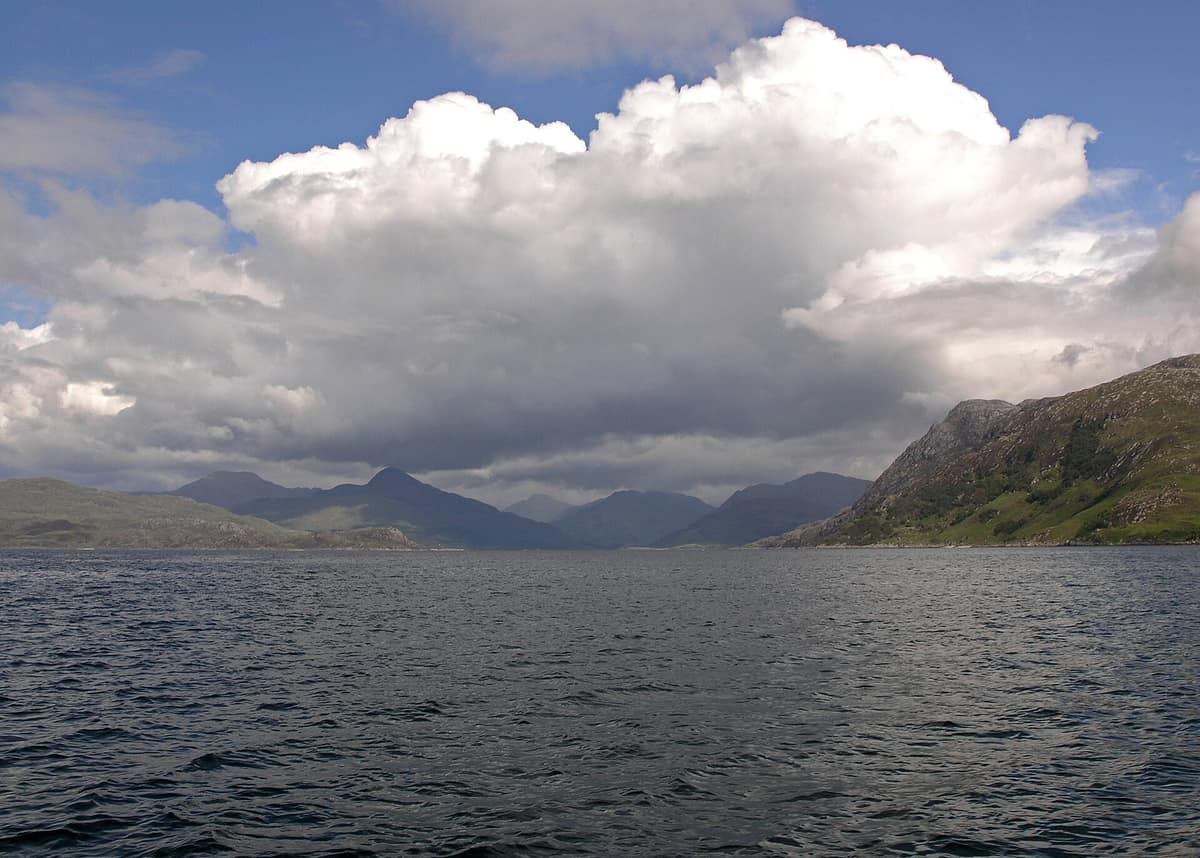
Knoydart Peninsula - Scotland's Last Great Wilderness
Knoydart
Scotland (Highlands / Mallaig / Inverie) · United Kingdom
Photo: paddy patterson from glasgow, scotland · CC BY 2.0 · Wikimedia Commons
Known as "Britain's last wilderness", a roadless peninsula dominated by Munro peaks and home to the UK's most remote pub, The Old Forge.
You cannot drive to Knoydart, and that changes everything. No public roads enter the peninsula: everyone arrives by ferry or on foot, and the seven miles of single-track tarmac within its bounds do not connect to the UK road network. Wedged between Loch Nevis and Loch Hourn in Lochaber on the west coast of Scotland, it is celebrated as the last great wilderness in Britain.
What makes it unique
Rare fragments of temperate rainforest survive in Knoydart beneath soaring peaks that rise well over a thousand metres.
The place
Nature
The landscape
Knoydart has often been described as "the Highlands of the Highlands", defined by wide glens, roaring torrents, and serene sea lochs. It is one of forty National Scenic Areas in Scotland, covering 50,696 hectares, comprising 40,201 hectares of land and 10,495 of marine waters.
The mountains rule here. The peninsula's Munros are Ladhar Bheinn (1020 m), Luinne Bheinn (939 m), Meall Buidhe (946 m), and Sgurr na Cìche (1040 m), drawing hillwalkers from across the world. Equally striking, however, are the remnants of ancient temperate rainforest—rare, moss-draped, and spectacular—which you can explore without scaling a single summit.
Around the coastal village of Inverie, where almost every visitor begins, the local community has undertaken extensive native woodland restoration. The most remarkable regeneration stands at Garsley on the northern slopes of the Corbett Sgurr Coire Choinnichean: planted in the early nineties, it has transformed into a rich, biodiverse habitat where previously only a few aged trees survived heavy deer pressure. Through the Knoydart Forest Trust, over 800,000 trees have now been planted across community and neighbouring lands.
Wildlife and seasons
Knoydart's wildlife is best appreciated at an unhurried pace. Community rangers guide wildlife walks to observe otters along Slisneach and harbour seals hauled out at Samadalan beach, tailoring itineraries to group interests ranging from coastal foraging to otter tracking.
Red deer are an integral part of this landscape's history: their high numbers once held back regeneration across the Garsley slopes when only isolated ancient trees remained. Today the foundation manages 7,000 hectares with the threefold goal of ecological restoration, community resilience, and carbon sequestration while enhancing biodiversity.
Species
With a page in the atlas
Being mentioned in a source doesn't guarantee sightings: check with the people who manage the area.
Memory and protection
History and conservation
Before the Jacobite rising of 1745, Knoydart supported a thriving population of around a thousand people. Successive waves of emigration to Canada followed, culminating in 1853 when three hundred and thirty people from the west coast were cleared aboard the vessel Sillery. In 1948, the Seven Men of Knoydart attempted a land raid to secure family crofts on the estate; though defeated in court, a commemorative cairn was unveiled at Inverie in 1981 honouring their stand for land reform.
The community-led Knoydart Foundation was established in 1997 to purchase the 7,100 hectare estate, forged through a groundbreaking partnership between local residents, the Highland Council, the Chris Brasher Trust, and the John Muir Trust.
Before you set off
Visiting
How to visit
There are three ways into Knoydart. The easiest and most popular is the passenger ferry from Mallaig to Inverie, taking about thirty to forty-five minutes; sailing timetables depend on the season and prevailing weather. The other two routes are on foot, recommended exclusively for experienced, well-equipped hillwalkers prepared for unpredictable Scottish weather. From Kinloch Hourn, a demanding 16 km walk takes between five and seven hours, representing the most frequented walking entry. From Glenfinnan, a 24 km traverse requires seven to nine hours of strenuous trekking. A third route from Loch Arkaig or Barrisdale is even more remote and arduous.
In Inverie, the ranger station stands between The Old Forge and the pier. Regular ranger-led walks explore community woodlands over two hours and a half, while private outings include historical village tours and Land Rover expeditions into the heart of Knoydart up to the Folach waterfalls. The foundation rents mountain bikes to reach Sandaig, Folach, and Inverguseran. Even a gentle half an hour stroll through village woods is deeply rewarding.
Before you go
Always verify ferry schedules and sailing conditions with the boat operator before setting out, as rough seas frequently cause cancellations. If walking in, embark only with proven wilderness experience, full mountain gear, and thorough preparation for severe Atlantic weather. Inquire with local rangers about available guided wildlife walks.
Check access, rules and visiting conditions in the official information from the managing body before you set off.
Location
Where it is and how far it reaches
Boundary of Knoydart · © OpenStreetMap contributors (ODbL) The coordinate is estimated; it isn't a verified access point.
Transparency
Sources
The research data with its sources, and the official links for this place, are in the Spanish version of this page. See the Spanish version
Around it
Around twenty-eight kilometres across the water lies the wild expanse of the Isle of Rum National Nature Reserve.
What else to explore nearby
Approximate straight-line distance between the edges of each area. It doesn't indicate access, routes or driving times.
- Isle of Rum National Nature Reserve
Scotland (Inner Hebrides / Rum / Kinloch)
About 28 km away
The largest of the Small Isles, a volcanic island reserve where a third of the world's Manx shearwater (Puffinus puffinus) population nests.
JFMAMJJASONDMay – October · Crowding very low
Entry #616 of the original atlas.