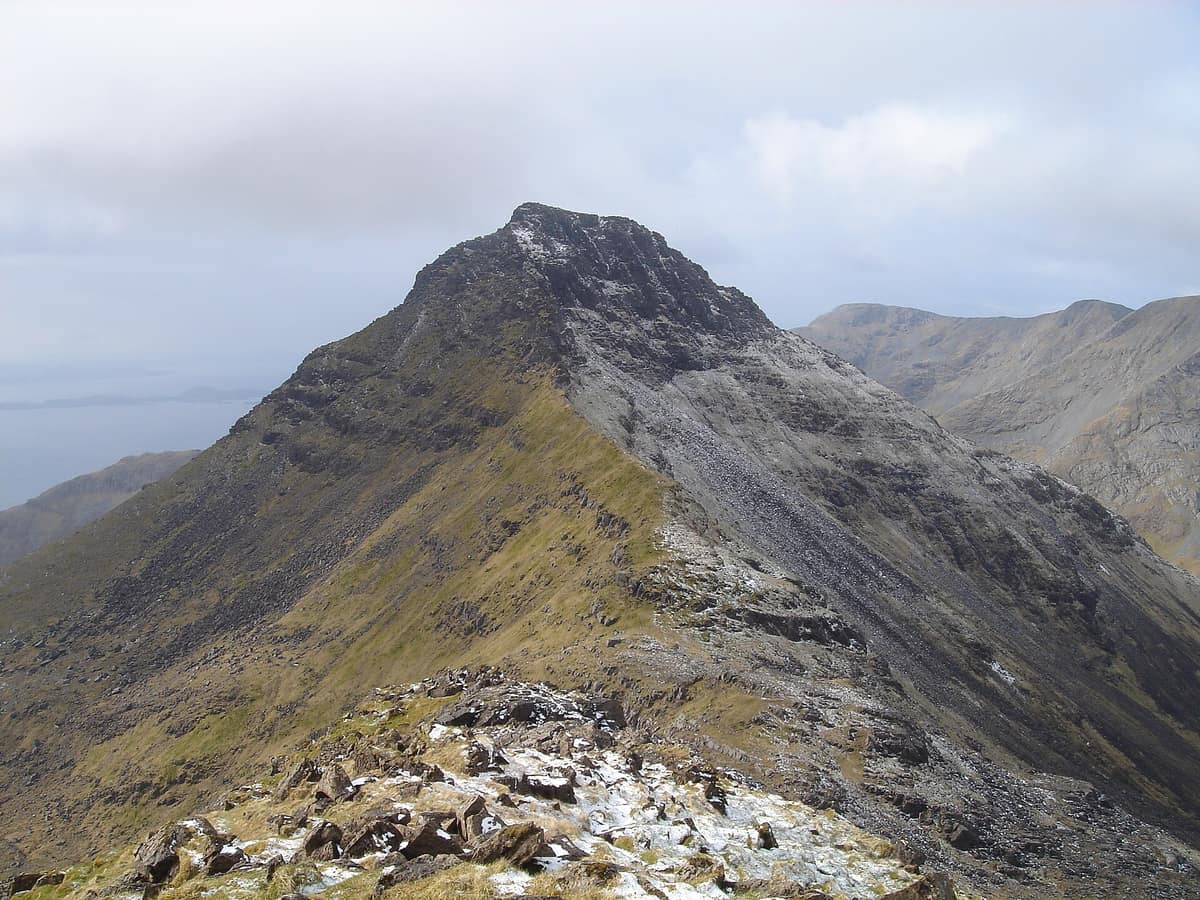
Isle of Rum National Nature Reserve
Scotland (Inner Hebrides / Rum / Kinloch) · United Kingdom
Photo: Michael Earnshaw · CC BY-SA 2.0 · Wikimedia Commons
The largest of the Small Isles, a volcanic island reserve where a third of the world's Manx shearwater (Puffinus puffinus) population nests.
Rùm is the monumental ruin of an ancient volcano. Some 60 million years ago, in the stormy dawn of the Paleogene, a fiery volcanic centre erupted here that subsequent erosion has dismantled down to its plutonic roots: an island of jagged peaks, the largest of the Small Isles, extending across 10,463 hectares. Today it is a National Nature Reserve defined by two iconic ecological hallmarks: the Manx shearwaters nesting on high mountain ridges and the red deer of Kilmory, studied by scientists for decades.
What makes it unique
A single high-mountain colony of Manx shearwaters on the island accounts for roughly thirty percent of the global breeding population.
The place
Nature
The landscape
Rùm is overwhelmingly igneous in origin. The Rum Cuillin are jagged mountains of layered gabbro, making Rùm the smallest island in Scotland to possess a mountain peak rising above 762 metres. Hallival and Askival were formed when heavy olivine and feldspar crystals settled in the magma chamber beneath an active volcano, which subsequently collapsed into a caldera. On Bloodstone Hill, volcanic gas bubbles trapped in cooling basalt lavas later crystallised into green plasma agate flecked with red jasper.
Rainfall is heavy: around 1,800 mm annually on the sheltered eastern coast and 3,000 mm over the montane heights. In this wet oceanic climate, heather moors, grasslands, maritime cliffs, and blanket mires with lochans nourish diverse ecosystems. In 1960, a native tree nursery was established at Kinloch to reintroduce twenty species of indigenous trees—including birch, hazel, rowan, and holly—and today more than a million trees thrive on the hillsides. Rare arctic-alpine flora includes arctic sandwort and alpine rock-cress, alongside 590 species of vascular plants and ferns.
Wildlife and seasons
In high summer, vast rafts of Manx shearwaters gather offshore in the evening dusk before returning to their burrows; by day they forage across open pelagic waters. They winter off southern Brazil in the South Atlantic, flying thousands of miles each spring to breed in high-altitude burrows on the Cuillin peaks.
In spring, more than ninety species of birds nest across habitats from coastal sea cliffs to rocky ridges. The white-tailed eagle was extirpated from the island in 1912; starting in 1975 it was reintroduced through the release of 82 young Norwegian eaglets over ten years, establishing a self-sustaining wild population. Resident raptors and moorland birds also include golden eagles, merlins, red-throated divers, twites, skylarks, and golden plovers.
Autumn heralds the red deer rut. Around Kilmory and Harris, researchers observe the red deer herds, subject to long-running field studies in Kilmory Glen. A 45-year study showed that climate change has altered their phenology and genetics: hinds give birth, on average, three days earlier per decade. Kilmory Glen is periodically closed to walkers during peak rutting season. A dedicated hide for observing Eurasian otters stands in woodland south of the main pier.
Species
With a page in the atlas
Being mentioned in a source doesn't guarantee sightings: check with the people who manage the area.
Memory and protection
History and conservation
The indigenous Gaelic population of over 400 people at the end of the eighteenth century was evicted during the Highland Clearances between 1826 and 1828 to transform the island into a private sporting estate. In 1957, the Nature Conservancy Council purchased Rùm on the strict condition that it remain a National Nature Reserve. Designated an SSSI in 1987, it encompasses seventeen scheduled ancient monuments. NatureScot manages the island and anchors its small community economy.
Hardy domestic and feral animals roam the island: small herds of Rum ponies, feral goats, and Highland cattle; the indigenous ponies bear primitive dorsal eel-stripes and zebra barrings on their legs. The sole native amphibian is the palmate newt and the only native reptile the viviparous lizard.
Before you set off
Visiting
How to visit
Travellers reach Rùm by ferry from Mallaig; the Caledonian MacBrayne passenger vessel links the Small Isles with the mainland. The most renowned hiking routes are the Rum Cuillin traverse, one of Scotland's classic mountain expeditions, and the gentle Coire Dubh Trail, an accessible circuit to discover reserve habitats in limited time.
Human history stretches into deep antiquity: at Farm Fields near Kinloch, archaeologists unearthed charred Mesolithic hazelnut shells dating back to 7700-7500 BC, representing some of the oldest evidence of human presence in Scotland. In 1900, the wealthy industrialist Bullough family erected eccentric Kinloch Castle.
Before you go
The island is isolated and experiences high rainfall, so oceanic mountain weather rules supreme. Coordinate with ferry timetables well in advance and consult NatureScot regarding local access advice, especially across Kilmory Glen during the autumn red deer rut.
Check access, rules and visiting conditions in the official information from the managing body before you set off.
Location
Where it is and how far it reaches
Boundary of Rùm · © OpenStreetMap contributors (ODbL) The coordinate is estimated; it isn't a verified access point.
Transparency
Sources
The research data with its sources, and the official links for this place, are in the Spanish version of this page. See the Spanish version
Around it
Just 6 km away lies Canna, while roughly 28 km to the east on the Scottish mainland lies the Knoydart Peninsula - Scotland's Last Great Wilderness.
What else to explore nearby
Approximate straight-line distance between the edges of each area. It doesn't indicate access, routes or driving times.
- Isle of Canna
Scotland (Inner Hebrides / Small Isles)
About 6 km away
Owned by the National Trust for Scotland, famed for Compass Hill, a basalt hill containing magnetite that distorts passing ship compasses.
JFMAMJJASONDMay – September · Crowding very low
- Knoydart Peninsula - Scotland's Last Great Wilderness
Scotland (Highlands / Mallaig / Inverie)
About 28 km away
Known as "Britain's last wilderness", a roadless peninsula dominated by Munro peaks and home to the UK's most remote pub, The Old Forge.
JFMAMJJASONDMay – October · Crowding very low
Entry #615 of the original atlas.