Liesjärvi National Park
Kanta-Häme (Tammela / Somero) · Finland
Photo: Markus Rantala ( Makele-90 ) · CC BY-SA 3.0 · Wikimedia Commons
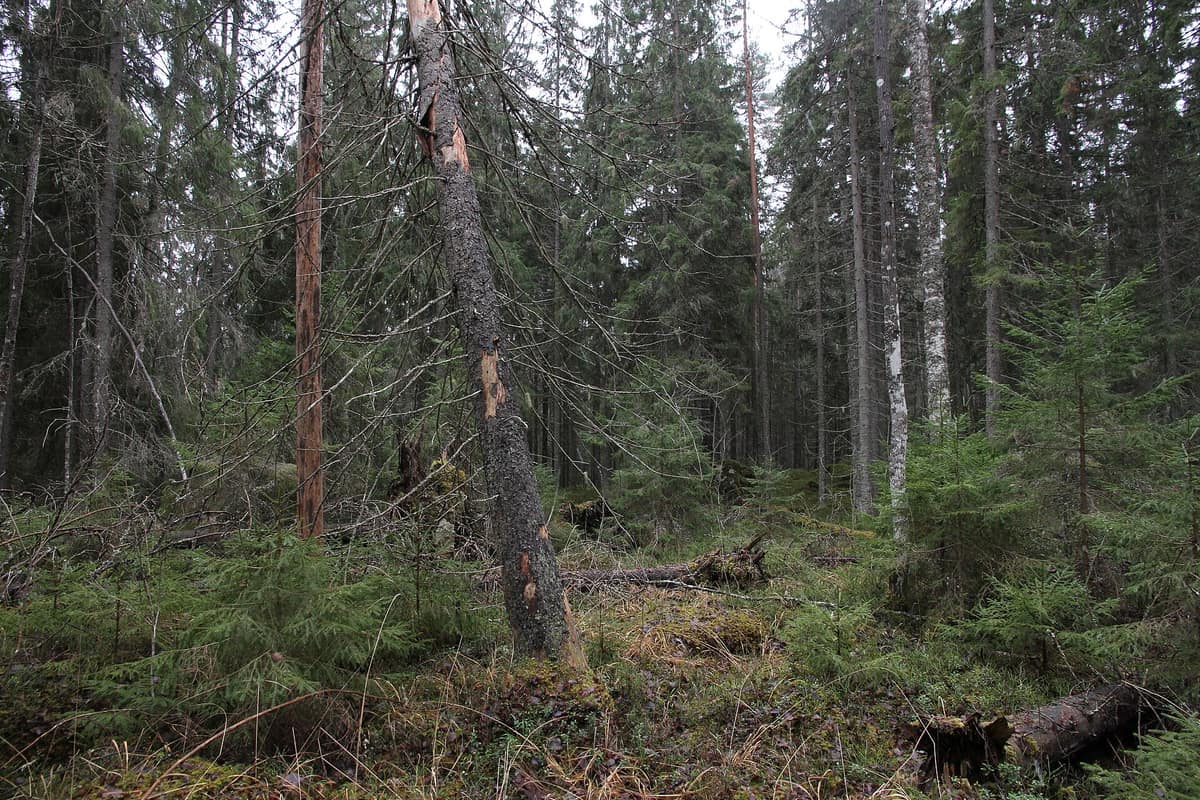
Century-old boreal taiga featuring the narrow Kyynäränharju esker ridge meandering like a natural causeway between two lakes.
A sandy causeway barely one kilometre long, flanked on either side by open water. Such is the defining portrait of Liesjärvi: a compact national park in southern Finland's Häme region preserving century-old spruce forests, quiet peatlands, pristine shorelines, and a heritage crown forester's farm operating almost exactly as in 1910. Established in 1956, it ranks among Finland's earliest national parks.
What makes it unique
An Ice Age esker serves as a natural bridge between two lakes beside old-growth woods and a heritage farm functioning as in 1910.
The place
Nature
The landscape
Glacial meltwater forged this terrain. The park's esker ridges took shape at the close of the Ice Age, and its most famous feature, Kyynäränharju, traces the path of retreating glacial currents. It forms a slender sandy spit nearly one kilometre in length dividing Lake Kyynäräjärvi from Lake Liesjärvi. Only a narrow channel connects the waters, crossed by walkers via a small timber bridge. Natural sand spits and labyrinths of wooded islands represent core conservation priorities.
Surrounding the lakes is dense boreal taiga. The predominant woodland type, accounting for nearly half the wooded acreage, is bilberry and lingonberry spruce forest. Many stands exceed a century in age, with veteran trees in untouched reserves reaching one hundred and eighty years. The primeval sanctuaries of Ahonnokka and Isosaari have been protected since the nineteen-twenties. Peatlands, mires, and nearly fifty kilometres of shoreline complete the setting. Previously logged stands are actively restored toward a natural state.
Wildlife and seasons
Old-growth timber and copious snags support cavity-nesting birds. Woodpeckers include the black woodpecker, great spotted woodpecker, Eurasian three-toed woodpecker, grey-headed woodpecker, and lesser spotted woodpecker. At night, listen for the calls of the boreal owl and the deep hooting of the Eurasian eagle-owl, while red-throated divers call across the lakes. Swallows dart above Korteniemi.
The park's elusive flagship mammal is the nocturnal Siberian flying squirrel. Though rarely glimpsed, it leaves yellow droppings beneath cavity-riddled aspens and tell-tale nibbled leaves. Stately lakeside aspens provide ideal nesting holes from which the squirrel glides more than fifty metres between tree trunks.
Spring brings the holly blue butterfly (Celastrina argiolus), virtually the sole blue-winged butterfly active so early, chosen as Finland's national butterfly in 2017. Later, on Korteniemi meadows and sunlit esker trails, wanders the flightless violet oil beetle. Meadows host maiden pinks, mountain everlasting, and bladder campion, while heritage fields bloom with cornflowers.
A vital seasonal rule applies: from 15 April to 15 July landing on sensitive nesting islets and entering the Tervalamminsuo mire sanctuary is prohibited.
Species
With a page in the atlas
Being mentioned in a source doesn't guarantee sightings: check with the people who manage the area.
Memory and protection
History and conservation
Human presence dates from the Stone Age, followed by slash-and-burn farming and tar production. In 1878, the Finnish state acquired the territory and appointed a crown forester to guard royal woods. The Korteniemi farmstead remains the historical heart of the park, preserved to safeguard agrarian heritage, where heritage rye is still cultivated with traditional methods.
In 2005, the park nearly doubled in area through the addition of surrounding mires and old-growth forest reserves.
Before you set off
Visiting
How to visit
Liesjärvi is best explored on day walks. The park network comprises some thirty kilometres of well-marked circular loops between 1,5 and 5 kilometres on easy terrain. Trails traverse the Ahonnokka virgin grove, the Kyynäränharju ridge, mossy spruce taiga, and sunny pine heaths.
For longer adventures, the trails connect with the Hämeen Ilvesreitti (Lynx Trail), extending over two hundred kilometres for multi-day backpacking treks. Designated campsites and open wilderness shelters include Peukaloinen lean-to, Kaksvetinen hut, and the Savilahti camping meadow. Walking, skiing, rowing, and canoeing are unrestricted outside seasonal bird sanctuaries, though no groomed ski tracks exist.
The highlight is Korteniemi Heritage Farm, southern Finland's sole surviving crown forestry smallholding with intact historic timber buildings. Open from May to early October, visitors can meet heritage farm staff and participate in traditional chores. Native sheep and cattle graze the paddocks, keeping the historical landscape open.
Before you go
Keep dogs on leashes at all times: pets are welcome but must remain leashed. There are no refuse bins or recycling stations, so carry out all rubbish. Open campfires are restricted to official fire rings with provided firewood; during forest fire warnings, all outdoor fires are prohibited except inside cooking shelters with flues like Tittilammi and the Kaksvetinen hut. Review park regulations on the official website before visiting.
Check access, rules and visiting conditions in the official information from the managing body before you set off.
Location
Where it is and how far it reaches
Boundary of Liesjärven kansallispuisto · IUCN II · © EEA, CDDA (CC-BY) The coordinate is estimated; it isn't a verified access point.
Transparency
Sources
The research data with its sources, and the official links for this place, are in the Spanish version of this page. See the Spanish version
Around it
Liesjärvi lies along national highway 2, less than one hundred kilometres from the Helsinki metropolitan area. Across northern latitudes, it shares the Siberian flying squirrel and primeval spruce woods with Alutaguse National Park and Syöte National Park in Finland.
If you like this place, elsewhere in Europe
Distant places with uncommon wildlife and habitats in common. The most widespread species don't count. Sharing species doesn't imply a corridor or guaranteed presence.
- Boubín Primeval Forest
South Bohemia (Vimperk / Šumava)
In common: Aegolius funereus · Three-toed woodpecker · Black woodpecker
A virgin forest reserve designated in 1858 to rescue its 400-year-old firs and beeches from commercial exploitation.
JFMAMJJASONDMay – October · Crowding low
Entry #598 of the original atlas.