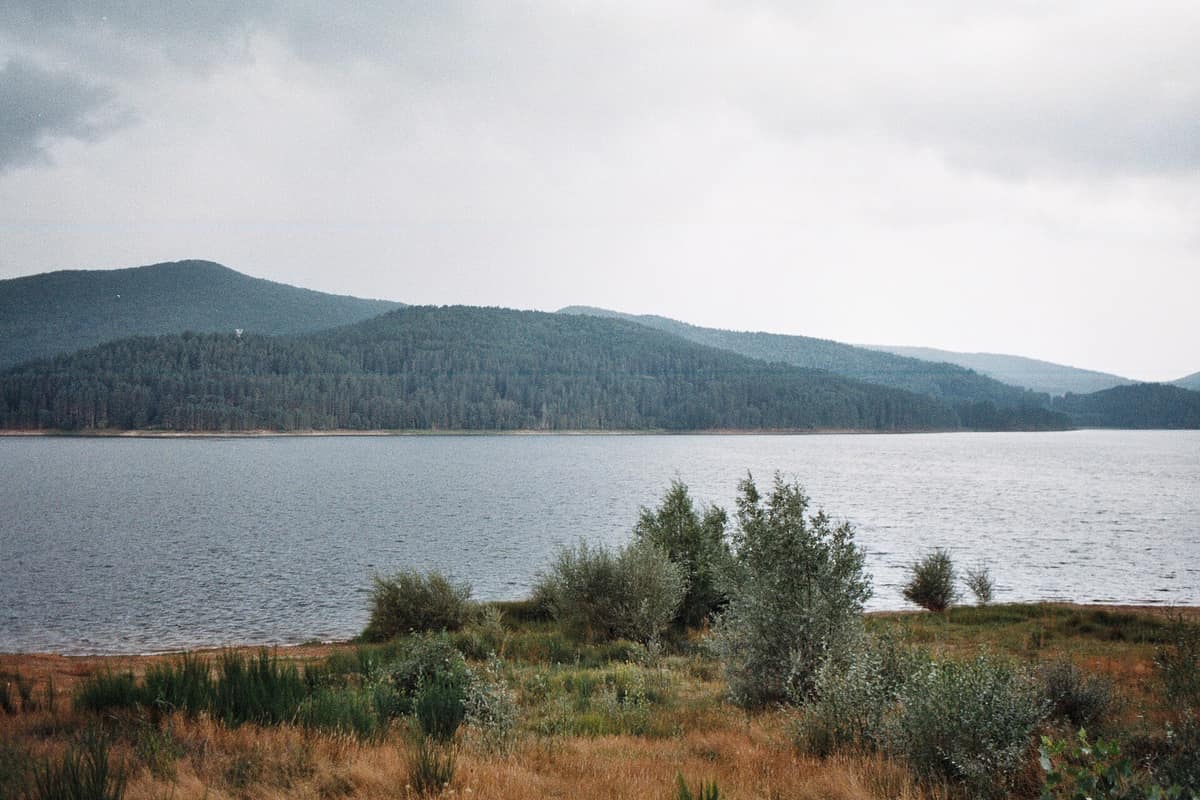
Sila National Park
Parco Nazionale della Sila
Calabria (Cosenza / Catanzaro / Crotone / Camigliatello Silano / Lorica) · Italy
Photo: Ugo Leonetti · CC BY-SA 4.0 · Wikimedia Commons
The 'Great Forest of Italy', a colossal highland plateau of centuries-old Corsican pine (Pinus nigra laricio) and giant inland lakes Cecita and Arvo.
There are mountains that evoke an entirely different land. In the heart of Calabria, the Sila resembles the Alps so closely in its granite structure that in 1898 it was dubbed the «Calabrian Alps». Sila National Park encompasses 73.695 hectares of this wild upland territory, headquartered in Lorica, distinguished by a striking metric: it is the Italian national park with the highest percentage of forest cover, nearly 80 % of its total area.
What makes it unique
Here the Calabrian black pine, «king of the Sila woods», outcompetes the beech, and beneath its canopy live wolves, red deer, and an endemic black-furred squirrel.
The place
Nature
The landscape
The Sila is an ancient highland massif with a crystalline core of granites and metamorphic rocks, structurally akin to the Alps. Its highest apex is Monte Botte Donato, rising to 1.929 metres. The park spans all three historical sectors of the plateau: Sila Greca, Sila Grande, and Sila Piccola; Sila Grande is the most expansive, holding the highest summits and the largest artificial reservoirs.
The lakes are twentieth-century creations built during the first half of the century. Three of them—Ampollino, Arvo, and Ariamacina—lie within the national park. Across the plateau run the Crati and Neto, the two longest and most vital rivers of Calabria.
Vegetation arranges into distinct altitudinal belts. Between 1.100 and 1.600 metres dominates almost exclusively the Calabrian black pine (Pinus nigra laricio). Above 1.400 metres beech appears, often alongside silver fir, while damp depressions foster relict peat bogs harbouring plant species that migrated south during Pleistocene glaciations. The pine forests thrive on sandy, acidic granitic soils where this hardy conifer easily outcompetes beech.
Wildlife and seasons
The wolf is the proud symbol of the national park, with an estimated three packs and between 15 and 20 individuals roaming the plateau. Red deer vanished early in the twentieth century and were successfully reintroduced in the nineteen-eighties in the Golia-Corvo reserve. Through the forest canopy scurries the southern black squirrel, the iconic arboreal rodent of these mountains, often venturing into village parks.
For birdwatchers, the park records 113 avian species, 57 of which are of high conservation priority. Northern goshawk, Eurasian sparrowhawk, common buzzard, and kites hunt overhead; among woodpeckers, the black woodpecker stands out as the keystone forest species. Since the winter of 2016, ornithologists have documented wintering black storks, an exceptional biological phenomenon. Among smaller fauna, the park shelters 12 amphibian and 10 reptile species of herpetological interest, including the Apennine yellow-bellied toad.
Species
With a page in the atlas
Being mentioned in a source doesn't guarantee sightings: check with the people who manage the area.
Memory and protection
History and conservation
The history of the Sila is one of a long-contested woodland. From the late eighteenth century, private encroachers seized public commons and cleared ancient woods for agriculture, leading peasants to perceive the forest as a competitor for arable land and provoking intentional wildfires. The first proposal for a national park arose in 1923, though formal establishment did not occur until 14 November 2002. Previously, the historic Calabria National Park had protected three separated forest sectors.
Today the park encompasses nine state biogenetic nature reserves; Fallistro protects the ancient Giganti della Sila, and Golia-Corvo provides a sanctuary for red deer. In rural valleys, ancestral transhumance remains actively practised. UNESCO also designated the Sila as Italy's tenth Biosphere Reserve.
Before you set off
Visiting
How to visit
The most comprehensive gateway is the Cupone Visitor Centre near Lake Cecita, close to Camigliatello Silano. It functions as an open-air eco-museum featuring nature trails, wildlife observatories, a geological garden, and a fully accessible botanical garden, with an adjacent enclosure for fallow deer. Another major hub is Centro Visite A. Garcea near Villaggio Mancuso, while in Cotronei the Museum of Water and Energy explains the park's cultural and natural heritage through interactive exhibits. Facilities also include nature classrooms, a native biodiversity nursery, and rehabilitation enclosures for wolf, deer, roe deer, and eagle-owl.
The trail network totals 600 kilometres, featuring 66 primary paths, 51 secondary routes, and five sections of the Sentiero Italia. An ideal introductory walk is the Sentiero dei Caprioli, a five-hour loop traversing Fossiata, Lake Cecita, and Cozzo del Principe through pristine core habitats. Park managers recommend it in July and August. In the Cecita valley stands the «Patriarca della Sila», an immense silver fir measuring over six metres in basal circumference, one of the oldest living trees in the park. The official Natura Italia portal and mobile app detail distances, elevations, and durations for all trails.
Before you go
Check trail conditions and visitor centre opening times before travelling. Use Natura Italia, the official park portal, to select routes suited to your fitness and schedule.
Check access, rules and visiting conditions in the official information from the managing body before you set off.
Location
Where it is and how far it reaches
Boundary of Parco nazionale della Sila · IUCN II · © EEA, CDDA (CC-BY) The coordinate is estimated; it isn't a verified access point.
Transparency
Sources
The research data with its sources, and the official links for this place, are in the Spanish version of this page. See the Spanish version
Around it
The Sila has no immediate neighbouring atlas entries, but shares ancient fauna with distant parks: it shares the black woodpecker and grey wolf with Aspromonte National Park in southern Calabria, and with the Muniellos Reserve in northern Spain.
If you like this place, elsewhere in Europe
Distant places with uncommon wildlife and habitats in common. The most widespread species don't count. Sharing species doesn't imply a corridor or guaranteed presence.
- Rodna Mountains National Park
Bistrița-Năsăud and Maramureș Counties (Pietrosu Rodnei)
In common: Black woodpecker · Black stork — old-growth forest, high mountain
The highest glacial mountains in the Eastern Carpathians hosting the Pietrosu Rodnei scientific reserve.
JFMAMJJASONDJune – October · Crowding low
- Strâmbu-Băiuț Primeval Forest
Maramureș County
In common: Black woodpecker · Black stork · Grey wolf
Continuous virgin beech forest of the Northern Carpathians designated as a UNESCO World Heritage site.
JFMAMJJASONDMay – October · Crowding very low
Entry #554 of the original atlas.