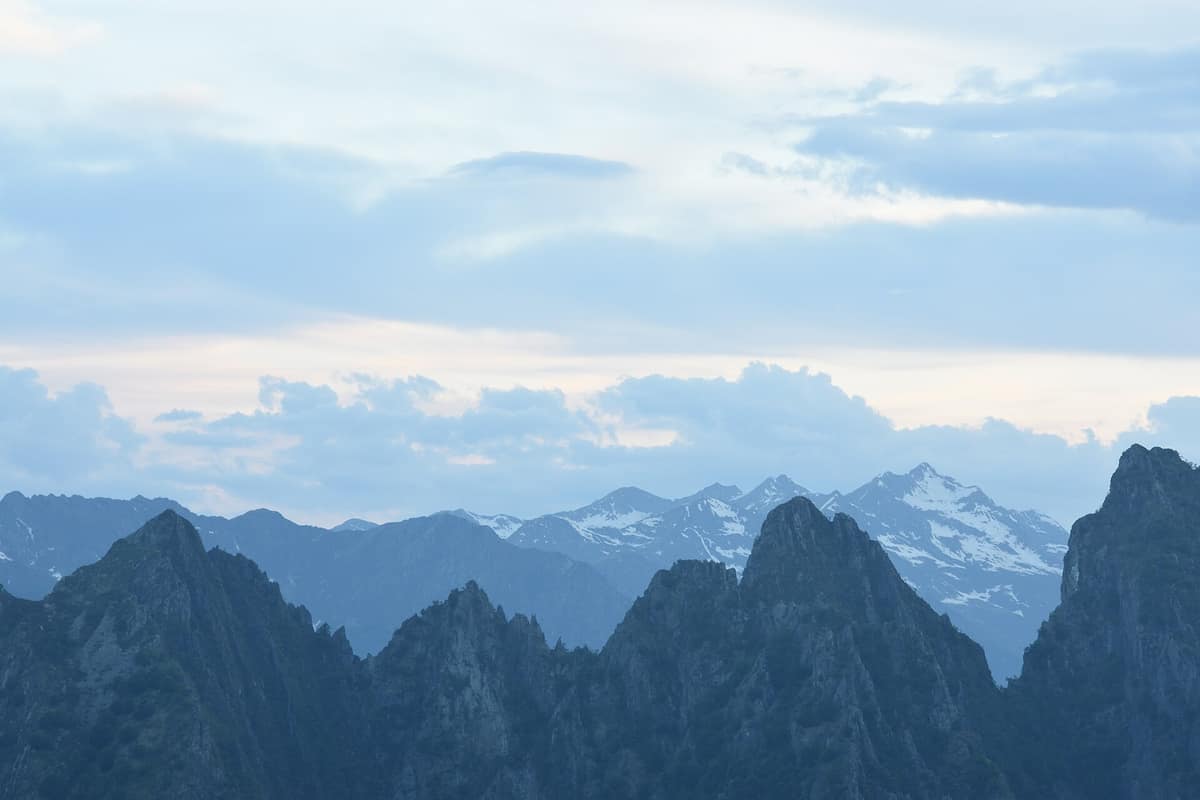
Val Grande National Park
Parco Nazionale della Val Grande
Piedmont (Verbania / Lake Maggiore / Malesco / Santa Maria Maggiore) · Italy
Photo: Mazzaloris95 · CC BY-SA 4.0 · Wikimedia Commons
The largest wilderness area in the Alps and Italy, an impenetrable canyon valley fully reclaimed by wild nature.
There is a hidden pocket in the Alps where the sole inhabited hamlet can only be reached on foot via a mule track, or by a road so tortuous and narrow that it takes 14 km from Verbania. That village is Cicogna, the «little capital» of Val Grande National Park, surrounding which stretches the largest wilderness territory in the Alps and in Italy. It is not pristine primeval nature, but rewilded nature: once home to alpine pastures, lumbering, and stonework, when people left, the forest recaptured the valleys.
What makes it unique
The most expansive wilderness territory in the Alps, born because human inhabitants departed and nature reclaimed what was rightfully hers.
The place
Nature
The landscape
The park protects 17.021 hectares in Piedmont, encompassing the entirety of Val Grande and its lateral tributary Val Pogallo. The two torrents that name the valleys, the Valgrande and Pogallo, cut sheer gorges through hard crystalline bedrock, rising and falling precipitously after rains. Only a few historic stone and iron bridges survive from the old trail network; without them, the mountain torrents would form impassable barriers.
Beneath your boots lies rare geology: Val Grande exposes exclusively metamorphic rocks, featuring the Alps' most extensive surface outcropping of deep continental crust, known as the Ivrea-Verbano Zone. Distinctive peaks such as Pedum, Proman, Corni di Nibbio, Cima Sasso, and Cima della Laurasca are composed of dark, greenish-black, ultra-hard stones: amphibolites, serpentinites, and peridotites.
The vegetation records this human retreat. Forests are comparatively young and dense, dominated by low-montane species like sweet chestnut, beech, and hazel. This young forest took over as abandoned high pastures and cleared slopes returned to natural succession.
Wildlife and seasons
With human presence virtually absent, wildlife has recolonized naturally. Birds include golden eagle, peregrine falcon, short-toed snake eagle, black grouse, hazel grouse, and Eurasian eagle-owl, alongside forest specialists like black woodpecker. Ungulates—chamois, roe deer, red deer, and wild boar—maintain healthy breeding herds, while smaller carnivores feature red fox, stone marten, pine marten, European badger, and least weasel. River torrents shelter brown trout, bullhead, white-throated dipper, and grey wagtail. Notable invertebrates include the endemic ground beetle Carabus lepontinus on the flanks of Monte Zeda and the strictly protected Rosalia alpina.
Apex predators have also returned. The grey wolf disappeared from northern Italy around 1920, beginning its return during the sixties and seventies from the Apennines into the Alps; the first stable packs near Verbania were confirmed in 2019, with resident status in Val Grande verified in 2022. The park also records a single wandering brown bear, first detected in 2019 and catalogued as M29. Lynx, otter, wildcat, and European polecat remain absent, though their natural return is anticipated.
Species
With a page in the atlas
Being mentioned in a source doesn't guarantee sightings: check with the people who manage the area.
Memory and protection
History and conservation
The history of Val Grande is a sequence of human exploitations. In the fourteenth century, the pink marble quarries of Candoglia began supplying the Duomo in Milan, triggering heavy timber logging across the valley. In the early twentieth century, logging in the remote woods of Pogallo turned its high alpe into a bustling logging village. In July 1944 the valley sheltered anti-fascist partisans: a brutal Nazi-fascist roundup left some 300 dead and 208 stone cabins burned.
The national park was established in 1992, expanded in 1998 and 2023, with headquarters in Vogogna. It encompasses two historic 1971 nature reserves: the strict integral reserve of Val Grande (973 hectares) and the guided reserve of Monte Mottac (2.410 hectares). Since 2018 it has been incorporated into the UNESCO Ticino Val Grande Verbano Biosphere Reserve.
Before you set off
Visiting
How to visit
The wild heart of the park lies in its deepest interior, guarded by a ring of summits. Reaching it demands several hours of vigorous walking and reliable fitness, as interior trails are rugged and unwaymarked. For this reason the park urges caution and recommends certified wilderness guides. Novice hikers should begin with the Sentieri Natura, self-guided paths of moderate grade.
Two nature trails depart from Cicogna: «La civiltà della fatica» climbs to Alpe Prà and Leciuri in about two and a half hours one way, winding past dry-stone terraces, veteran chestnuts, and rock carvings, guided by eight panels, four lecterns, and twenty observation points. «All'ombra degli abeti» connects Cappella Porta with Pian Cavallone with eight interpretive panels, recommended from April to November. A gentler walk of an hour and a half reaches Pian Cavallone from Gabbio with 430 metres of ascent.
For summit panoramic views, Monte Zeda and Pizzo Marona above Lake Maggiore can be climbed in a moderately demanding day trip. In contrast, the knife-edge ridge from Casa dell'Alpino to Bocchetta di Campo is strictly for experienced mountaineers.
For multi-day treks, unstaffed wilderness bivouacs (bivacchi) remain open year-round: each offers a wood stove, cookware, and wooden bunks, requiring visitors to bring sleeping bags and food. Dogs are permitted if kept strictly on a leash.
Park visitor centres explain the territory at each entrance: four visitor centres, two museums, and a geological laboratory. Cicogna offers interactive exhibits on Val Grande; Intragna introduces the Terre di Mezzo and mountain life; and the Soapstone Archaeological Museum in Malesco highlights ancient quarrying from prehistoric to Roman times. The park also runs guided outings, educational workshops, and volunteer conservation camps.
Before you go
Wild camping is prohibited: for overnight stays, use open bivouac shelters; if full, a small tent may be pitched alongside from dusk to dawn. The park operates no weather stations or snow reports; consult local forecasts and regional avalanche bulletins. Verify visitor centre opening times before heading into the mountains.
Check access, rules and visiting conditions in the official information from the managing body before you set off.
Location
Where it is and how far it reaches
Boundary of Parco nazionale della Val Grande · IUCN II · © EEA, CDDA (CC-BY) The coordinate is estimated; it isn't a verified access point.
Transparency
Sources
The research data with its sources, and the official links for this place, are in the Spanish version of this page. See the Spanish version
Around it
At 29 km sits Landschaftspark Binntal.
What else to explore nearby
Approximate straight-line distance between the edges of each area. It doesn't indicate access, routes or driving times.
- Binntal Nature Park
Valais (Binn / Ernen)
About 29 km away
Alpine valley in Valais world-renowned for its extraordinary diversity of rare minerals.
JFMAMJJASONDJune – October · Crowding low
Entry #535 of the original atlas.