Bory Tucholskie National Park
Park Narodowy Bory Tucholskie
Pomeranian Voivodeship (Charzykowy) · Poland
Photo: MOs810 · CC BY-SA 4.0 · Wikimedia Commons
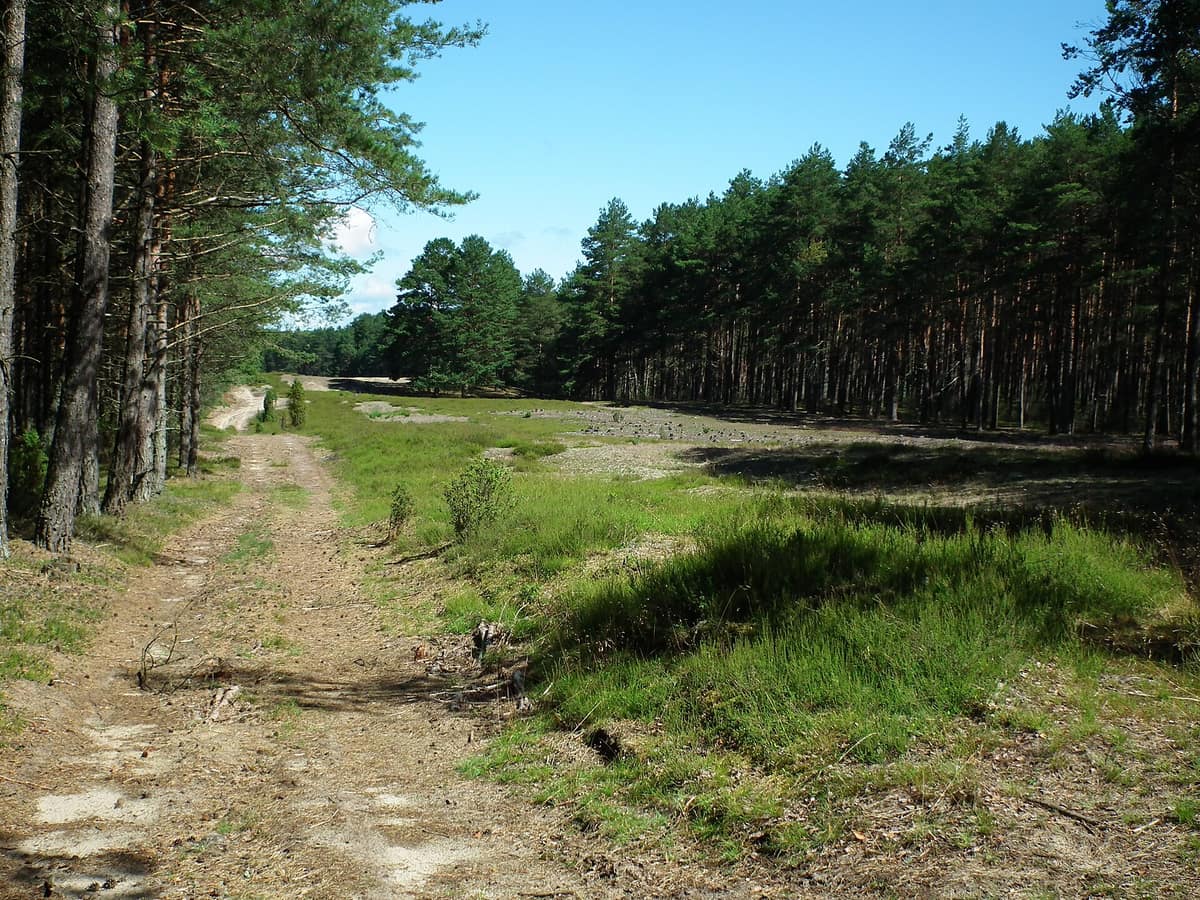
A vast expanse of Scots pine forests on outwash sands with lobed lakes of crystal-clear water.
During the autumn migration, up to 2,300 common cranes gather at Lake Ostrowite, a spectacle that captures the essence of this protected sanctuary: a compact park of pellucid lakes and pine woodlands tucked inside Bory Tucholskie, the largest forest complex in Poland. Bory Tucholskie National Park was established in 1996 and encompasses 4613.04 ha in the northern part of the country, within Chojnice County.
It is not an expansive park, and it was nearly created on an even smaller footprint. An initial proposal envisioned 130 km², but negotiations with local communities agreed to delimit its boundaries around the basin of the Struga Siedmiu Jezior, the Stream of Seven Lakes. Since 2010 it forms the core zone of the UNESCO-designated Bory Tucholskie Biosphere Reserve.
What makes it unique
In its clear Lobelia lakes grows water lobelia alongside botanical rarities as exceptional as Isoëtes lacustris and Luronium natans.
The place
Nature
The landscape
Everything stems from glacial ice. The Scandinavian ice sheet sculpted the terrain, leaving an outwash sandur plain interrupted by dunes and kettle basins. The lakes are elongated, narrow, and arranged in chain-like channels, the longest extending for 17 km. Within the park lie 21 lakes; the largest and deepest is Ostrowite, while seven are linked together by the Struga Siedmiu Jezior, a tranquil 13.9 km stream.
Four of these basins—Wielkie Gacno, Małe Gacno, Nierybno, and Głuche—are Lobelia lakes: an extraordinarily rare oligotrophic freshwater habitat characterized by transparent waters where water lobelia thrives, known in Poland from just 130 lakes across Pomerania. Alongside it grow Isoëtes lacustris, Isoëtes echinospora, Litorella uniflora, Myriophyllum alterniflorum, and Luronium natans.
Surrounding the waters, forest blankets some 3800 ha, nearly 83 % of the park's territory, and 98 % of these wooded habitats consist of pine stands. While soils are nutrient-poor and acidic, biodiversity is surprisingly high: 634 species of vascular plants, 33 % of all lichens recorded across Poland, and 483 species of fungi.
Wildlife and seasons
Faunal statistics reflect an aquatic ecosystem: 252 vertebrates and 1,686 invertebrates. In the lakes linked by the stream live 28 fish species; records include amphibians (11 species), reptiles (5), and 37 mammal species. Invertebrate diversity features 42 species of butterflies, 17 ant species, and 45 species of dragonflies. The waters also harbour weatherfish and European bitterling (różanka), both enjoying partial protection.
Avian life represents the true highlight of the calendar. A total of 130 bird species have been recorded, 98 of them breeding within the park. Ostrowite, Płęsno, and Skrzynka serve as crucial resting, feeding, and moulting stations during spring and autumn passages, and during autumn migration the common crane gathers in congregations reaching up to 2,300 individuals on Ostrowite. Nocturnal raptors include Eurasian eagle-owl, Eurasian pygmy owl, tawny owl, and boreal owl; waterfowl feature whooper swan, common teal, bean goose, and smew, alongside white-tailed eagle and western marsh harrier.
The wolf has been recolonizing the area since 2010. The western capercaillie, however, immortalized in the park's emblem, no longer inhabits the territory.
Species
With a page in the atlas
Being mentioned in a source doesn't guarantee sightings: check with the people who manage the area.
Memory and protection
History and conservation
A total of 7 % of the park enjoys strict protection across 10 designated reserves, only two of which may be entered by the public: Małe Gacno and Kacze Oko.
Before you set off
Visiting
How to visit
The park maintains educational interpretive trails, each highlighting a distinct ecological aspect. The red trail at Łąki Józefowskie covers a 5.3 km circuit that takes about two and a half hours to walk. The blue trail at Piła Młyn features thirteen interpretive stops spanning lichens, lake ecology, and conservation measures for birds, bats, and amphibians. A botanical path adjacent to park headquarters introduces regional flora and is fully accessible to wheelchair users. Meanwhile, the green trail at Wielkie Gacno illustrates sand dune succession, ecotones, and lake morphology.
The Park Nature Education Centre is located in Chociński Młyn, while administrative headquarters reside in Charzykowy, 3 km outside Chojnice.
Before you go
May to October offers the most rewarding conditions. Trails feature sandy footpaths and uneven terrain with protruding tree roots, making sturdy footwear advisable. Before setting out, check access regulations on the managing authority's website.
Check access, rules and visiting conditions in the official information from the managing body before you set off.
Location
Where it is and how far it reaches
Boundary of Park Narodowy Bory Tucholskie · © EEA, CDDA (CC-BY) The coordinate is estimated; it isn't a verified access point.
Transparency
Sources
The research data with its sources, and the official links for this place, are in the Spanish version of this page. See the Spanish version
Around it
Far to the west, The Flow Country — Caithness and Sutherland Peatlands shares with Bory Tucholskie freshwater lochs supporting Myriophyllum alterniflorum and water lobelia.
If you like this place, elsewhere in Europe
Distant places with uncommon wildlife and habitats in common. The most widespread species don't count. Sharing species doesn't imply a corridor or guaranteed presence.
- The Flow Country — Caithness and Sutherland Peatlands
Scotland (Caithness and Sutherland — Forsinard)
In common: Lobelia dortmanna · Myriophyllum alterniflorum — lake
Europe's largest blanket bog expanse, World Heritage site since 2024: an intricate expanse of pool complexes and sphagnum moss locking up carbon since the last Ice Age.
JFMAMJJASONDMay – July · Crowding none
Entry #106 of the original atlas.