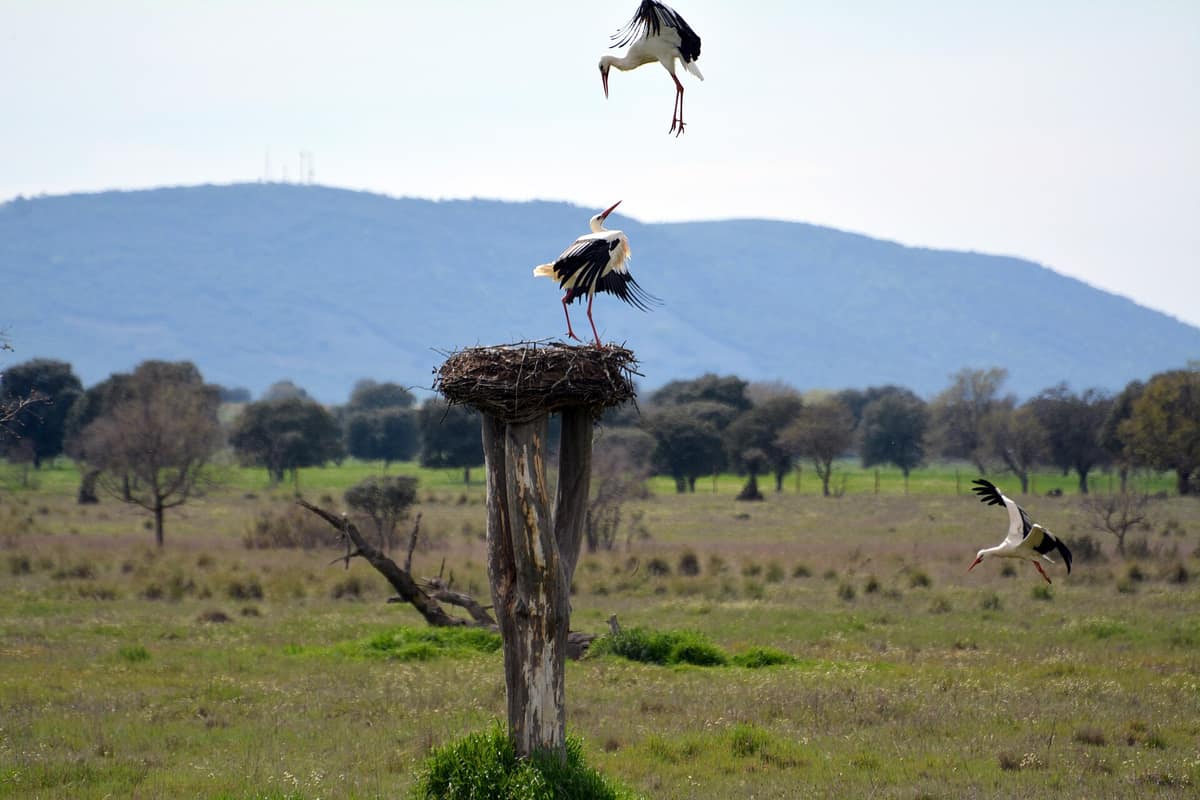
Cabañeros National Park
Parque Nacional de Cabañeros
Castilla-La Mancha (Ciudad Real / Toledo / Navas de Estena / Retuerta del Bullaque) · Spain
Photo: FrDr · CC BY-SA 4.0 · Wikimedia Commons
Open rañas, Mediterranean forested mountain ranges, and riverbanks where you can discover the habitats of the red deer, cinereous vulture, and Spanish imperial eagle.
In autumn, across a sparsely wooded plain in the Montes de Toledo, male deer clash during the rut while you watch them from a distance. That scene epitomises Cabañeros. The national park, lying between Ciudad Real and Toledo, combines open rañas, Mediterranean forested mountain ranges, and river channels, with each environment inviting a distinct way of exploring: watching wildlife from afar, walking beneath ancient tree canopies, or searching rocky strata for traces of a primeval ocean.
What makes it unique
The open raña and the forested mountain ridges together tell the story of how geology and human practices shaped the Mediterranean woodland.
The place
Nature
The landscape
One must journey back to a primeval sea. Sediments accumulating on that ancient ocean floor endured intense compression from colliding tectonic plates; they folded, fractured, and were pushed up to the surface. From this process arose the mountain ranges. Resilient quartzite shapes elevated ridges and pedrizas: boulder slopes formed from fragments broken loose by past freeze-thaw cycles.
At the foot of the mountains, a different process unfolded. During cold, arid epochs, torrential flash floods and mudflows laid down vast sheets of detritus across immense plains: the rañas.
The tree canopy is dominated by four Quercus species, slow-growing trees with broad crowns, each claiming its niche according to water availability. The holm oak is best suited to drought; the Portuguese oak and cork oak favour slightly more humid areas; the Pyrenean oak demands the most moisture, thriving along watercourses or higher slopes. The most widespread woodlands are holm oak woods, cork oak groves, gall oak stands, and Pyrenean oak forests, flanked by riparian gallery woods along river courses. Rockrose and heather scrub represents the most common understorey, while hillsides host strawberry trees, laurestine, rosemary, heather, and cistus alongside the trees.
The climate governs everything else: summer drought, occasional winter snowfall, and variable precipitation in spring and autumn, yielding 550-600 mm annually. Water gives the park a distinct character. There are around 40 km of perennial rivers and about a thousand temporary streams, flowing toward the Tagus or the Guadiana; the Bullaque bounds the park to the east and the Estena to the west, both feeding the Guadiana. In certain valley bottoms, relic peat bogs persist from earlier epochs, supporting sweet gale and carnivorous plants such as sundew and butterwort.
The botanical variety reflects this history: over a thousand vascular plant species and nearly 550 lichen species, accounting for a fifth of all species recorded in the Iberian Peninsula. This richness stems above all from the pristine conservation status of the park's 17 habitats of community interest and the absence of airborne pollutants.
Wildlife and seasons
The raña is the great stage for red deer: large maternal nursery herds in spring and, come autumn, ferocious clashes between stags during the rut. Observe them from afar. In the first light of dawn, sounders of wild boars withdraw into thickets. Near dusk, the black-winged kite takes over from the common kestrel and lesser kestrel, hunting rodents across open ground.
The open plain also shelters steppe birds, including the calandra lark, Thekla's lark, and short-toed lark, while the distinct calls of the little bustard and red-legged partridge echo through the grass.
On the rocky heights, the cinereous vulture builds bulky stick nests in venerable cork oaks anchored above boulder screes. The Spanish imperial eagle, an endemic and endangered raptor that symbolises Cabañeros' biodiversity, finds secluded nesting sites among mature trees. The shy, forest-dwelling black stork selects aged trees near quiet streams for breeding. Rivers sustain the Eurasian otter, the park's quintessential aquatic mammal, alongside the jarabugo, a small, highly endangered endemic river fish. For this reason, delicate zones demand peace: never seek out nesting sites.
The cycle of seasons sets the tempo. At the southern boundary, the timber Cigüeñas Observatory overlooks the open raña, offering panoramic views from spring through autumn of a thriving colony of white storks nesting in gall and holm oaks. In spring, two live webcams at Casa Palillos stream views from inside a barn owl nest and a lesser kestrel nest.
Species
With a page in the atlas
Being mentioned in a source doesn't guarantee sightings: check with the people who manage the area.
Memory and protection
History and conservation
The park's name reveals its past: Cabañeros derives from the rustic huts (cabañas) of shepherds and charcoal-burners. Sections of the open plain were formerly cleared for cereal farming, resulting in its modern open woodland silhouette. On 20 November 1995, Parliament enacted Law 33/1995, establishing Cabañeros National Park. Its Master Plan for Use and Management was adopted via Decree 69/2021 on 1 June, incorporating conservation measures that limit disturbance during sensitive bird nesting cycles.
The most pressing conservation dilemma remains less conspicuous than the deer herds: Pyrenean oak stands struggle to regenerate due to summer heat and browsing pressure from ungulates, meaning protective stewardship is vital for sapling survival.
Before you set off
Visiting
How to visit
Begin in Horcajo de los Montes, home to the main visitor centre. Its exhibition details Cabañeros' ecosystems through the four seasons and includes a traditional quintería display on local folk culture. Torre de Abraham focuses on water ecology, offering an engaging exhibition, a river woodland model, and an accessible boardwalk trail along the Bullaque for visitors with reduced mobility. Its reservoir viewpoint features three interpretive panels overlooking the lake and the Retuerta raña.
Trails cater to varying abilities. Plaza de los Moros is a circular trail measuring 3.5 km with 150 m of elevation gain. The Boquerón del Estena route covers 6 km round-trip from its trailhead parking area. From Los Navalucillos, where a wooden cabin marks access to El Chorro, Chorrera Chica, Rocigalgo, and the Encina trail, the climb to El Chorro spans 4.2 km one-way with 200 m of ascent: remember to budget time for the return leg. Selecting one leisurely trail is far more rewarding than rushing across multiple paths.
Surrounding hamlets round off the excursion. Alcoba hosts an ethnographic museum highlighting pastoral and agrarian heritage in the Montes de Toledo, while Casa Palillos, off the road between Pueblonuevo del Bullaque and Santa Quiteria, offers accessible botanical and ethnographic trails. In Navas de Estena, the information post features an exhibit on historic banditry and local natural heritage, alongside an accessible boardwalk at Tabla del Acebo near the Estena riverbank. Retuerta hosts the Zoorama fauna interpretive centre. For guided excursions, the visitor point at Pueblonuevo del Bullaque provides details and manages bookings by phone.
Plan your day calmly and take time to absorb the vast horizons.
Before you go
Straying from marked tracks is strictly prohibited, so remain on designated paths. Check local timetables: opening schedules for Horcajo, Torre de Abraham, and village desks vary seasonally. In October 2026, the exhibition and model at Casa Palillos were temporarily closed for refurbishment, as was Retuerta's Zoorama. Dogs must remain leashed on trails and are not allowed inside visitor buildings. Always carry plenty of drinking water.
Check access, rules and visiting conditions in the official information from the managing body before you set off.
Location
Where it is and how far it reaches
Boundary of Cabañeros · IUCN II · © EEA, CDDA (CC-BY) The coordinate is estimated; it isn't a verified access point.
Transparency
Sources
The research data with its sources, and the official links for this place, are in the Spanish version of this page. See the Spanish version
Around it
Exploring Cabañeros takes you through its gateway villages: Horcajo de los Montes, Alcoba, Retuerta del Bullaque, Navas de Estena, and Los Navalucillos. While it has no adjoining neighbours in this atlas, it shares ecological affinities with several protected reserves.
It shares populations of Iberian lynx, Spanish imperial eagle, and cinereous vulture, as well as old-growth Mediterranean woods, with both Parque Natural Despeñaperros y Sierra Morena Oriental and Parque Natural Sierra de Andújar, the latter also featuring an intact river corridor. Reserva Natural de la Sierra de Malcata mirrors its Iberian lynx, cinereous vulture, and black stork habitats. Furthermore, Río Drava y Llanura de Inundación shares the black stork and Eurasian otter within its mature woodland and riparian river corridor.
If you like this place, elsewhere in Europe
Distant places with uncommon wildlife and habitats in common. The most widespread species don't count. Sharing species doesn't imply a corridor or guaranteed presence.
- Sierra de Andújar Natural Park
Andalusia (Jaén / Andújar / Baños de la Encina)
In common: Iberian lynx · Spanish imperial eagle · Cinereous vulture — old-growth forest, river corridor
The historical stronghold and ultimate sanctuary of the Iberian lynx (Lynx pardinus), home to centuries-old dehesas of holm and cork oaks.
JFMAMJJASONDOctober – April · Crowding low
Entry #475 of the original atlas.