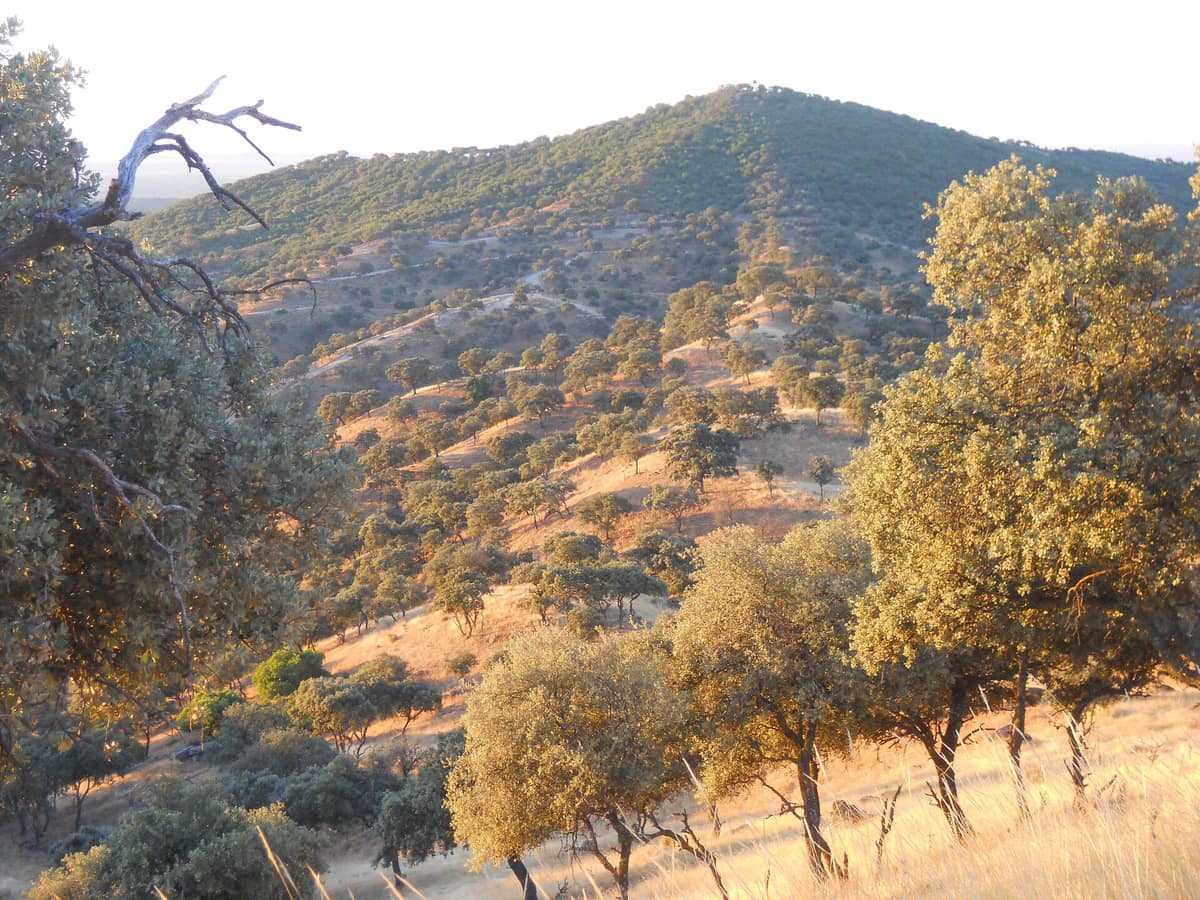
Sierra de Andújar Natural Park
Parque Natural Sierra de Andújar
Andalusia (Jaén / Andújar / Baños de la Encina) · Spain
Photo: Lichinga · CC BY-SA 4.0 · Wikimedia Commons
The historical stronghold and ultimate sanctuary of the Iberian lynx (Lynx pardinus), home to centuries-old dehesas of holm and cork oaks.
There is a place on earth where the planet's most endangered feline thrives in its largest population: the Sierra de Andújar, in north-western Jaén province. It represents Sierra Morena in almost untouched condition, a landscape of gentle rolling hills dotted with dehesas, Mediterranean scrub and pine woods, traversed by the Jándula River. The Iberian lynx is the star resident, though this range also protects Andalusia's main redoubt of the grey wolf.
What makes it unique
Harbours the world's largest population of Iberian lynx within Sierra Morena's most extensive tracts of natural vegetation.
The place
Nature
The landscape
The park is an exemplary display of the rolling hillscape typical of Sierra Morena, showing three distinct facets. At its heart lie Mediterranean woodlands and open dehesas. To the north rise rugged mountain ridges. To the south spread dense pine forests. It forms a mid-mountain expanse preserving the largest uninterrupted patches of natural vegetation across the entire range, where the holm oak woodlands are the most expansive in Sierra Morena.
Holm oaks and cork oaks reign in classic dehesa wood-pastures, with gall oaks appearing at higher, more humid elevations. Among them emerge massive rounded granite boulders known locally as bolos, which landowners have historically adapted as drinking troughs for livestock. Down by the water the scenery transforms: the Jándula River forms a verdant gallery forest corridor of willows, ashes, alders, tamujo shrubs and oleanders, offering a sharp contrast to the surrounding Mediterranean scrub. Together with the Yeguas River, it forms the park's primary riparian arteries.
Wildlife and seasons
The fauna is the park's primary allure. Besides the lynx, which boasts its highest numbers on Earth here, and the wolf, the skies are patrolled by the Spanish imperial eagle, golden eagle and cinereous vulture. Some of these great raptors can be readily spotted along the Jabalí-Encinarejo trail. Red deer, fallow deer, mouflons, wild boars, Egyptian mongooses, European wildcats and Eurasian otters also thrive.
Look towards the rivers as well. Along the Jándula you can sight kingfishers, mallards, grey herons, little grebes and great cormorants, with otters finding refuge in the current. Dedicated bird observatories stand at Doña Rosa and Los Lastrones. Mammals are shyer: deer, wild boars, red foxes and stone martens conceal themselves, but along the Junquillo trail their tracks appear with dependable regularity.
Species
With a page in the atlas
Being mentioned in a source doesn't guarantee sightings: check with the people who manage the area.
Memory and protection
History and conservation
The park has served as a sanctuary for endangered fauna, proven by the lynx: Sierra de Andújar maintained one of the few viable breeding stocks and supported the wider peninsular conservation strategy. It remains the paramount stronghold of the Iberian lynx, an endangered species.
The terrain also preserves human memory. In the very heart of the mountains rises the sanctuary of the Virgen de la Cabeza, where the annual pilgrimage of the patroness of hunters takes place. In Baños de la Encina stands Burgalimar Castle, one of the oldest in Europe, while Andújar retains its Roman bridge.
Before you set off
Visiting
How to visit
Begin at the Viñas de Peñallana visitor centre, situated at the entrance to the park at kilometre 13 of the road linking Andújar with the sanctuary of the Virgen de la Cabeza. It provides an engaging introduction to the park's ecosystems: you can touch tactile models, walk through a reconstructed Mediterranean woodland, view a replica Iberian wolf den and examine lynx tracks to understand their habitat, behaviour and the threats facing the most endangered cat on the planet.
Then, explore on foot. The Junquillo trail is an easy one-way walk of 5,684 metres, taking about two hours with low difficulty. It traverses nearly flat dehesas and pockets of Mediterranean scrub where birds are easily spotted, illustrating how private estates contribute to biodiversity as scenery changes between properties. It begins at a signposted junction on the A-6178 heading towards Valdelagrana and Las Tapias, about nineteen kilometres from the sanctuary. The Jabalí-Encinarejo trail finishes at the Encinarejo reservoir, where a stroll alongside the Jándula under riverine forest rounds off the excursion. The riverside path traces the waterway deeper into the park.
Before you go
Never disturb or feed the wildlife, as it alters natural behaviour, and keep strictly to marked pathways. Silence is essential: noise is another form of pollution. Keep your mobile phone charged to dial 112, though signal is not guaranteed everywhere.
Check access, rules and visiting conditions in the official information from the managing body before you set off.
Location
Where it is and how far it reaches
Boundary of Sierra de Andújar · IUCN V · © EEA, CDDA (CC-BY) The coordinate is estimated; it isn't a verified access point.
Transparency
Sources
The research data with its sources, and the official links for this place, are in the Spanish version of this page. See the Spanish version
Around it
About 2 km away lies Sierra Madrona and Valle de Alcudia Natural Park, and nineteen kilometres away is Sierra Morena Oriental - Despeñaperros. Further off, Cabañeros National Park and the Montes de Toledo SAC share with Andújar the Iberian lynx, imperial eagle and cinereous vulture, while Serra da Malcata Natural Reserve shares the lynx and cinereous vulture.
What else to explore nearby
Approximate straight-line distance between the edges of each area. It doesn't indicate access, routes or driving times.
- Valle de Alcudia and Sierra Madrona Natural Park
Castilla-La Mancha (Ciudad Real / Fuencaliente / Mestanza / Almodóvar del Campo)
About 2 km away
The largest protected space in Castilla-La Mancha (150,000 ha), featuring vast historic transhumance wood-pastures and intact oak forests.
JFMAMJJASONDOctober – May · Crowding very low
If you like this place, elsewhere in Europe
Distant places with uncommon wildlife and habitats in common. The most widespread species don't count. Sharing species doesn't imply a corridor or guaranteed presence.
- Cabañeros National Park
Castilla-La Mancha (Ciudad Real / Toledo / Navas de Estena / Retuerta del Bullaque)
In common: Iberian lynx · Spanish imperial eagle · Cinereous vulture — old-growth forest, river corridor
Open rañas, Mediterranean forested mountain ranges, and riverbanks where you can discover the habitats of the red deer, cinereous vulture, and Spanish imperial eagle.
JFMAMJJASONDApril – May · September – November · Crowding low
Entry #477 of the original atlas.