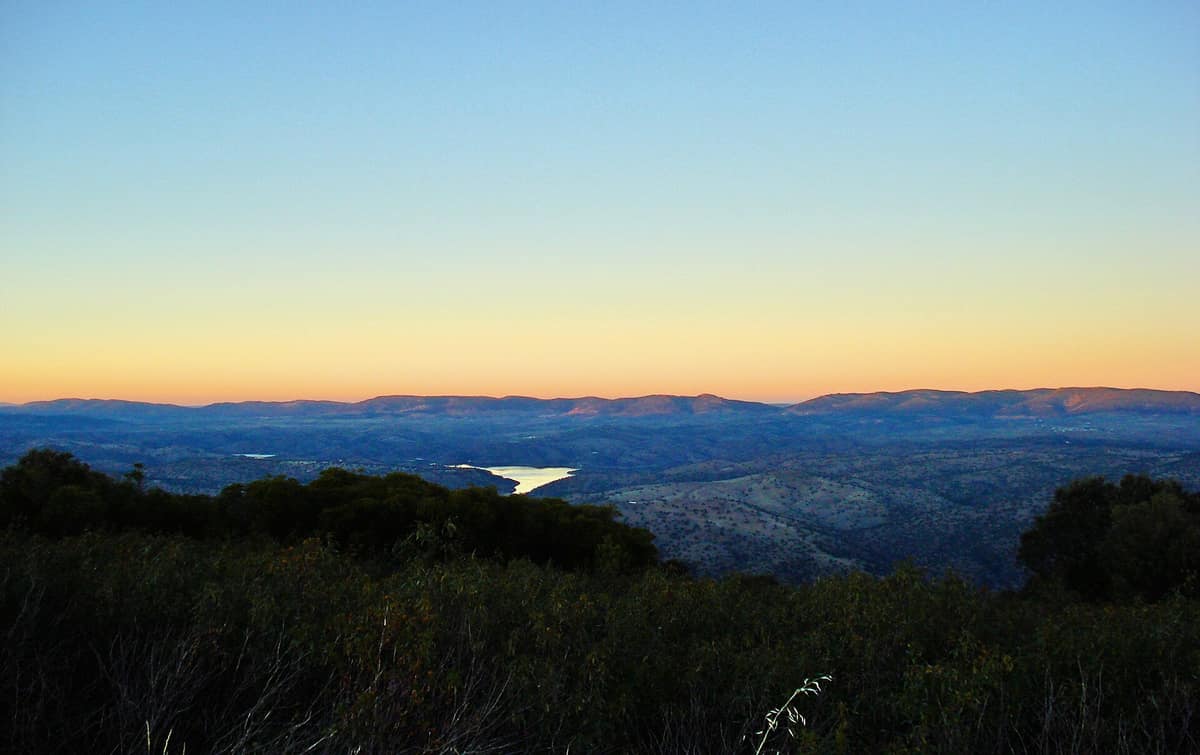
Valle de Alcudia and Sierra Madrona Natural Park
Parque Natural de Sierra Madrona y Valle de Alcudia
Castilla-La Mancha (Ciudad Real / Fuencaliente / Mestanza / Almodóvar del Campo) · Spain
Photo: Ameliacsj · CC BY-SA 3.0 es · Wikimedia Commons
The largest protected space in Castilla-La Mancha (150,000 ha), featuring vast historic transhumance wood-pastures and intact oak forests.
In mid-September across southern Ciudad Real, an ancient autumn sound echoes through the wooded hills: the bellowing rut of the red deer. The rut extends through mid-October and provides just one compelling reason to discover the Valle de Alcudia and Sierra Madrona. Designated a natural park on 10 March 2011, it spans some 149 463 ha across Almodóvar del Campo, Brazatortas, Cabezarrubias del Puerto, Fuencaliente, Hinojosas de Calatrava, Mestanza, San Lorenzo de Calatrava, and Solana del Pino. This southern belt of Ciudad Real encompasses ridges such as Sierra Madrona, Umbría de Alcudia, and San Andrés, forming part of the Natura 2000 network as the Sierra Morena special protection area.
What makes it unique
Within a single space, ancient pastoral dehesas, near-pristine Mediterranean forests, and a vital sanctuary for threatened raptors and the Iberian lynx.
The place
Nature
The landscape
Two distinct landscapes gaze upon each other. The Valle de Alcudia is a gentle, pastoral plain sculpted by centuries of livestock grazing: vast expanses of holm oak dehesas and rich seasonal pastures. In contrast, Sierra Madrona preserves exceptionally intact Mediterranean forest belts: holm oak woods on warm, dry slopes, gall oak groves in moist depressions, cork oak woods on temperate hillsides, and Pyrenean oak forests across cooler northern heights. The park weaves together mature forests, dense scrub, wood-pastures, and riverine gallery woods.
Botanical rarities abound. Relict stands of Algerian oak (Quercus canariensis) persist, alongside riparian galleries of alder, ash, willow, and tamujo, and well-preserved peat bogs (bonales). Among monumental trees, El Abuelo is a venerable oak rising majestically within Sierra Madrona surrounded by strawberry trees. In all, the valley can host more than 1065 plant species, 65 of which are threatened. Notable natural monuments include the volcanic formations of Castillejos de la Bienvenida, the La Alberquilla crater lagoon, and the Alhorín volcano.
Wildlife and seasons
Approximately 275 vertebrate species dwell here, six of them endangered, notably the cinereous vulture, Spanish imperial eagle, Bonelli's eagle, black stork, and Iberian lynx. Sierra Madrona is a key conservation zone for the imperial eagle, cinereous vulture, and black stork, while supporting crucial breeding pairs of golden eagle, Egyptian vulture, griffon vulture, peregrine falcon, and Eurasian eagle-owl. Over 160 bird species breed or winter in the park. The sierra also shelters critically endangered remnants of the grey wolf, as well as European wildcats, Egyptian mongooses, and common genets.
Streams retain healthy populations of otters and endemic fish like the bogardilla, Iberian arched-mouth nase, and southern Iberian barbel. The area is also essential for cave-dwelling bats of the genera Rhinolophus, Miniopterus, and Myotis.
Two seasonal highlights stand out. The autumn deer rut, from mid-September to mid-October, is best experienced at dawn or dusk. With the first autumn rains, the canopy shifts from deep green to warm ambers, russets, and golds; spring and autumn offer optimal visiting windows, when wintering common cranes animate the dehesas.
Species
With a page in the atlas
Being mentioned in a source doesn't guarantee sightings: check with the people who manage the area.
Memory and protection
History and conservation
The valley contains ancient transhumance drovers' routes, rock art shelters dating back 4,000 years, and historic mining settlements exploited by the Romans. Today it is protected as a natural park and a Natura 2000 conservation site.
Before you set off
Visiting
How to visit
The Explora tu Espacio park programme includes an introduction at the visitor centre and a short film before you venture onto the trails. Marked paths suit all abilities. The Ojuelos interpretive route from Brazatortas forms an 8.3 km circular walk that can be shortened. The Estrecho de Valdoro path covers 6.90 km on foot in roughly three hours. The Camino de la Ermita de la Antigua starts from Solana del Pino, connecting the village to the mountain pass and sanctuary before reaching Puerto de la Antigua at 968 metres.
Take time to enjoy the peace of these vast horizons.
Before you go
Stay on marked trails at all times and wear sturdy walking shoes year-round.
Check access, rules and visiting conditions in the official information from the managing body before you set off.
Location
Where it is and how far it reaches
Boundary of Valle de Alcudia y Sierra Madrona · IUCN VI · © EEA, CDDA (CC-BY) The coordinate is estimated; it isn't a verified access point.
Transparency
Sources
The research data with its sources, and the official links for this place, are in the Spanish version of this page. See the Spanish version
Around it
Parque Natural Sierra de Andújar lies just two kilometres away and Sierra Morena Oriental y Despeñaperros around fifteen. Further afield, Parque Nacional de Cabañeros and ZEC Montes de Toledo share the Iberian lynx, imperial eagle, and cinereous vulture in mature Mediterranean woods and river corridors, while Reserva Natural da Serra da Malcata also shelters the lynx and vulture.
What else to explore nearby
Approximate straight-line distance between the edges of each area. It doesn't indicate access, routes or driving times.
- Sierra de Andújar Natural Park
Andalusia (Jaén / Andújar / Baños de la Encina)
About 2 km away
The historical stronghold and ultimate sanctuary of the Iberian lynx (Lynx pardinus), home to centuries-old dehesas of holm and cork oaks.
JFMAMJJASONDOctober – April · Crowding low
If you like this place, elsewhere in Europe
Distant places with uncommon wildlife and habitats in common. The most widespread species don't count. Sharing species doesn't imply a corridor or guaranteed presence.
- Cabañeros National Park
Castilla-La Mancha (Ciudad Real / Toledo / Navas de Estena / Retuerta del Bullaque)
In common: Iberian lynx · Spanish imperial eagle · Cinereous vulture — old-growth forest, river corridor
Open rañas, Mediterranean forested mountain ranges, and riverbanks where you can discover the habitats of the red deer, cinereous vulture, and Spanish imperial eagle.
JFMAMJJASONDApril – May · September – November · Crowding low
Entry #495 of the original atlas.