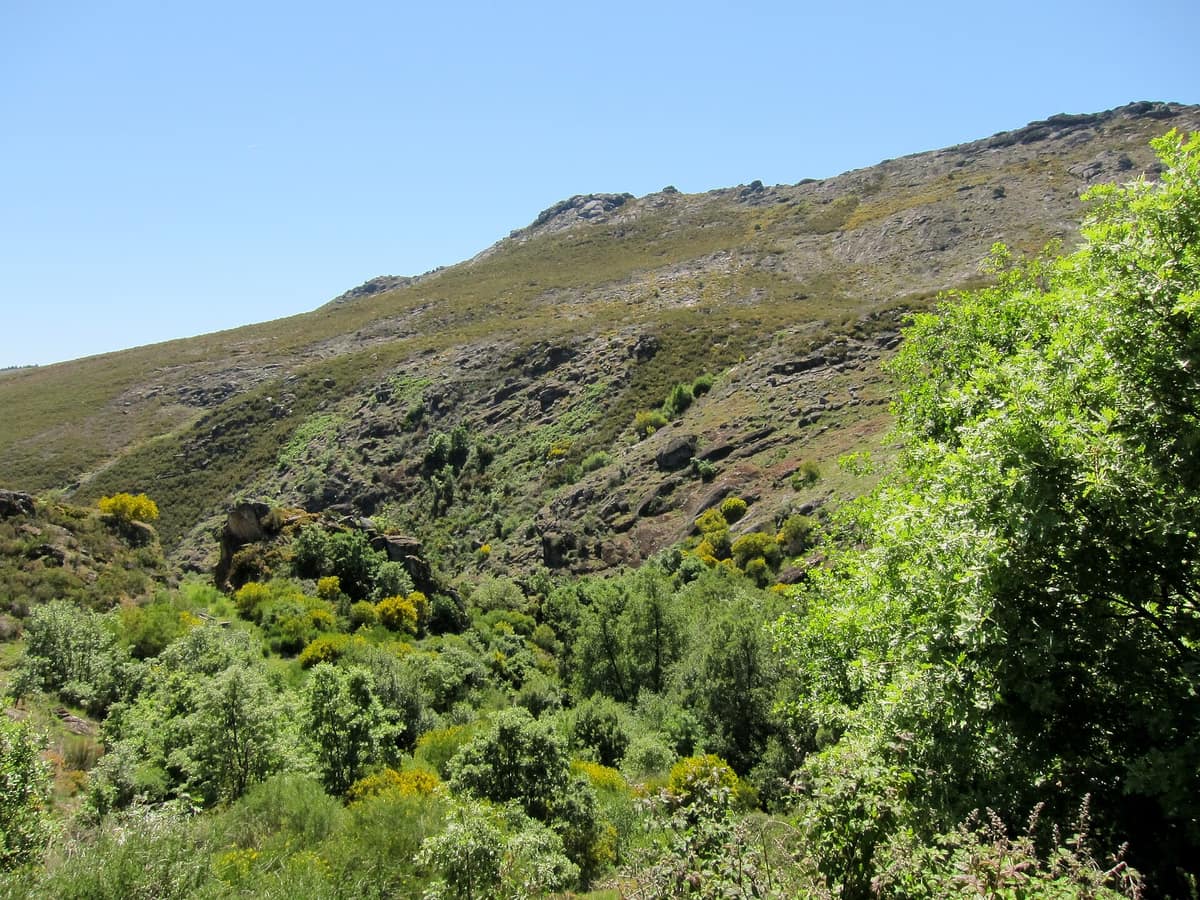
Montesinho Natural Park
Parque Natural de Montesinho
Northern Portugal (Trás-os-Montes / Bragança / Vinhais) · Portugal
Photo: Miguel Vieira from Redwood City, CA, USA · CC BY 2.0 · Wikimedia Commons
The Iberian stronghold of the Iberian wolf in Portugal (75,000 ha in Trás-os-Montes), with extensive Pyrenean oakwoods and traditional schist slate architecture.
There are winters of –12 °C and summers reaching 40 °C, and caught between the two are 92 villages, some 9,000 people, and the Iberian wolf. Montesinho Natural Park spans some 75 thousand hectares across north-eastern Trás-os-Montes, in the heart of the Terra Fria Transmontana. It was formally established as a natural park in 1979.
What makes it unique
One of the most vital Iberian wolf (lobo) populations on the peninsula, set in a mountain redoubt where flocks are still guarded by majestic Cão de Gado Transmontano livestock guardian dogs.
The place
Nature
The landscape
The relief is markedly diverse: undulating high plateaus dissected by deep, incised valleys, crowned by rugged mountain chains. The two primary ranges are the Serra de Montesinho, rising north of Bragança, and the Serra da Coroa, stretching north of Vinhais. Altitudes span from 438 metres in the riverbed of the Mente to 1486 m atop the Serra de Montesinho.
Schists dominate the geology, alongside granites, ultrabasic rock formations, and localized limestone outcrops. The Sabor River rises on the border with Spain among the summits of the Serra de Montesinho, flowing past Bragança. Watercourses wind through steep-sided valleys punctuated by ancient watermills, many of which remain actively utilized by villagers, crossed by millenary Roman bridges.
Wildlife and seasons
The vegetation forms a rich pastoral mosaic. Extensive matos (heathlands, cistus scrub, and broom) cloak slopes long retired from cultivation, offering prime wildlife cover. Mountain hay meadows, known as lameiros, line stream corridors. Sweet chestnut groves (soutos) constitute the core perennial agricultural land. Across lower elevations, steep sun-drenched slopes shelter evergreen holm-oak woods locally known as sardoais. The Pyrenean oak (carvalho-negral) forms the primary native forest tract, maintaining a continuous wooded corridor southwards towards the Serra da Nogueira. Native trees also include wild cherry, wych elm, common hazel, and crab apple; Montesinho represents the sole locality in Portugal where European spindle (Euonymus europaeus) occurs in native stands. Ultrabasic serpentinite soils nurture botanical rarities such as Armeria eriophylla, Anthyllis sampaiana, and Santolina semidentata.
This is one of the most critical montane wildlife sanctuaries in Portugal and throughout Europe, harbouring around two hundred and fifty vertebrate species. Notable mammals include the Iberian wolf, red deer, Pyrenean desman, wildcat, greater horseshoe bat, and Cabrera's vole. In 2019 a roaming Cantabrian brown bear was documented here. Among some 160 bird species, the golden eagle and black stork stand out. The streams support native barbel and brown trout. Walking the trails offers prime opportunities to discover tracks of red fox, wild boar, roe deer, and wolf.
Species
With a page in the atlas
Being mentioned in a source doesn't guarantee sightings: check with the people who manage the area.
Memory and protection
History and conservation
The park was designated to safeguard the extraordinary natural and cultural values of this frontier territory. Its management plan seeks to maintain native habitats and biodiversity while restoring degraded resources. The area partially encompasses the Montesinho/Nogueira Special Protection Area and Special Area of Conservation.
The Cão de Gado Transmontano, a magnificent livestock guardian dog, actively defends flocks against wolf packs: the park authority maintains a stud registry and places pups directly with pastoralists.
Before you set off
Visiting
How to visit
The park maintains 19 waymarked hiking trails. The Porto Furado trail is a circular route spanning 7.8 kilometres, graded moderate and taking about three hours. It starts and ends in the schist village of Montesinho, accessed from Bragança via the N103-7. The path passes Roman hydraulic works including the dam and aqueduct of Porto Furado, along with rock art at Castro Curisco.
The Trilho do Castro is another elongated circular hike of some 17 kilometres departing from the village of São Julião. Graded moderate to demanding, it takes about 5 hours. It passes the Iron Age hillfort of Fragas do Castro alongside an active traditional watermill. In the Alta Lombada sector, additional walking routes—PR13 Fraga do Coelho, PR14 do Castro, and GR2 dos Moinhos—complement mountain-biking options. For optimal wildlife watching, head out at dawn or dusk: along the Castro trail it is easy to spot soaring raptors or hear the call of a hoopoe.
The park master plan encourages walking excursions, interpretive itineraries, and wildlife observation as core nature tourism activities. The park administration is based in Bragança, with a regional delegation and visitor interpretation centre at the Casa da Vila in Vinhais.
Before you go
Recreational activities within the park are governed by official conservation zoning. Consult the ICNF regarding specific rules and trail conditions before visiting.
Check access, rules and visiting conditions in the official information from the managing body before you set off.
Location
Where it is and how far it reaches
Boundary of Montesinho · IUCN V · © EEA, CDDA (CC-BY) The coordinate is estimated; it isn't a verified access point.
Transparency
Sources
The research data with its sources, and the official links for this place, are in the Spanish version of this page. See the Spanish version
If you like this place, elsewhere in Europe
Distant places with uncommon wildlife and habitats in common. The most widespread species don't count. Sharing species doesn't imply a corridor or guaranteed presence.
- Gerês-Xurés Transboundary Biosphere Reserve
Northern Portugal (Viana do Castelo / Braga / Vila Real) (PT) / Galicia (Ourense / Lobios) (ES)
In common: Quercus pyrenaica · Grey wolf — old-growth forest, high mountain, river corridor
Portugal's sole National Park joined with Galicia's Serra do Xurés Natural Park, forming a transboundary reserve of granite monoliths and herds of free-roaming Garrano horses.
JFMAMJJASONDMay – October · Crowding low
Entry #524 of the original atlas.