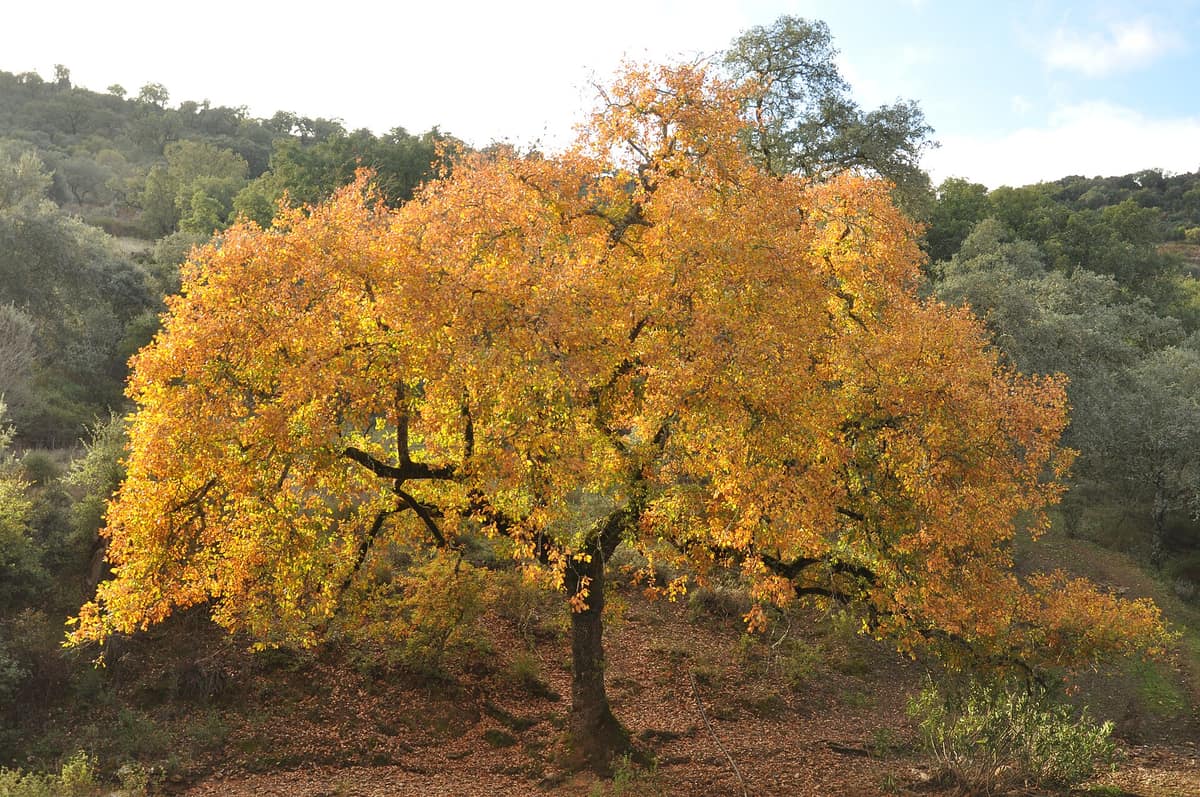
Sierra de Aracena and Picos de Aroche Natural Park
Parque Natural Sierra de Aracena y Picos de Aroche
Andalusia (Huelva / Aracena / Aroche / Cortegana) · Spain
Photo: Ricoleta · CC BY-SA 4.0 · Wikimedia Commons
Sprawling holm and cork oak dehesas interspersed with centennial chestnut groves in the western reaches of Sierra Morena.
Here Sierra Morena comes to an end, or begins: Sierra de Aracena and Picos de Aroche Natural Park occupies its westernmost reach in northern Huelva province. These medium-altitude mountain ranges feature dark schists and quartzites that tint the soil deep hues beneath dense forest cover, nourished by generous rainfall and a gentle microclimate. It is an undulating territory of dehesas, chestnut woods and river gallery corridors, sprinkled with whitewashed villages.
What makes it unique
Sierra de Aracena holds the most extensive network of historic mountain towns and hamlets in Sierra Morena, linked by ancient walkable stone trails.
The place
Nature
The landscape
The terrain shifts with elevation and moisture. Extensive holm oak dehesas yield to cork oaks in humid swales, while highest north-facing slopes host Pyrenean oak woodlands, such as at Solana de los Bonales. Around Fuenteheridos, Galaroza and Castaño del Robledo, centuries-old sweet chestnut groves mantle the hillsides. Along watercourses like the Múrtigas, verdant gallery forests thrive with black poplars, narrow-leaved ashes, willows and alders, intertwined with wild brambles and climbing ivy.
Open oak savannas provide acorn pasture for the free-ranging Iberian pig, which underpins the rural economy of celebrated hamlets such as Cumbres Mayores and Jabugo. Alongside native forest, historical eucalyptus plantations formerly harvested for paper pulp now supply renewable biomass.
Three distinct river basins drain the park: the Guadalquivir, the Guadiana via the Múrtigas river, and the Odiel.
Wildlife and seasons
Diverse forest formations support rich southern wildlife. Mammals include the Egyptian mongoose, the common genet and the elusive Eurasian otter along clean streams. In the skies soar griffon vultures, kites and elusive black storks. El Castañuelo viewpoint serves as an open-air raptor watchpoint for circling vultures, golden eagles and red kites.
Passing seasons transform forest rhythms: from chestnut harvesting to acorn pannage and autumn mycological gatherings, traditional agroforestry coexists with ancient stone watermills.
Species
With a page in the atlas
Being mentioned in a source doesn't guarantee sightings: check with the people who manage the area.
Memory and protection
History and conservation
The area was designated a natural park in 1989. In 2001, the monumental Holm Oak and Cork Oak of Dehesa de San Francisco was declared a Natural Monument; in 2002 the territory joined the UNESCO Dehesas de Sierra Morena Biosphere Reserve, and in 2003 it was classified as a Special Protection Area for birds. In 2004 the park was awarded the European Charter for Sustainable Tourism.
At Alájar, the scenic crag of Peña de Arias Montano was the spiritual retreat of Renaissance humanist Benito Arias Montano, perched above a cavernous labyrinth including the Palacio Oscuro cave.
Before you set off
Visiting
How to visit
Begin at Cabildo Viejo Visitor Centre in Plaza Alta in Aracena, housed in a historic sixteenth-century town hall. Exhibits detail local geology, flora and fauna, the temperate microclimate and high rainfall, highlighting the dehesa, chestnut groves and riparian galleries. Signposted walking trails depart directly toward Fuenteheridos, Linares de la Sierra and Corteconcepción.
The Alto del Chorrito trail is a linear walk of nearly four kilometres, taking about two and a half hours of easy hiking. Starting near Los Marines, it descends into the Valle del Silo ravine to finish in Linares de la Sierra among chestnut and cork oak trees, olive orchards and fern-covered stone terraces. It takes its name from a rock outcrop with a small cascade. Los Marines owes its name to sixteenth-century Galician settlers surnamed Marín. It connects with the trail between Aracena and Linares de la Sierra, meandering past orchards and holm oak dehesas whose sweet acorns fatten Iberian pigs.
From the Castañuelo viewpoint, take in the pastoral patchwork of dehesas and oak woods extending toward the mountains of Extremadura. One kilometre away, a trail leads to the archaeological settlement of El Castañuelo, dating back to the second millennium BC. Beneath Aracena, the Gruta de las Maravillas opened to the public in 1914 as the first show cave in Spain; it features 1400 m of visitable subterranean chambers, maintained at a constant year-round temperature between 16 and 19 degrees.
Before you go
Never disturb or offer food to wildlife, as this disrupts natural behaviour. Check local hunting calendar notices before setting out, as designated public recreation facilities remain safety zones. Consult weather forecasts and keep to marked footpaths.
Check access, rules and visiting conditions in the official information from the managing body before you set off.
Location
Where it is and how far it reaches
Boundary of Sierra de Aracena y Picos de Aroche · IUCN V · © EEA, CDDA (CC-BY) The coordinate is estimated; it isn't a verified access point.
Transparency
Sources
The research data with its sources, and the official links for this place, are in the Spanish version of this page. See the Spanish version
Around it
Further afield, Despeñaperros and Eastern Sierra Morena Natural Park, Cabañeros National Park and Serra da Malcata Nature Reserve share mature Mediterranean oak woodlands, black vultures and black storks with Aracena.
If you like this place, elsewhere in Europe
Distant places with uncommon wildlife and habitats in common. The most widespread species don't count. Sharing species doesn't imply a corridor or guaranteed presence.
- Cabañeros National Park
Castilla-La Mancha (Ciudad Real / Toledo / Navas de Estena / Retuerta del Bullaque)
In common: Spanish imperial eagle · Cinereous vulture · Black stork — old-growth forest
Open rañas, Mediterranean forested mountain ranges, and riverbanks where you can discover the habitats of the red deer, cinereous vulture, and Spanish imperial eagle.
JFMAMJJASONDApril – May · September – November · Crowding low
Entry #493 of the original atlas.