Peene River Valley / Rewilding Peene
Rewilding Peene Valley / Peenetal
Mecklenburg-Western Pomerania · Germany
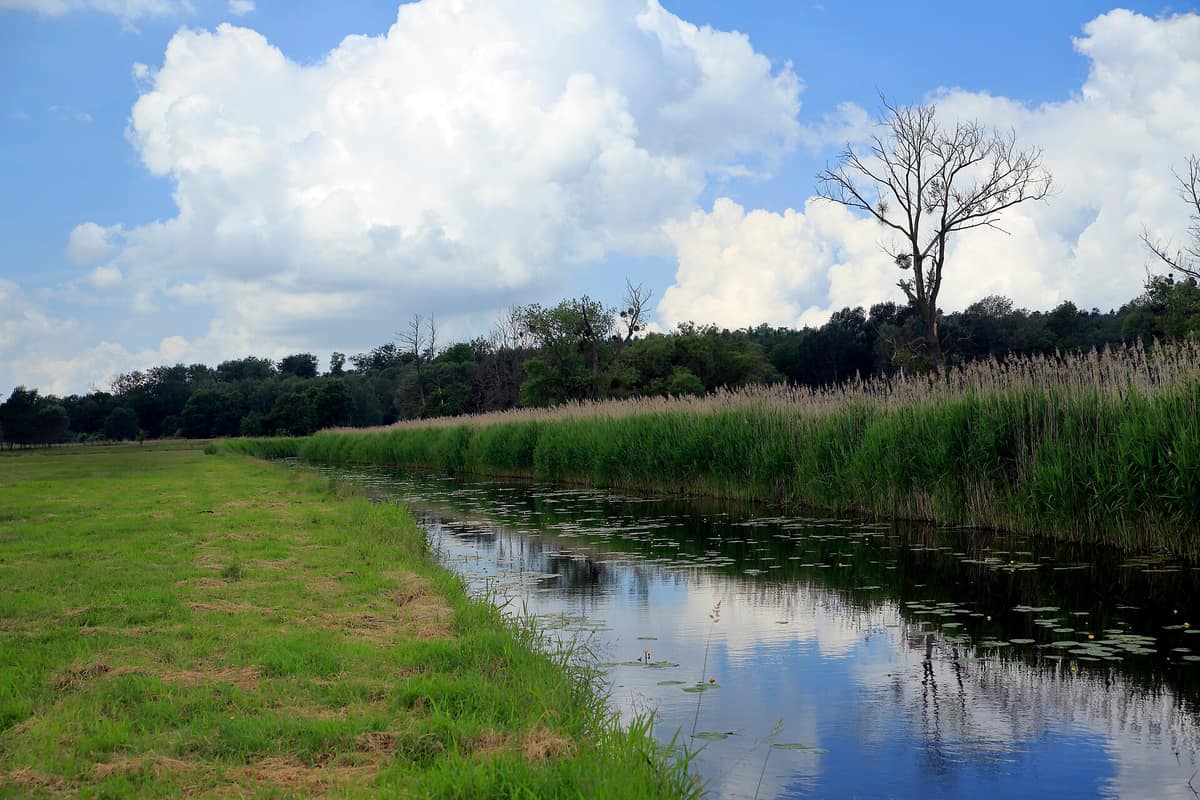
Photo: Falk2 · CC BY-SA 4.0 · Wikimedia Commons
The 'Amazon of the North', one of Central Europe's last unchannelized peatland river valleys.
A river that hardly knows which way to go. The Peene often flows so slowly that it barely seems to move at all, and at times it even flows westward. The reason lies in its origins: it formed around 10.000 years ago at the end of the Weichselian glaciation as a meltwater channel, and when the ice sheet receded, the ground rebounded and subsided, causing the river to reverse course and flow eastward. From that almost motionless channel arose a fen peatland valley: the Flusslandschaft Peenetal Nature Park in Mecklenburg-Western Pomerania, along the Peene between Dargun, Demmin, Loitz, Jarmen, Gützkow, and Anklam. It is the most pristine river valley in all of northern Germany and one of the largest contiguous lowland fen peatlands in Central and Western Europe.
What makes it unique
A valley where species grow that hardly thrive anywhere else: orchids found in Germany only here, all three regional eagles, and a river with otters and beavers everywhere.
The place
Nature
The landscape
An almost stagnant river lets life accumulate. With calm waters, the valley gradually silted up, forming a textbook river valley peatland with spring mires along the edges, percolating fens, and flood fens along the river and coast. The river winds for nearly one hundred kilometers from Lake Kummerow to the Peenestrom, through a valley one to two kilometers wide.
Along the flanks, the valley changes character. The dry slopes at the valley edges are rich and colorful, especially in late spring and early summer, supporting steppe elements tied to the Oder system such as the meadow pasqueflower. Down in the fens, rare plants abound to the point that two orchids, the Ostsee-Knabenkraut and the Baltische Knabenkraut, are found in Germany only within the Peenetal. In total, around 750 flowering plants and ferns have been recorded.
Wildlife and seasons
Birds are the primary reason to visit. All three eagle species of Mecklenburg-Western Pomerania breed here: the osprey, the white-tailed eagle, and the scarce lesser spotted eagle. Since ecological restoration, numbers have risen for spotted crake, corn crake, common snipe, northern lapwing, black-tailed godwit, ruff, Eurasian curlew, Eurasian bittern, marsh and black terns, black-headed gull, and mute swan. Since the polders were opened, the floodplain has become a vital stopover and resting area for ducks, geese, swans, lapwings, golden plovers, rails, and grebes.
In the water, the valley is famed for the Eurasian otter and the Eurasian beaver: large populations thrive throughout the territory. If you want to spot a beaver, look along the Peene on summer evenings at dusk. Around 40 mammal species inhabit the valley, including the barbastelle bat, protected under European law. Of the 51 native freshwater and migratory fish species in Mecklenburg-Western Pomerania, 37 regularly live in the Peene system, notable among them river lamprey, spined loach, mudminnow, bitterling, and Atlantic salmon. The floodplain also hosts roughly two-thirds of the region's diurnal butterfly species and is the only location in the North German Plain with the Menetries ground beetle.
Species
With a page in the atlas
Being mentioned in a source doesn't guarantee sightings: check with the people who manage the area.
Memory and protection
History and conservation
Until the mid-nineteenth century, agricultural use was sparse, and until 1900 peat cutting for fuel was more significant than farming. Between 1992 and 2009, one of Germany's largest nature conservation projects was carried out in the valley: it sought to restore the fen valley into a living peat body by enhancing hydrology and dismantling polders, which had been the main obstacle to establishing uninterrupted nature reserves. Alkaline fens are critically endangered today, and their primary refuge is the Peenetal.
Rewilding projects
Before you set off
Visiting
How to visit
Start at the park center in Stolpe an der Peene. Its exhibition, featuring interactive displays, scale models, and informational panels, details the park's wildlife, plants, and history, with staff on hand to help plan hiking, cycling, or canoeing routes. For canoeists, a specialized Nordland-Verlag map details all rest areas, river kilometers, scenic viewpoints, and bird observation towers.
Three observation towers and platforms have been restored; they provide access to a beloved rest area along the Peene in Dersewitz and a popular trail in Menzlin. Boating on the Peene is permitted, but inside the protected area mooring is allowed only at official resting spots. Within the reserve, anchoring is permitted only clear of floating aquatic vegetation, and camping is forbidden. The valley can also be explored along marked hiking trails from multiple access points.
Before you go
In nature reserves you must stay on designated paths whether on foot, bicycle, or horseback. The airspace belongs to birds: drones and aircraft are prohibited. In nature reserves you must always expect falling trees and branches; entry is at your own risk.
Check access, rules and visiting conditions in the official information from the managing body before you set off.
Location
Where it is and how far it reaches
Boundary of Unteres Peenetal und Peene-Haff [Vorpommern-Greifswald] · IUCN V · © EEA, CDDA (CC-BY) The coordinate is estimated; it isn't a verified access point.
Transparency
Sources
The research data with its sources, and the official links for this place, are in the Spanish version of this page. See the Spanish version
Around it
Twenty-six kilometers away lies Wolin National Park and the Świna River Delta.
What else to explore nearby
Approximate straight-line distance between the edges of each area. It doesn't indicate access, routes or driving times.
- Wolin National Park and Świna River Delta
West Pomerania (Wolin Island / Międzyzdroje / Świnoujście)
About 26 km away
Glacial moraine cliffs rising 95 m above the Baltic Sea, coastal beech forests, and Poland's foremost coastal European bison reserve.
JFMAMJJASONDMay – October · Crowding low
Entry #14 of the original atlas.