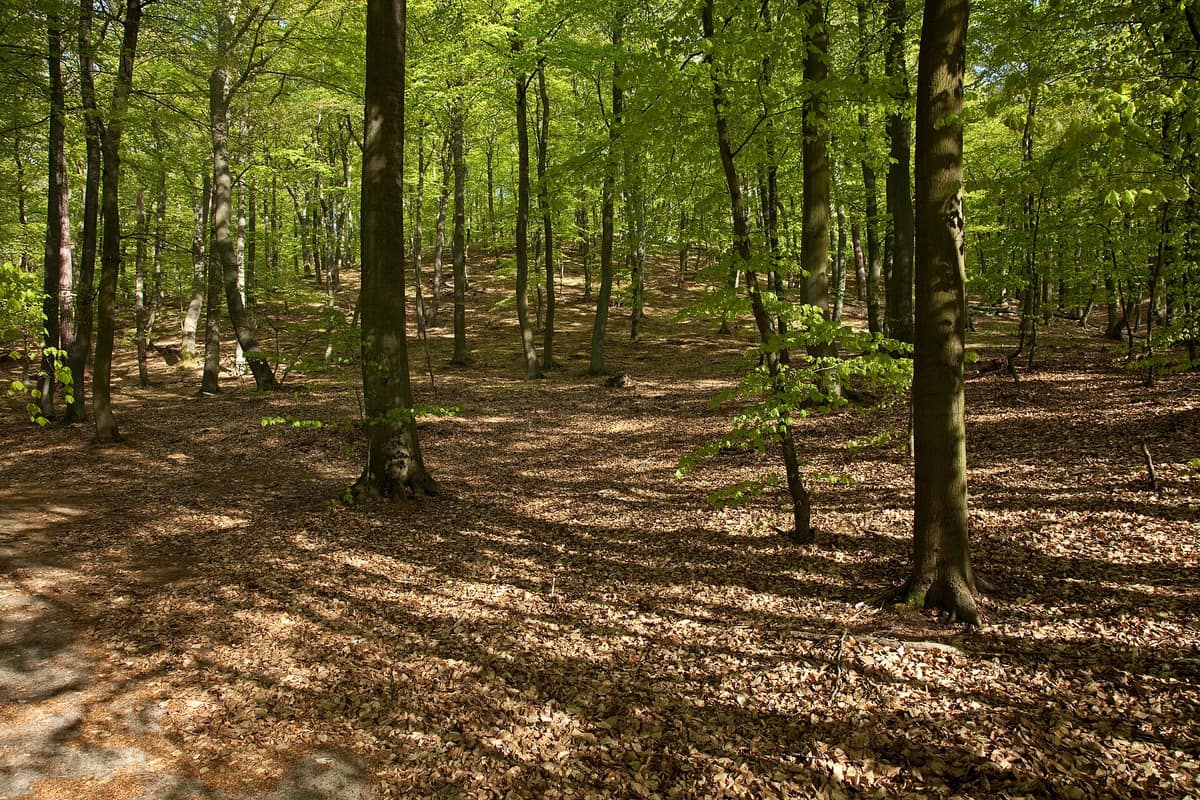
Wolin National Park and Świna River Delta
Woliński Park Narodowy & Delta Świny
West Pomerania (Wolin Island / Międzyzdroje / Świnoujście) · Poland
Photo: Wieckowicz · CC BY-SA 3.0 pl · Wikimedia Commons
Glacial moraine cliffs rising 95 m above the Baltic Sea, coastal beech forests, and Poland's foremost coastal European bison reserve.
Each year the Baltic Sea erodes roughly 80 centimetres of Wolin's coastline. The highest active sea cliffs soar to 95 m, undercut by crashing waves while primeval beechwoods crown the rim. This striking coastline forms the hallmark of Wolin National Park, which shelters part of Poland's largest island between Pomerania Bay and the Szczecin Lagoon. Its emblem features two coastal icons: the white-tailed eagle and sea holly (mikołajek nadmorski).
Founded in 1960 and expanded in 1996 to encompass coastal marine waters, lagoon expanses, and an archipelago of delta islets, it stands as Poland's first marine national park, covering 10 937 ha across mainland, sea, and delta environments.
What makes it unique
Combines dynamic moraine cliffs, near-natural coastal beechwoods, and an evolving delta of marshy islands within a single protected territory.
The place
Nature
The landscape
Three distinct landscapes define the park. The dominant element is an undulating terminal moraine ridge spanning roughly 75 % of the territory, culminating at Mount Grzywacz (115.9 m). The second landscape is the Świna reverse delta: dozens of swampy islets dissected by meandering channels where sedimentary land building remains actively underway, constantly reconfiguring shoals and shallows. The third, lying in the east, comprises a picturesque post-glacial lake district featuring Warnowo, Czajcze, Domysłowskie, Zatorek, and Wisełka.
Dense woodland blankets much of the dry land. Scots pine accounts for 68 % of the forested terrain, beech occupies 23 %, and pedunculate oak covers 7 %, boasting an average stand age of 130 years. The coastal beechwoods retain a near-primeval structural complexity, sheltering woodland melick, rare orchids, and bulbiferous toothwort in the understorey. Along the bluffs, cliff faces host impenetrable sea buckthorn thickets, while sandy foredunes harbor sea sandwort, sea lyme grass, and sea rocket, complemented by around 30 halophyte species adapted to brackish delta marshland.
Across Wolin Island more than 1300 vascular plant species thrive, approximately 600 of which occur within national park borders.
Wildlife and seasons
Wolin lies along the primary avian flyway following the Baltic littoral, with over 230 bird species recorded in the park. Coastal wetlands offer tranquil feeding grounds, especially during spring and autumn passages, establishing the Świna delta as an Important Bird Area of European stature. Near the mouth of the Świna, Kentish plover and white-tailed eagle hunt alongside various tern species; the aquatic warbler represents a priority Natura 2000 species, exceptionally threatened across Poland and the wider continent. The white-tailed eagle has nested continuously here for well over a century, while dedicated conservation projects seek to encourage the recolonization of the Eurasian eagle-owl.
In the marine sector, the bay provides refuge for marine mammals and fishes of high conservation concern, including grey seal, harbor porpoise, harbor seal, and ringed seal. On land, Eurasian otter, European beaver, greater mouse-eared bat, and European bison roam the habitats. Notable woodland insects include thriving populations of stag beetle and great capricorn beetle.
May through October provides optimal conditions for visits, with spring and autumn migratory passages offering world-class birdwatching spectacles.
Species
With a page in the atlas
Being mentioned in a source doesn't guarantee sightings: check with the people who manage the area.
Memory and protection
History and conservation
At Grodzisko Lubin stand the remnants of an early medieval stronghold that flourished between the tenth and twelfth centuries, commanding panoramic vistas across the lagoon. The park encompasses seven strict protection reserves—six protecting ancient woodland—and overlaps the European habitats site «Ujście Odry i Zalew Szczeciński» and special protection area «Wolin i Uznam».
Before you set off
Visiting
How to visit
Begin at the Natural History Museum in central Międzyzdroje on Filaretów Hill, which features botanical grounds and aviaries housing rehabilitated white-tailed eagles and eagle-owls. It preserves Poland's preeminent taxidermy collection of ruffs in full breeding plumage, displaying 130 mounted specimens. The park also maintains a European bison demonstration enclosure near Międzyzdroje, and an educational post in Zalesie adjacent to a Second World War bunker complex.
For hiking, the red trail runs for nineteen kilometers along the Baltic bluffs and scales the Kawcza Góra lookout. The blue trail covers twenty-six kilometers past turquoise Lake Turkusowe and viewpoints at Piaskowa Góra and Zielonka, tracing the Szczecin Lagoon shoreline where wetland birds congregate. The Kawcza Góra spur connects Żubrowisko to Międzyzdroje via Kawcza, while the coastal route links Świnoujście, Międzyzdroje, and Kołczewo. Five active panoramic viewpoints await: Gosań, Kawcza, Zielonka, Piaskowa Góra, and Grodzisko Lubin, alongside two nature trails at Zatorek and Łuniewo.
Cyclists can cross the territory via international routes R-10 (Baltic Sea Cycle Route) and R-66 (Szczecin Lagoon Ring).
Before you go
Review trail bulletins and park access notices before your outing. The seaside town of Międzyzdroje experiences moderate tourist influxes during the peak summer holiday season.
Check access, rules and visiting conditions in the official information from the managing body before you set off.
Location
Where it is and how far it reaches
Boundary of Woliński Park Narodowy · IUCN II · © EEA, CDDA (CC-BY) The coordinate is estimated; it isn't a verified access point.
Transparency
Sources
The research data with its sources, and the official links for this place, are in the Spanish version of this page. See the Spanish version
Around it
Twenty-six kilometers away lies the Valle del río Peene / Rewilding Peene. Farther southwest, the Parque Nacional Desembocadura del Warta shares with Wolin key populations of whooper swans, white-tailed eagles, and alluvial marshlands.
What else to explore nearby
Approximate straight-line distance between the edges of each area. It doesn't indicate access, routes or driving times.
- Peene River Valley / Rewilding Peene
Mecklenburg-Western Pomerania
About 26 km away
The 'Amazon of the North', one of Central Europe's last unchannelized peatland river valleys.
JFMAMJJASONDMay – October · Crowding very low
Entry #446 of the original atlas.