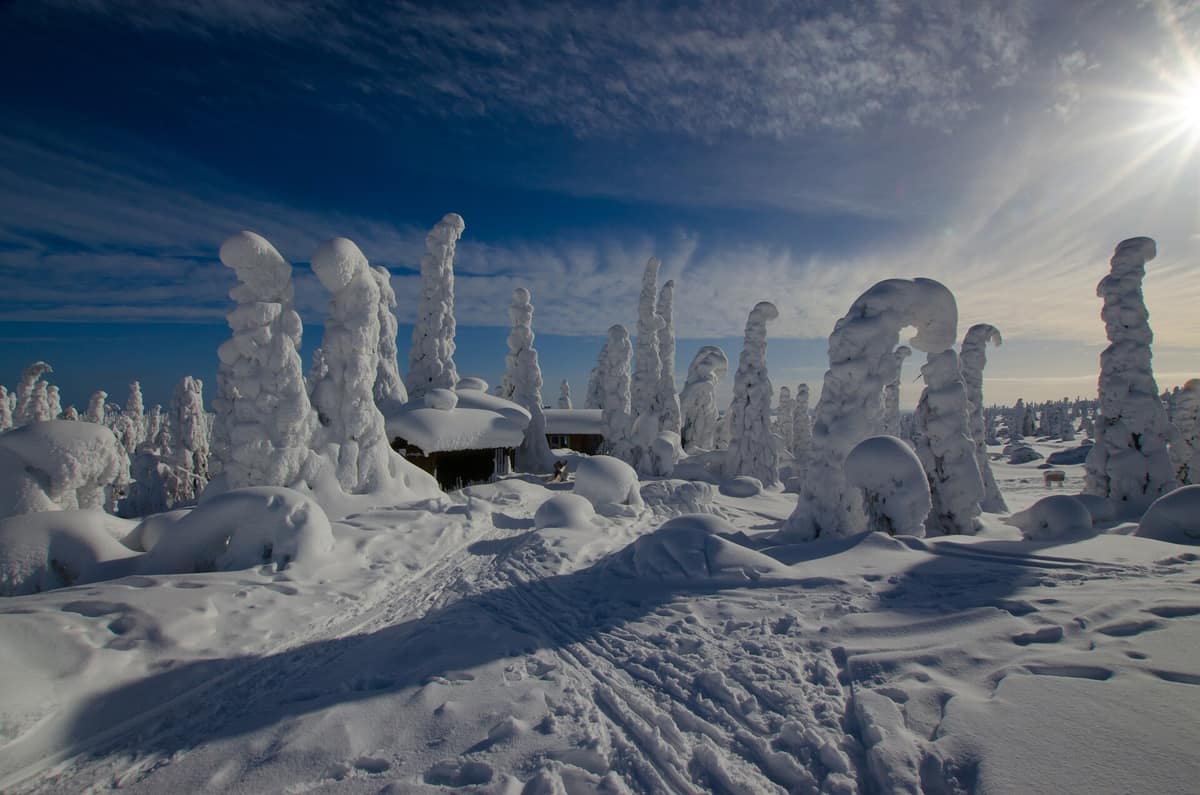
Riisitunturi National Park
Finnish Lapland (Posio / Kuusamo) · Finland
Photo: Tero Laakso from Hyvinkää, Finland · CC BY-SA 2.0 · Wikimedia Commons
World-famous for heavy snow and hard frost formations on boreal spruce trees (tykky) across upland fells.
Some forests stay upright not through raw strength, but through form. In Riisitunturi, as soon as winter sets in, moisture condenses as rime and heavy snow on branches, and an adult spruce can carry three to four tonnes. Finns call it tykky, and it is what transforms this national park in Posio, in Finnish Lapland. Outside that season, the park is an expansive landscape of wooded fells and sloping bogs.
What makes it unique
Here snow does not just fall on the forest: it builds it, tree by tree, sculpting it into living statues.
The place
Nature
The landscape
It all stems from the clash of two elements: moist air masses and the hills of the Kuusamo upland. As the air rises, moisture turns into frost and snow on trees, while feeding a wealth of peatlands. Riisitunturi represents southern fell nature: its highest summit reaches 465 meters, with others exceeding 400. Almost the entire area lies above 300 meters, and the Maanselkä drainage divide, a gentle chain of hills separating Baltic from Arctic watersheds, runs right through the park. Water to the west drains into the Kemijoki, and to the east into the Kitkajärvi lakes.
The highest peaks are treeless heathlands, classic examples of southern fell heaths, home to alpine bearberry (Arctostaphylos alpina), trailing azalea (Loiseleuria procumbens), and alpine clubmoss (Diphasiastrum alpinum). Further down the slopes, extensive old-growth spruce forests feature abundant deadwood, with the tree line delineated by the spruce itself: tykky accumulating on crowns limits tree growth on the hills. Slender northern spruces bear the heavy snow load far better than pines.
Sloping bogs are the park's other signature feature. Many reach almost to the summits; they are largely nutrient-poor, while richer fens occur less frequently. Numerous streams and brooks flow among them.
Wildlife and seasons
The park's wildlife is emblematized by its logo: a northern hawk owl, hiiripöllö, perched beside a spruce laden with tykky. As for plant life, the European Natura network protects two species here: yellow marsh saxifrage, lettorikko (Saxifraga hirculus), and Lapland buttercup, lapinleinikki (Ranunculus lapponicus).
Winter is the peak season. Riisitunturi's snow-clad forest under moonlight draws hikers and photographers from across the world. During that season, a 20 km multi-use winter trail is maintained for snowshoeing, skiing, and fatbiking.
Species
With a page in the atlas
Being mentioned in a source doesn't guarantee sightings: check with the people who manage the area.
Memory and protection
History and conservation
Finnish naturalists already knew the area at the beginning of the twentieth century for its hanging bogs. In 1971 Metsähallitus protected more than 40 km² of forest in Riisitunturi, and the national park act took effect on 1 January 1982. Today it forms part of internationally important wetlands designated under Ramsar. It represents a vital tract of northern boreal natural forest and varied sloping mires, renowned for its pristine wilderness character. The area's nature has long inspired naturalists and peatland researchers, serving as a study site for the Oulanka research station.
Before you set off
Visiting
How to visit
The Riisitunturi area offers over 40 km of marked trails. The two classic day hikes are Riisin rääpäsy, a 4,3 km circular trail, and Riisin rietas, measuring 10,9 km. For longer journeys, Riisitunturin reitti connects Kirintövaara to Riisitunturi across 26 km each way.
Near the twin summit of Riisitunturi, at 465,3 m, sits the park's only wilderness hut.
Before you go
Trails feature open wilderness shelters with campfire sites and designated space for pitching tents. For an overnight stay you can use the wilderness hut north of Riisitunturi, a lean-to shelter, or your own tent.
Check access, rules and visiting conditions in the official information from the managing body before you set off.
Location
Where it is and how far it reaches
Boundary of Riisitunturin kansallispuisto · © OpenStreetMap contributors (ODbL) The coordinate is estimated; it isn't a verified access point.
Transparency
Sources
The research data with its sources, and the official links for this place, are in the Spanish version of this page. See the Spanish version
Around it
Oulanka National Park is about twenty-five kilometers away. Further afield, Urho Kekkonen National Park shares moose, brown bear, fell highlands, primeval taiga forests, and vast wetlands with Riisitunturi.
What else to explore nearby
Approximate straight-line distance between the edges of each area. It doesn't indicate access, routes or driving times.
- Oulanka National Park
Finnish Lapland / North Ostrobothnia (Kuusamo / Salla)
About 25 km away
Torrential rivers carved into sandstone gorges and pristine boreal pine forests, crossed by suspension bridges along the Karhunkierros trail.
JFMAMJJASONDMay – October · Crowding low
Entry #594 of the original atlas.