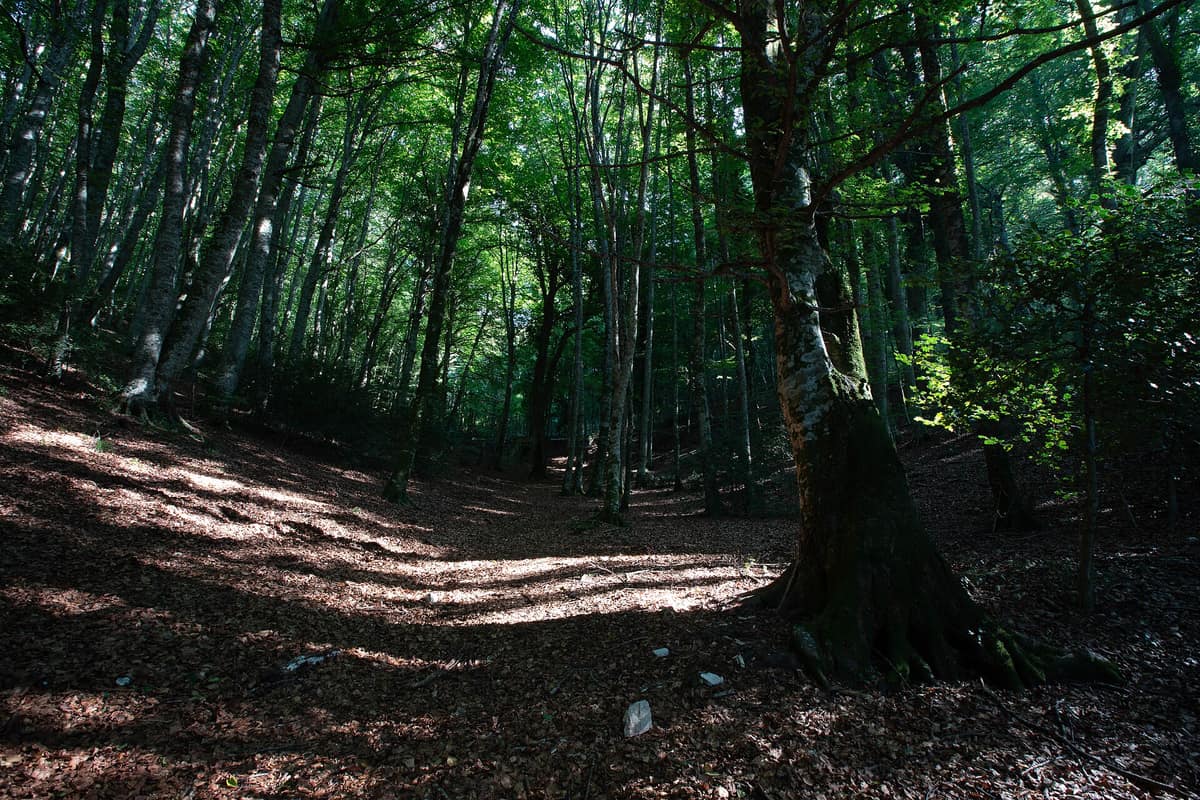
Foresta Umbra State Nature Reserve (Gargano National Park)
Riserva Naturale Statale Foresta Umbra (Parco Nazionale del Gargano)
Puglia (Foggia / Vieste / Monte Sant'Angelo / Vico del Gargano) · Italy
Photo: Pakycassano · CC BY-SA 4.0 · Wikimedia Commons
Europe's most dazzling low-altitude primeval beech forest in Italy's 'spur of the boot' (UNESCO World Heritage).
Some forests carry shadow in their very name. Foresta Umbra lies in east-central Gargano, at around 800 meters of altitude, within Gargano National Park. The name derives from Latin, meaning dark and gloomy, and in large part it remains so today. Its ancient beech groves have been recognized as a UNESCO World Heritage site since 7 July 2017.
What makes it unique
Here beech grows at the lowest known elevations, forming the 'faggete depresse', a phenomenon unique to the Gargano.
The place
Nature
The landscape
The Gargano is predominantly sedimentary rock—limestones and dolomites of Cretaceous and Jurassic age—and its karst landscape has formed more than 4000 sinkholes. Foresta Umbra rests upon this plateau, forming an almost continuous, dense woodland covering over 12.000 hectares according to the park authorities and around 15.000 according to Italian Wikipedia.
The forest is stratified into three distinct zones: beech at higher elevations, Turkey oak forest in the middle, and Mediterranean woodland with holm oaks down below. 'Arboreal cathedrals' of monumental beech, hornbeam, maple, and yew surge toward the canopy seeking light; the jungle is so dense that distinguishing one species from another can be difficult. The microclimate of the 'faggete depresse' is what allows beech to thrive here at lower altitudes than anywhere else. In autumn, the forest is breathtaking when foliage turns into vibrant autumnal shades.
Wildlife and seasons
The wildlife is as elusive as the dense forest itself. Wild boars, roe deer, woodpeckers, and weasels dwell here, and camera traps deep in the interior have confirmed the presence of the Apennine wolf. The Gargano roe deer has never crossbred with imported stock and is considered a probable native subspecies of high scientific interest. Six species of woodpeckers inhabit the woods, including the white-backed and middle spotted woodpecker, both very rare. Diurnal raptors include buzzard, sparrowhawk, and goshawk, while tawny owls, eagle owls, and scops owls hunt by night.
In spring, Cutino d'Umbra teems with life: at the beginning of the season, hundreds of common toads gather there to breed. And among the forest floor flora blossoms a remarkable collection of wild orchids.
Species
With a page in the atlas
Being mentioned in a source doesn't guarantee sightings: check with the people who manage the area.
Memory and protection
History and conservation
The forest enjoys multiple protection tiers. The biogenetic nature reserves of Foresta Umbra (399 ha) and Falascone (48 ha) have been safeguarded since 1977, preserving mixed beech woodland, while the Sfilzi strict reserve of 56 ha was created in 1971 to protect the Gargano's only montane perennial spring. The small Sorgentola reserve is a strict nature reserve: all human activity and even entry are prohibited.
Before you set off
Visiting
How to visit
Foresta Umbra is the hiking capital of the Gargano. There are fifteen signposted trails, all fitted with directional markers and yellow trail blazes on trees and boulders, adding up to a 54 km network. Forest entrances are marked by large timber panels with parking lots at each trailhead. One route links Laghetto d'Umbra with Falascone, another connects Murgia to Lago d'Otri, and the path from Sfilzi to Casalini is fully equipped. Mountain biking and e-biking are also popular.
Along the trails, short detours lead to the gravi—fenced natural sinkholes with interpretive signs. At Villaggio Umbra, the nature museum has three indoor pavilions and an outdoor area: Gargano flora, with illuminated panels and a topographic model, and archaeology, displaying Paleolithic and Neolithic stone tools. Beside the museum lies a small wildlife enclosure with fallow deer and mouflons, plus a labeled arboretum. At the Caritate experimental nursery, you can see around twelve oak species native to Puglia.
Before you go
Zone A of the forest, the core wildlife breeding sanctuary, is strictly closed to the public, and in Zone B disturbing noise and shouting are forbidden. The museum operates seasonally: check opening dates or booking requirements before visiting.
Check access, rules and visiting conditions in the official information from the managing body before you set off.
Location
Where it is and how far it reaches
Boundary of RISERVA NATURALE BIOGENETICA E INTEGRALE FORESTA UMBRA · IUCN Ia · © EEA, CDDA (CC-BY) The coordinate is estimated; it isn't a verified access point.
Transparency
Sources
The research data with its sources, and the official links for this place, are in the Spanish version of this page. See the Spanish version
Around it
There are no neighboring places published in the atlas; it shares the Eurasian eagle-owl and karst terrain with Cheile Crișului Repede.
If you like this place, elsewhere in Europe
Distant places with uncommon wildlife and habitats in common. The most widespread species don't count. Sharing species doesn't imply a corridor or guaranteed presence.
- Liesjärvi National Park
Kanta-Häme (Tammela / Somero)
In common: Black woodpecker · Eurasian eagle-owl — old-growth forest
Century-old boreal taiga featuring the narrow Kyynäränharju esker ridge meandering like a natural causeway between two lakes.
JFMAMJJASONDMay – October · Crowding very low
Entry #532 of the original atlas.