Soomaa National Park
Soomaa rahvuspark
Estonia (Pärnumaa / Viljandimaa) · Estonia
Photo: Juta.lopp · CC BY-SA 3.0 · Wikimedia Commons
Expansive raised bogs severed by meandering rivers that overflow each spring: the «fifth season», when canoeists paddle between submerged trees.
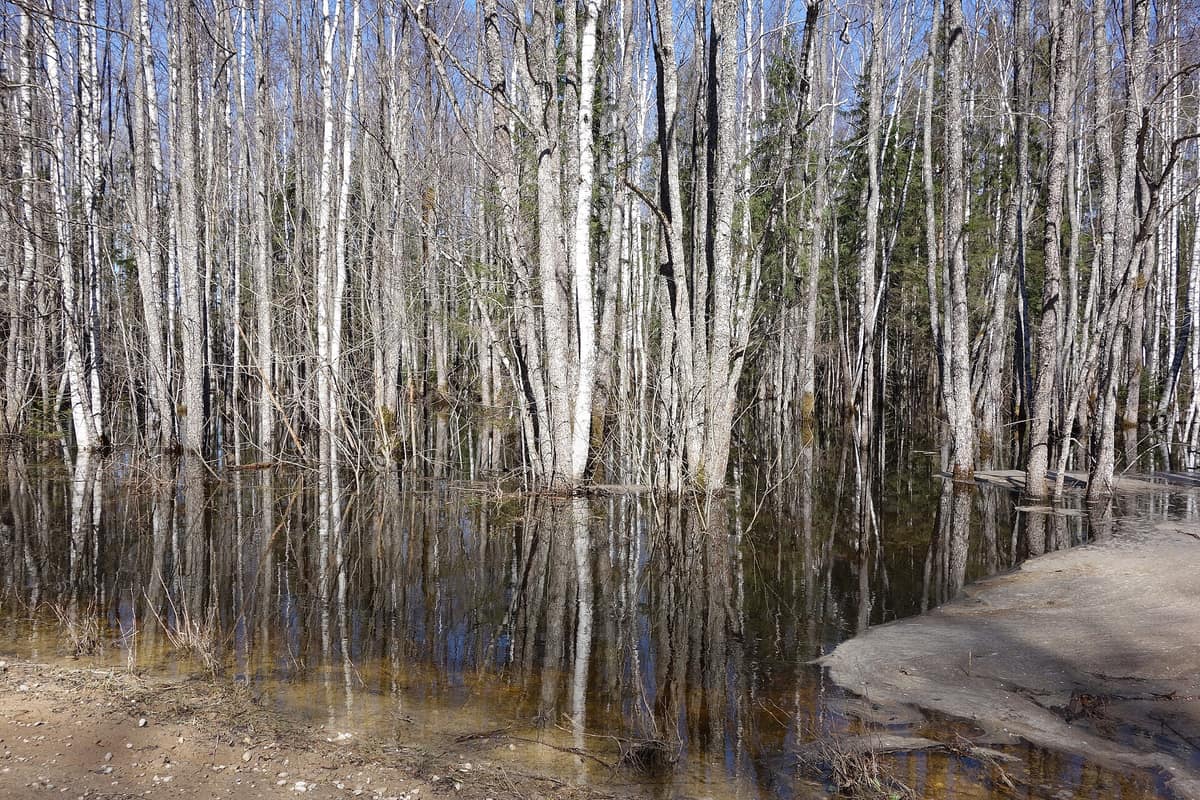
In late March or early April, the waters rise abruptly. In certain years levels have surged by one meter a day for three or four days in succession. Floods submerge meadows, infiltrate forests, swallow roads, and leave entire sectors of the park cut off from dry land. In Soomaa this annual deluge is celebrated as the fifth season, and travel is by canoe. Soomaa literally means «land of bogs»: a national park of some 398 km² formed by five vast raised bogs (Valgeraba, Öördi, Riisa, Kikepera, and Kuresoo), separated by the Navesti, Halliste, Raudna, and Lemmjõgi rivers. It was established in 1993 to preserve raised bogs, floodplains, swamp forests, and meandering rivers.
What makes it unique
It is arguably the only place in Europe where the prehistoric tradition of dugout canoes survived intact into the twenty-first century, and where spring flooding constitutes a recognized fifth season.
The place
Nature
The landscape
The high-water phenomenon is immense: the Riisa floodplain extends across 175 km², forming the largest regular seasonal inundation zone in Estonia and northern Europe. At peak water levels, the flooded expanse can measure 7-8 km in breadth, with steep-edged raised bogs standing out like isolated islands in a vast lake. Flooding is triggered by rapid spring snowmelt when swollen meltwater overwhelms river channels.
When the floodwaters recede, the peat domes dominate the horizon. Kuresoo is one of the two best-preserved expansive raised bogs in Estonia; its southern margin drops 8 meters toward the Lemmjõgi across a span of only 100 m. Along the eastern fringe of the park rise the highest inland sand dunes in mainland Estonia, roughly 50 km from the current Baltic coast; the Ruunaraipe dunes reach 12 meters in height.
Alluvial meadows and riparian woodlands hold tremendous botanical interest, supporting some 200 plant species including Gladiolus imbricatus, Iris sibirica, and Sedum telephium. In total, Soomaa sustains nearly 540 vascular plant species, over 200 bryophytes, and more than 360 fungi, with at least 29 species under statutory protection.
Wildlife and seasons
Soomaa shelters a substantial share of Estonia's large mammal fauna. Roe deer, moose, and wild boar represent the most abundant ungulates, while Eurasian beaver, Eurasian lynx, grey wolf, and brown bear occur regularly. The park functions as a key research hub for Estonian large carnivores and herbivores, featuring continuous GPS tracking of lynx and wolves since 2004. Mammal species exceed 40, accompanied by roughly 150 bird species, 20 fish, four reptiles, six amphibians, and 35 dragonfly species.
For avifauna, the park serves as a prime migratory staging ground. It consistently hosts over 1 % of regional populations of Bewick's swan and common crane: in autumn roughly 1.000 cranes and 500 swans stage here, whereas spring passage gathers around 2.000 swans. Recorded nesting or staging raptors and waders include golden eagle, whimbrel (over 100 breeding pairs), European golden plover (about 150 pairs), merlin, willow ptarmigan, and Montagu's harrier.
Species
With a page in the atlas
Being mentioned in a source doesn't guarantee sightings: check with the people who manage the area.
Memory and protection
History and conservation
Soomaa has been designated a Ramsar wetland since 1997 and joined Natura 2000 in 2004. In 2009 it received PAN Parks wilderness certification as one of the largest pristine bog wilderness complexes in Europe. Human population density has plummeted more than tenfold; in 2011 only 87 residents lived within the park.
Before you set off
Visiting
How to visit
Start at the visitor center in the heart of the park at Kõrtsi-Tõramaa. Completed in 1998 at a historic winter crossroads between Pärnu and Viljandi, it hosts the permanent exhibition «Travelling in Soomaa in an Expanded Dugout Canoe», with the Beaver Trail setting off directly outside. The center offers trail maps, guidebooks, and films. From 31 August to 31 May it opens Tuesday to Saturday from 10.00 to 16.00, and from 1 June to 30 August Monday to Friday from 09.00 to 17.00 and weekends from 10.00 to 18.00.
Trails combine footpaths and raised wooden boardwalks across the wet peat. Riisa (5 km, about 3 h) and Ingatsi (4,5 km, about 3 h) lead to timber observation towers overlooking the Riisa and Kuresoo bogs. The Beaver Trail covers 2 km (1,5 h) through beaver habitat and flooded forest. The Tõramaa Trail, 2,5 km long and requiring around 3 h, traverses the bird-rich Halliste floodplain meadow and features a wildlife viewing tower. The Kuresoo Trail, spanning 32 km over two days, links wilderness landscapes and cultural sites. The trail network includes boardwalk sections accessible for wheelchairs and strollers.
Canoeing season spans from April to October; outfitters offer guided excursions in traditional aspen dugout canoes and summer dugout-building workshops. In winter, when bogs freeze solid, snowshoeing and kicksled trips take place, alongside cross-country skiing when snow cover allows.
From the observation tower overlooking the wooded meadow of Tõramaa along the Halliste river, you can watch wildlife, ancient oaks, and seasonal high water or frozen floodplains.
Before you go
Stick strictly to marked trails and designated parking areas: soft peat soils cannot support vehicular weight. During spring flooding water inundates access roads and isolates park sectors. The premier window for experiencing the high-water phenomenon is late March and early April.
Check access, rules and visiting conditions in the official information from the managing body before you set off.
Location
Where it is and how far it reaches
Boundary of Soomaa rahvuspark · © EEA, CDDA (CC-BY) The coordinate is estimated; it isn't a verified access point.
Transparency
Sources
The research data with its sources, and the official links for this place, are in the Spanish version of this page. See the Spanish version
Around it
While Soomaa has no immediate neighbors in the atlas, it shares ecological affinities with distant wilderness areas. Šumava National Park in Czechia and Kampinos National Park - Strict Protection Area in Poland share peatlands, mature woodlands, moose, beaver, and lynx; Aukštaitija National Park and Žemaitija National Park in Lithuania share moose, beaver, and wolf.
If you like this place, elsewhere in Europe
Distant places with uncommon wildlife and habitats in common. The most widespread species don't count. Sharing species doesn't imply a corridor or guaranteed presence.
- Lake Peipus and Emajõgi River Delta
Tartumaa (Kallaste / Varnja / Luunja)
In common: Iris sibirica · Moose — wetland
Europe's fifth-largest lake (3,500 km²) and the vast uninhabited wilderness wetland of the Emajõgi delta.
JFMAMJJASONDMay – October · Crowding very low
Entry #1010 of the original atlas.