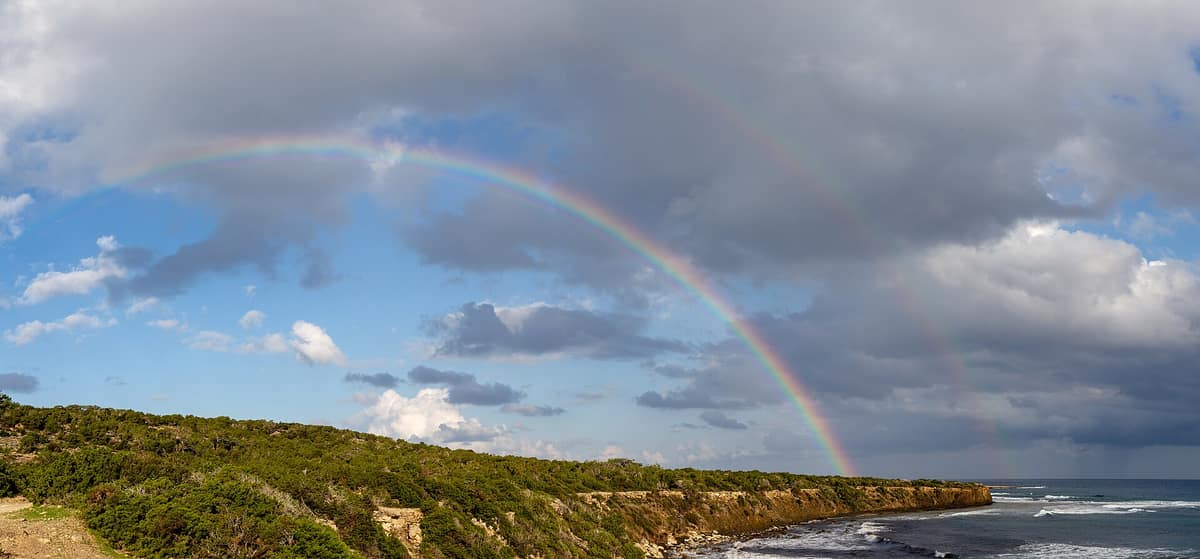
Akamas Peninsula
Χερσόνησος Ακάμα
Cyprus (Paphos — Polis / Latchi) · Cyprus
Photo: Michal Klajban · CC BY-SA 4.0 · Wikimedia Commons
Mediterranean scrub and woodland, rugged gorges, and vital nesting beaches for green and loggerhead sea turtles in northwestern Cyprus.
Until the year 2000, gunfire from the British armed forces frequently echoed across the northwestern tip of Cyprus, where the Akamas Peninsula served as an active military training and firing range. With that turmoil subsided, what stands revealed is a pristine mosaic: dense pine groves, arid garrigue, limestone ravines, sea cliffs, and secluded coves where marine turtles nest. Bordered by Pegeia to the south and Polis to the northeast, Akamas unfolds from the inside out: from ancient botanical refuges down to golden sandspits where, each summer, new turtle hatchlings begin life.
What makes it unique
Brings together plants strictly endemic to the gorges of Akamas alongside pristine beaches where the loggerhead sea turtle and green turtle lay their eggs.
The place
Nature
The landscape
To grasp Akamas one must begin with its bedrock, which dictates every habitat. The northwest is dominated by ophiolitic complexes and volcanic pillow lavas mingled with metabasalts, diabases, and serpentine intrusions. Elsewhere the geological palette shifts: Pleistocene marine conglomerates and stepped calcarenite terraces cover much of the plateau. Soil conditions dictate the vegetation mantle: Aleppo and Calabrian pine woods, garrigue scrub, coastal scarps, and sandy coves.
Stands of Turkish pine (Pinus brutia) occur almost exclusively on state forest land. On the northern flanks yawn the impressive defiles of Androlykou and Petratis. Along the coast behind the embryonic foredunes of Lara, stabilised fossil dunes are anchored by mastic bushes and Phoenician juniper. Maritime air tempers the Mediterranean aridity. This fertility is ancient knowledge: Ptolemy described Akamas as a densely wooded headland.
To read the peninsula like a stone archive, visit the Geology and Paleontology Information Centre in Pano Arodes. It interprets regional strata, fossil assemblages, Cyprus's tectonic emergence, geomorphology, seismicity, and the history of copper mining.
Wildlife and seasons
Endemic micro-flora rivals charismatic megafauna in significance. Akamas safeguards an extraordinary share of Cyprus's endemic plants: wild cyclamens, the Cyprus tulip, rare terrestrial orchids, the exclusive local endemic Alyssum akamasicum, alongside Cyclamen cyprium, Gagea juliae, and Gladiolus triphyllus. Species of special conservation interest include Centaurea veneris, Ophrys kotschyi, and Tulipa cypria.
Among them, Centaurea akamantis clings exclusively to damp, shaded limestone gorge walls within the Akamas State Forest and Natura 2000 site. It flowers from May to November and fruits from July to December. Its existence relies entirely on these cliff faces remaining pristine: observe it from trails without disturbing the rock. Along the Aphrodite Trail look out for Onosma fruticosa and Cyprus sage (Phlomis cypria).
Terrestrial fauna includes red fox and long-eared hedgehog, alongside the Cyprus warbler and Cyprus scops owl. Vulnerable species feature cave-roosting bats, the Mediterranean monk seal, and marine turtles—the stars of the summer season.
At Lara, municipal monitoring tracks loggerhead sea turtle nesting between late May and early August. Green turtles begin depositing clutches roughly two weeks later, with hatchlings emerging approximately seven weeks after laying. In Lara Bay clutches are protected within a wire-cage hatchery. The dunes face stealthy pressures: marine plastics, light and acoustic disturbance, and beach erosion. Keep your distance and respect protective measures.
Species
With a page in the atlas
Being mentioned in a source doesn't guarantee sightings: check with the people who manage the area.
Memory and protection
History and conservation
Following its military firing range era, two prime nesting beaches were designated as Sites of Community Importance and the peninsula became a Special Protection Area. Protection remains narrower than proposed: of the terrestrial surface nominated in 2003 for Natura 2000, authorities formally designated barely 50 % in 2009.
Threats persist: commercial tourism expansion and the planned A7 motorway between Polis and Paphos generate heavy encroachment, while unauthorised off-road driving damages coastal foredunes at Toxeftra. Consequently, official regulations at Lara–Toxeftra ban motor vehicles from beaches, and the Lara Nature Reserve prohibits beach umbrellas and sunbeds.
Before you set off
Visiting
How to visit
The natural springboard is the Baths of Aphrodite near Polis, where mythological lore situates the goddess's pool. The 7.5-kilometer Aphrodite Trail begins here. Adjacent to the spring, the Department of Forests botanical garden showcases regional habitats in miniature, with nature paths, aquatic pools, and preserved scrub. It serves as an informative orientation point before setting out onto open trails.
For shorter loops, Smigies features a 2.5-kilometer trail and a 6-kilometer route, while Pissouromoutti spans 3 kilometers from the same recreation site.
For turtle education, head to Ineia. Since 2023 the village has hosted the Innia–Lara Turtle Museum, dedicated to chelonian ecology, alongside an environmental education centre offering digital exhibits. The Aphrodite Cultural Route information point, facing Archangelos Michail chapel, supplies orientation maps and multimedia (distinct from the Baths trail). At Ammoudi, in northern Lara Bay, the Department of Fisheries operates a research station dedicated to turtle preservation amid wind-sculpted sand dunes.
Before you go
Check trail accessibility with the Department of Forests before setting out: in October 2026 the Aspros Potamos–Toxeftra track was closed. Municipal signage directs access from Ineia via Pittokopos to the Pegeia–Lara coastal road. Check centre operating hours and obey beach sanctuary notices: driving on sand and planting beach umbrellas are strictly forbidden.
Check access, rules and visiting conditions in the official information from the managing body before you set off.
Location
Where it is and how far it reaches
Boundary of Akamas (FD) · © EEA, CDDA (CC-BY) The coordinate is estimated; it isn't a verified access point.
Transparency
Sources
The research data with its sources, and the official links for this place, are in the Spanish version of this page. See the Spanish version
Around it
Akamas has no immediate neighbors in the atlas, but several distant parallels. Zakynthos National Marine Park shares loggerhead turtles and Mediterranean monk seals across marine habitats. The Meseta Kárstica y Acantilados de La Mola also shares loggerheads, while the Reserva Natural Marina de Rocha do Navio shelters monk seals. With Parque Natural de Mondragó it shares coastal mastic and juniper scrub.
If you like this place, elsewhere in Europe
Distant places with uncommon wildlife and habitats in common. The most widespread species don't count. Sharing species doesn't imply a corridor or guaranteed presence.
- Lastovo Archipelago Nature Park
Dubrovnik-Neretva (Lastovo Island)
In common: Green turtle · Mediterranean monk seal · Loggerhead sea turtle — wild coast, mediterranean forest, marine
One of Croatia's most remote inhabited islands and dozens of islets, with pristine night skies and largely undisturbed seabed ecosystems.
JFMAMJJASONDMay – June · September – October · Crowding very low
- Mondragó Natural Park
Balearic Islands (Mallorca / Santanyí)
In common: Pistacia lentiscus · Juniperus phoenicea — wild coast
White-sand coves nestled between coastal juniper groves, wild olive ravines and the freshwater wetlands of Ses Fonts de n’Alis.
JFMAMJJASONDApril – June · September – October · Crowding moderate
Entry #1044 of the original atlas.