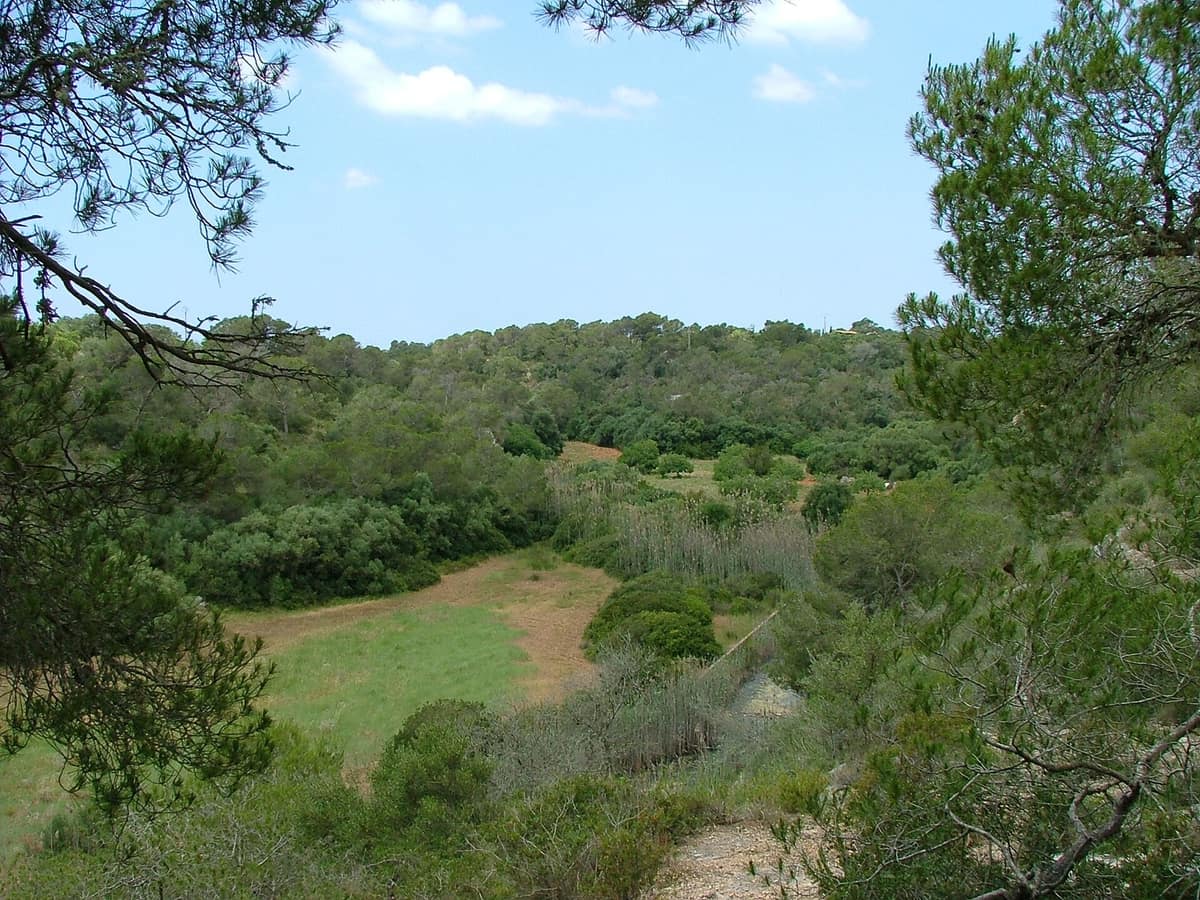
Mondragó Natural Park
Parque Natural de Mondragó
Balearic Islands (Mallorca / Santanyí) · Spain
Photo: diba · CC BY-SA 2.0 de · Wikimedia Commons
White-sand coves nestled between coastal juniper groves, wild olive ravines and the freshwater wetlands of Ses Fonts de n’Alis.
Around 6 million years ago, this landscape was neither farmland nor juniper grove: a shallow tropical sea with coral reefs bathed ancient Mallorca. That primordial seabed now forms the island’s southeastern coast in Santanyí, and Mondragó Natural Park is the best way to explore it on foot: narrow sea inlets, two coastal lagoons, wild olive garrigue and an intricate mosaic of dry-stone enclosures.
What makes it unique
A compact coastal mosaic uniting pine forests, wetlands, dunes, cliffs and sea caves, framed by active dry-stone agricultural terraces.
The place
Nature
The landscape
The bedrock tells the geological story. At the base of coastal cliffs lies a fossil reef preserving corals and calcareous algae; above sit the Santanyí limestones, and on the shoreline rests marès, calcarenite sandstone formed from prehistoric beaches and dunes. Seasonal torrents subsequently carved deep ravines, and rising seas drowned their mouths, creating long, sheltered calas such as Cala Mondragó.
Garrigue scrub blankets the rocky terrain, dominated by wild olive alongside Phoenician juniper and Aleppo pine, with mastic, rockrose and rosemary filling the understorey. Along canyon bottoms where deeper soil retains moisture, fragmented holm oak woodlands find a sheltered refuge.
Freshwater and sea meet in two coastal lagoons: s’Amarador and ses Fonts de n’Alis. In the latter, salinity encourages sea rush and glasswort. In s’Amarador, fresher water supports dense reedbeds. Behind s’Amarador beach lies a fragile dune belt anchored by sea daffodils and sea holly, while wind-sculpted rocky shelves sustain rock samphire and the Balearic endemic hedgehog lettuce (Launaea cervicornis).
Interspersed across the park are traditional rural plots enclosed by dry-stone walls (marges), where almond, carob and fig trees flourish alongside old waterwheels, irrigation channels and cisterns.
Wildlife and seasons
Mondragó offers exceptional birdwatching across varied coastal habitats. Around a hundred bird species have been recorded, many pausing at the freshwater ponds during trans-Mediterranean migrations between Europe and Africa. The lagoons attract mallard, common moorhen and Eurasian coot. Along maritime cliffs, the European shag and Audouin's gull patrol the coastline. Raptors include the peregrine falcon, the red kite and the osprey, while dense scrub provides nesting territory for great tits and hoopoes.
Among reptiles, Hermann's tortoise is the flagship species, bolstered by captive-breeding releases since the park’s creation. Ponds host viperine snakes and the green toad (calàpet), which breeds in temporary pools. Mammals include hedgehogs, wood mice, least weasels, pine martens and the common genet.
Seasonally, wild orchids bloom across forest glades, including the dark bee orchid, autumn lady's-tresses and the endemic Balearic orchid (Ophrys balearica).
Species
With a page in the atlas
Being mentioned in a source doesn't guarantee sightings: check with the people who manage the area.
Memory and protection
History and conservation
Mondragó was designated a natural park in 1992. It belongs to Natura 2000 as both a Special Protection Area and a Special Area of Conservation, while also holding Balearic Natural Area of Special Interest status. Of its 766 hectares, only 95 are public property; the remainder consists of small private agricultural estates dedicated to traditional dry farming, making park conservation inseparable from agrarian stewardship.
At Caló d’en Garrot, coastal dunes have suffered historic degradation from unauthorized vehicle access.
Before you set off
Visiting
How to visit
The park features five signposted walking trails, all easy and taking between 15 and 60 minutes: Ses Fonts de n’Alis viewpoint, the Sa Guàrdia d’en Garrot loop, Sa Punta de ses Gatoves, S’Amarador and S’Hort d’en Metge. The viewpoint trail links the main car park to the beach through coastal pine woods along the lagoon. The Sa Punta de ses Gatoves trail through coastal junipers is fully accessible for visitors with reduced mobility. Visitors requiring assistance can request an all-terrain Joëlette chair.
The visitor information centre is located beside the Ses Fonts de n’Alis car park and provides recommendations suited to your interests. Free guided tours are offered year-round by advance reservation.
Before you go
Walk quietly and remain on signposted footpaths to avoid disturbing nesting wildlife and fellow visitors. Wildfire risk is acute; open fires and smoking are strictly forbidden. Dogs must be kept on a leash and are prohibited on beaches. There are no waste bins in the park, so pack out all trash. Respect historical dry-stone structures and private farmland.
Check access, rules and visiting conditions in the official information from the managing body before you set off.
Location
Where it is and how far it reaches
Boundary of Mondragó · IUCN II · © EEA, CDDA (CC-BY) The coordinate is estimated; it isn't a verified access point.
Transparency
Sources
The research data with its sources, and the official links for this place, are in the Spanish version of this page. See the Spanish version
Around it
Beyond Mallorca, the park shares Mediterranean coastal affinities with Cap de Creus Natural Park (Aleppo pine, European shag and Hermann's tortoise), the Akamas Peninsula (mastic and Phoenician juniper) and Lastovo Archipelago Nature Park (Aleppo pine and Audouin's gull).
If you like this place, elsewhere in Europe
Distant places with uncommon wildlife and habitats in common. The most widespread species don't count. Sharing species doesn't imply a corridor or guaranteed presence.
- Cap de Creus Natural Park
Catalonia (Girona / Cadaqués / El Port de la Selva / Roses)
In common: Tarentola mauritanica · Pinus halepensis · European shag — wild coast
The easternmost point of the Iberian Peninsula, where the Pyrenees plunge into the sea in a labyrinth of metamorphic schists sculpted by the tramontana.
JFMAMJJASONDApril – June · September – October · Crowding moderate
- Akamas Peninsula
Cyprus (Paphos — Polis / Latchi)
In common: Pistacia lentiscus · Juniperus phoenicea — wild coast
Mediterranean scrub and woodland, rugged gorges, and vital nesting beaches for green and loggerhead sea turtles in northwestern Cyprus.
JFMAMJJASONDApril – June · September – October · Crowding low
- Lastovo Archipelago Nature Park
Dubrovnik-Neretva (Lastovo Island)
In common: Pinus halepensis · Audouin's gull — wild coast
One of Croatia's most remote inhabited islands and dozens of islets, with pristine night skies and largely undisturbed seabed ecosystems.
JFMAMJJASONDMay – June · September – October · Crowding very low
Entry #636 of the original atlas.