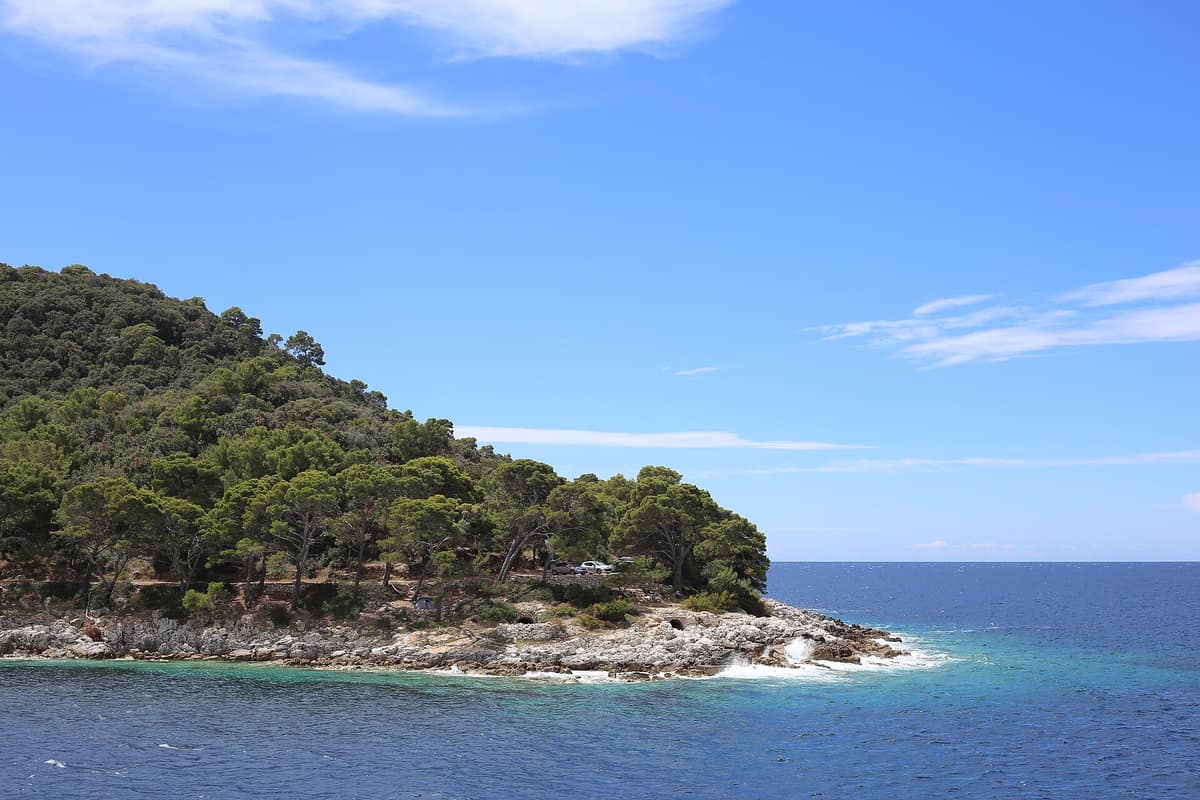
Lastovo Archipelago Nature Park
Park prirode Lastovsko otočje
Dubrovnik-Neretva (Lastovo Island) · Croatia
Photo: Adzelalija · CC BY-SA 4.0 · Wikimedia Commons
One of Croatia's most remote inhabited islands and dozens of islets, with pristine night skies and largely undisturbed seabed ecosystems.
On a summer night on the islet of Zaklopatica, shearwater parents and chicks call to each other through the pitch darkness. That eerie, haunting cry is the signature soundtrack of Lastovo. Lastovo is one of the most remote inhabited islands in the Adriatic, lying south of Korčula, and its nature park, designated by the Croatian Parliament on 29 September 2006, encompasses 46 islands, islets, rocks, and reefs: 53 km² of land and 143 km² of sea. The largest are Lastovo and Sušac.
What makes it unique
A remote archipelago of 46 islands, featuring a forested island of lush maquis, one of Europe's darkest night skies, and major colonies of shearwaters and Audouin's gulls.
The place
Nature
The landscape
Lastovo is built of ancient rock: Jurassic and Cretaceous strata, predominantly dolomite, dolomitised limestone, and pure limestone. Hum, at 417 m, is its highest point and finest viewpoint. Underground, the best-known cave is Rača, protected since 1965; Medjedina, a former refuge of the Mediterranean monk seal, is now known for its large bat colonies.
About 70 % of the island group is cloaked in woodland, making Lastovo, together with Mljet, Croatia's most wooded island. Maquis dominates, featuring strawberry trees, holm oaks, and Aleppo pine woods. An impressive 810 plant species have been documented, including Aurinia leucadea and the grass Ampelodesmos mauretanica, which grows nowhere else in Croatia. On the outlying island of Sušac, 278 species and eight endemics thrive, notably Brassica cazzae, which clings to crevices in the coastal cliffs.
The climate is mild Mediterranean, with around 2700 hours of sunshine annually, and snowfall is an extreme rarity.
Wildlife and seasons
Birds provide the greatest spectacle. The archipelago serves as a vital resting haven for migratory birds and a prime nesting ground for the Yelkouan shearwater and Scopoli's shearwater. On Zaklopatica shearwaters nest in burrows, and on summer nights their haunting voices ring out as parents reunite with chicks. They fly over 400 km a day foraging at sea, live between 25 and 30 years, and lay just a single egg each year. On the islets of Lastovnjaci and Vrhovnjaci nests around 70 % of Croatia's population of the globally threatened Audouin's gull, while the rare Eleonora's falcon nests on the cliffs of Struga.
During seasonal migrations, the Lastovo-Palagruža-Pelješac flyway forms a bottleneck for raptors and cranes: more than 700 European honey buzzards and more than a thousand cranes reliably rest here.
Underwater, shallow coastal shallows are draped in lush meadows of posidonia, protected and crucial as nursery and feeding grounds. Gorgonian fans, red coral, and the endemic Hvar coral thrive on reef walls. In open water, several dolphin species appear frequently: short-beaked common, bottlenose, and Risso's; as do loggerhead and green sea turtles. The Mediterranean monk seal formerly inhabited Medjedina Cave, and sporadic sightings by islanders keep hope of its return alive. There are no venomous snakes on land; the only snake is the Caspian whipsnake (Dolichophis caspius). Medjedina Cave shelters three species of threatened bats, including the greater horseshoe bat.
Species
With a page in the atlas
Being mentioned in a source doesn't guarantee sightings: check with the people who manage the area.
Memory and protection
History and conservation
In Ubli stand the ruins of a single-nave sixth century basilica of Saint Peter. In the Middle Ages, Lastovo retained internal autonomy under nominal Byzantine rule while Croats settled the adjacent mainland. The Struga lighthouse, built in 1839, perches 90 m above the waves.
Across the archipelago, 175 vertebrate species have been recorded, 71 of them nationally threatened and 37 protected across Europe. The marine waters support 330 invertebrate species, 20 of which are threatened.
Before you set off
Visiting
How to visit
Arrival on Lastovo is by ferry or catamaran. Once on the island, there are three main ways to explore: on foot, by boat, and by night.
On foot, the «Preko sadašnjosti u prošlost» trail measures 6.4 km, takes about two hours, has medium difficulty, and features 11 panels; it weaves through Aleppo pine woods and holm oak, past fields with ponds, vineyards, and olive groves, and through Lastovo village. The «Artina» path leads from Zaklopatica to Lastovo in 45 minutes with six panels on Audouin's gulls and both shearwater species; its name comes from the local islanders' word for the shearwater. The «Hermitage Trail» offers two walking routes among stone chapels: one taking 1 hour and 30 minutes and another of 3 hours. Of the 46 stone chapels, 21 are officially registered as protected cultural heritage.
From the Sozanj viewpoint on the road between Ubli and Lastovo, you can see Zaklopatica and the Lastovnjaci islets; about 300 m higher, the panorama extends to Vis, Korčula, and Mljet. The park's guided educational boat trip departs at 9:00 and lasts around 4 hours; booking ahead is required.
By night: a southern viewpoint is the prime spot to admire Lastovo's night sky, the second darkest in Europe with minimal light pollution. The park runs stargazing sessions two to three times a week from Hum or other panoramic viewpoints with laser pointers and telescopes; the archipelago is a candidate International Dark Sky Park. Nights can turn chilly: bring long-sleeved clothing.
Before you go
Boats must moor to buoys rather than dropping anchor, and anchoring in posidonia seagrass meadows is strictly prohibited. The recommended months for visiting are May, June, September, and October.
Check access, rules and visiting conditions in the official information from the managing body before you set off.
Location
Where it is and how far it reaches
Boundary of Lastovsko otočje · IUCN V · © EEA, CDDA (CC-BY) The coordinate is estimated; it isn't a verified access point.
Transparency
Sources
The research data with its sources, and the official links for this place, are in the Spanish version of this page. See the Spanish version
Around it
Nacionalni park Mljet is fifteen kilometres away. Further afield, Parc national de Port-Cros, Parco Nazionale dell'Arcipelago Toscano, and Parc national des Calanques share Yelkouan shearwaters, Scopoli's shearwaters, and posidonia, while Parc Natural del Cap de Creus shares Yelkouan shearwaters, posidonia, and bottlenose dolphins.
What else to explore nearby
Approximate straight-line distance between the edges of each area. It doesn't indicate access, routes or driving times.
- Mljet National Park
Dubrovnik-Neretva (Island of Mljet — Pomena / Polače)
About 15 km away
The western end of the island of Mljet: Mediterranean forests of Aleppo pine and holm oak embracing two saltwater lakes with an island monastery.
JFMAMJJASONDMay – June · September – October · Crowding moderate
If you like this place, elsewhere in Europe
Distant places with uncommon wildlife and habitats in common. The most widespread species don't count. Sharing species doesn't imply a corridor or guaranteed presence.
- Karst Plateau and Cliffs of La Mola
Balearic Islands (Formentera / El Pilar de la Mola)
In common: Eleonora's falcon · Audouin's gull · Loggerhead sea turtle — wild coast, marine
Independent limestone plateau elevated 200 m above the sea with precipitous desert-like cliffs at the eastern tip of Formentera.
JFMAMJJASONDApril – June · September – October · Crowding low
- Selvagens Islands Nature Reserve
Autonomous Region of Madeira (Selvagem Grande / Selvagem Pequena)
In common: Short-beaked common dolphin · Loggerhead sea turtle · Scopoli's shearwater — wild coast, marine
Portugal's southernmost territory and one of Europe's oldest strict marine reserves (1971), harbouring the world's densest colony of Cory's shearwater (Calonectris diomedea).
JFMAMJJASONDMay – September · Crowding none
- Port-Cros National Park
Provence-Alpes-Côte d'Azur (Var / Hyères)
In common: Yelkouan shearwater · Scopoli's shearwater · Posidonia oceanica — wild coast, marine, mediterranean forest
One of the oldest marine parks in Europe (1963): an island cloaked in Mediterranean forest and posidonia seabed protected for sixty years.
JFMAMJJASONDMay – June · September – October · Crowding moderate
Entry #1051 of the original atlas.