Port-Cros National Park
Parc national de Port-Cros
Provence-Alpes-Côte d'Azur (Var / Hyères) · France
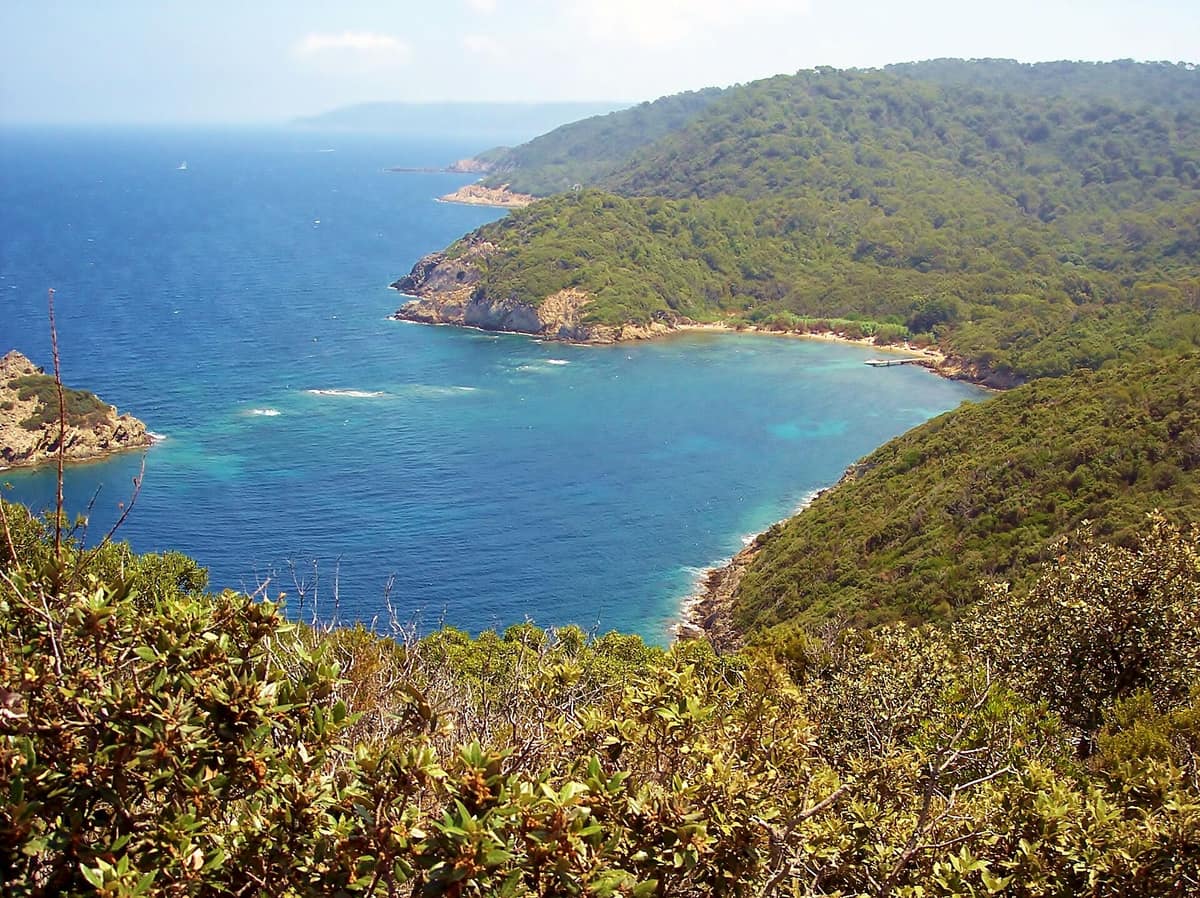
Photo: Espirat · CC BY-SA 4.0 · Wikimedia Commons
One of the oldest marine parks in Europe (1963): an island cloaked in Mediterranean forest and posidonia seabed protected for sixty years.
Before becoming a national park, Port-Cros was an island for sale. In 1937, after fifteen years of lawsuits, it went to auction, with a property developer waiting in the wings. Paule Desmarais bought it, rescuing its pristine beauty. Today Port-Cros National Park, in the Hyères archipelago, is both a terrestrial and marine park: 1.700 ha of land and 2.900 ha of sea, spanning Porquerolles, Port-Cros, Bagaud, the islet of La Gabinière, and the Rascas rock.
What makes it unique
It was the first national park in Europe to unite terrestrial and marine protection, and the birthplace of the Mediterranean's first snorkeling underwater trail.
The place
Nature
The landscape
Port-Cros is a steep, forested rock rising from the Mediterranean. Only 4,2 km long and 2,4 km wide, its coastline alternates dramatic cliffs plunging into deep blue waters with small sheltered coves: the bay of Port-Cros, the bay of Port-Man, and the calanque de la Palud. Valleys converge toward the sea, fed by seasonal streams that support dense green woodlands. Less than 10 km from the southern shore of Port-Cros, the continental slope plunges to 2.000 m deep.
The forest has a fiery past. Holm oak woods once cloaked virtually the entire island except for arid exposed ridges; in 1870 wildfire devastated almost the entire island, and today ancient holm oaks survive primarily in shaded valley bottoms. The flora counts some 700 species, including rarities such as Linum maritimum and narrow endemics like Delphinium requienii. Coastal halophytic vegetation is lush yet exceptionally vulnerable to trampling.
Beneath the surface, the Mediterranean's foundational habitats unfold: expansive meadows of posidonia harboring salema and saddled seabream, coralligenous drop-offs patrolled by dusky groupers, morays, and dentex, and sandy shoals relentlessly sifted by schools of red mullet.
Wildlife and seasons
The park's undisputed celebrity is the dusky grouper, with an artistic pedigree: Jojo the grouper, star of Cousteau's The Silent World, filmed right here at Port-Cros. Once decimated by spearfishing, the population has rebounded within the marine reserve since the nineteen-eighties, surging over sixty years from just 40 individuals to nearly 1.000. The islet of La Gabinière is renowned among divers worldwide for its dense congregations of groupers.
In surrounding waters roam the common bottlenose dolphin, long-finned pilot whale, devil rays, loggerhead sea turtle, and occasional barracudas.
High above, sea cliffs host thriving seabird colonies. The Scopoli's shearwater colony on neighboring Porquerolles is the largest along French shores, and nearly 90 % of breeding Yelkouan shearwaters nest along this coastline. The peregrine falcon claims its cliff niches and Eleonora's falcon is a regular visitor. Across spring and autumn migrations, hordes of passerines make landfall. Overall, 144 bird species have been recorded, 40 of them breeding locally.
Terrestrial rarities include the Tyrrhenian painted frog and the European leaf-toed gecko, a small nocturnal reptile in decline. Researchers have documented 13 bat species.
Species
With a page in the atlas
Being mentioned in a source doesn't guarantee sightings: check with the people who manage the area.
Memory and protection
History and conservation
For centuries Port-Cros served as a strategic military outpost. In 1531 Francis I established a marquisate over the Îles d'Hyères—Bagaud, Port-Cros, and Levant—to counter Barbary corsairs, mandating defensive fortifications; Napoleon upgraded the bastions in 1811 and garrisoned the island's stone forts. Later the island became a haven for writers: the Fort de la Vigie hosted creative residencies for Malraux, Gide, Saint-John Perse, and Valéry.
The national park was established in 1963 through the advocacy of André Malraux, bolstered by land donations from Marceline Henry—the central champion of Port-Cros conservation in the twentieth century—and the heirs of Paule Desmarais. In 2012 protection expanded to encompass most of Porquerolles. The island of Bagaud and the islet of La Gabinière are designated strict nature reserves with all landing strictly prohibited. Since 1999 the park also coordinates the French sector of the Pelagos Sanctuary for Mediterranean marine mammals.
Modern challenges are acute. Wildfire risk escalates in summer, when drought and Mistral winds coincide with tourist arrivals, while the invasive Hottentot-fig threatens native cliff-dwelling flora. In 2023 the park was formally cited as vulnerable to overtourism, underscoring the urgent need to cap seasonal visitor flows.
Before you set off
Visiting
How to visit
Access is by passenger ferry from Hyères. Once ashore on Port-Cros, the park invites exploration by land and by sea.
On foot, the Sentier des Crêtes traverses the Fausse-Monnaie cove above the South Beach, ascends the Solitude valley, and reaches Mont Vinaigre at 194 m, the island's highest summit. By sea, the underwater trail of La Palud offers six interpretive buoys explored autonomously with fins, mask, and snorkel in the sheltered waters of La Palud bay. A classic day combines coastal hiking under shady pines with snorkeling along the underwater trail.
All motorized vehicles and bicycles are strictly banned on Port-Cros: travel is exclusively on foot.
Before you go
Summer crowds peak at Port-Cros harbor and on Porquerolles; the recommended visiting windows are May–June and September–October. Bagaud and La Gabinière are closed to the public. Always consult sailing guidelines, mooring zones, and open hiking sectors with the park office prior to visiting.
Check access, rules and visiting conditions in the official information from the managing body before you set off.
Location
Where it is and how far it reaches
Boundary of Port-Cros · IUCN II · © EEA, CDDA (CC-BY) The coordinate is estimated; it isn't a verified access point.
Transparency
Sources
The research data with its sources, and the official links for this place, are in the Spanish version of this page. See the Spanish version
Around it
Port-Cros has no immediate neighbors in the atlas, yet it shares pelagic seabirds and marine habitats with other Mediterranean archipelagos. Tuscan Archipelago National Park and Lastovo Archipelago Nature Park share Yelkouan shearwaters, Scopoli's shearwaters, and posidonia meadows. Cap de Creus Natural Park shares shearwaters, posidonia, and bottlenose dolphins.
If you like this place, elsewhere in Europe
Distant places with uncommon wildlife and habitats in common. The most widespread species don't count. Sharing species doesn't imply a corridor or guaranteed presence.
- Lastovo Archipelago Nature Park
Dubrovnik-Neretva (Lastovo Island)
In common: Yelkouan shearwater · Scopoli's shearwater · Posidonia oceanica — marine, wild coast, mediterranean forest
One of Croatia's most remote inhabited islands and dozens of islets, with pristine night skies and largely undisturbed seabed ecosystems.
JFMAMJJASONDMay – June · September – October · Crowding very low
- Cap Corse and Agriate Marine Natural Park
Corsica (Bastia / Saint-Florent / Centuri)
In common: Yelkouan shearwater · Scopoli's shearwater · Common bottlenose dolphin — marine, wild coast
The largest Marine Natural Park in metropolitan France (6.800 km²), safeguarding the pristine scrubland of the Agriates Desert and the Genoese towers of Cap Corse.
JFMAMJJASONDMay – October · Crowding low
- Cap de Creus Natural Park
Catalonia (Girona / Cadaqués / El Port de la Selva / Roses)
In common: Yelkouan shearwater · Posidonia oceanica · Common bottlenose dolphin — marine, wild coast
The easternmost point of the Iberian Peninsula, where the Pyrenees plunge into the sea in a labyrinth of metamorphic schists sculpted by the tramontana.
JFMAMJJASONDApril – June · September – October · Crowding moderate
Entry #1018 of the original atlas.