Mljet National Park
Nacionalni park Mljet
Dubrovnik-Neretva (Island of Mljet — Pomena / Polače) · Croatia
Photo: Andvladimir · CC BY-SA 4.0 · Wikimedia Commons
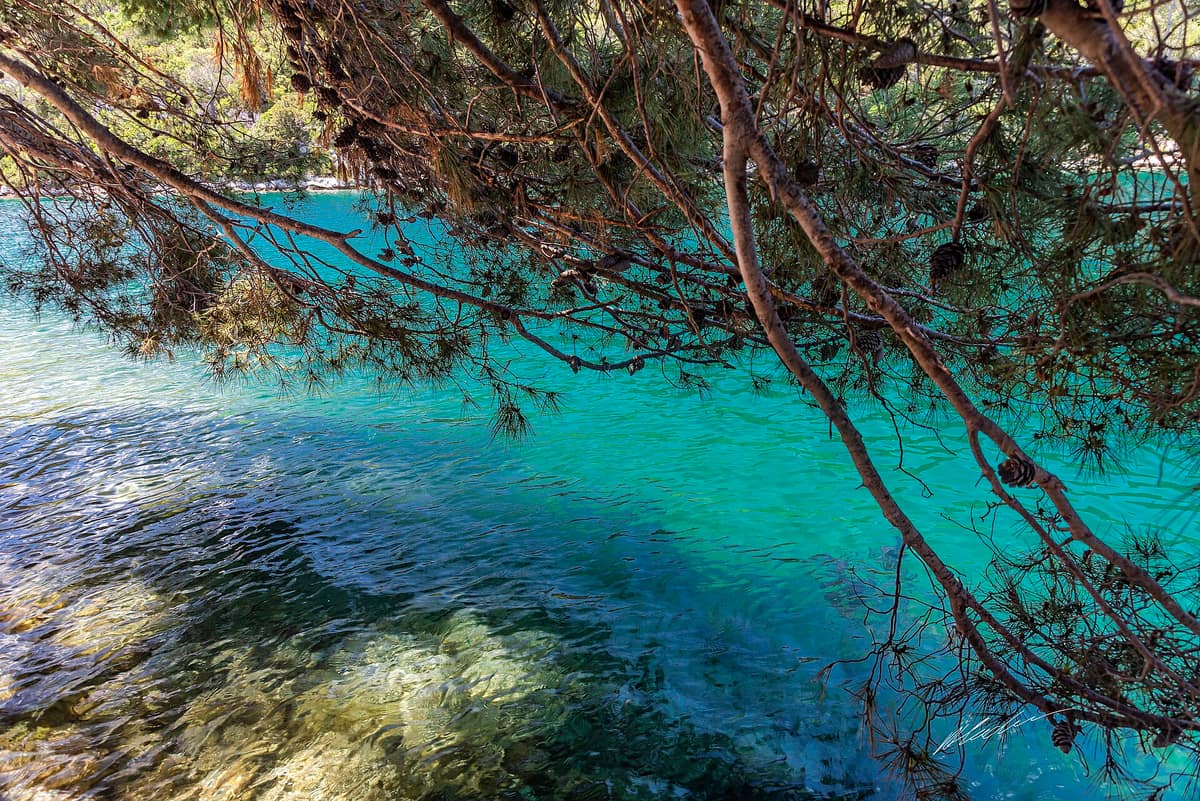
The western end of the island of Mljet: Mediterranean forests of Aleppo pine and holm oak embracing two saltwater lakes with an island monastery.
A lake that is not truly a lake. The two saltwater basins of Mljet, Veliko Jezero (Big Lake) and Malo Jezero (Small Lake), appear as tranquil inland waters embraced by pine woods, yet they are in fact a deep marine flooded depression formed when sea levels rose after the last Ice Age, occupying former karst sinkholes. In the middle of the Big Lake sits an islet crowned by a Romanesque Benedictine monastery. All this, alongside emerald woodlands spilling directly into the salt waters, forms Mljet National Park, spanning almost 5300 hectares, including a marine coastal belt extending 500 metres out to sea, encompassing roughly one-third of the island.
What makes it unique
Two saltwater lakes, an island monastery, and the endemic jellyfish Aurelia relicta, which exists nowhere else on Earth.
The place
Nature
The landscape
Virtually the entire park rests upon Cretaceous limestone and dolomite, where karst erosion has left an extensive subterranean legacy: sea caves, grottos, and deep sinkholes inhabited by endemic cave fauna, several named scientifically after Mljet where they were first discovered. Veliko Jezero spans 145 hectares and reaches depths of up to 46 metres; Malo Jezero covers 24 hectares with depths up to 29 metres. Both constitute an extraordinary geological and oceanographical phenomenon within the Adriatic karst. In the interior lie the "blatine", brackish marsh pools that occasionally dry out in summer, representing an important Natura 2000 wetland habitat across Europe.
Dense woodland is dominated by Aleppo pine: around the saltwater lakes, Goveđari, and Pomena bay, it forms the finest and most intact old-growth Aleppo pine forest in the Mediterranean basin. Forests blanket 90 % of the national park’s territory. Endemic coastal flora includes the Dubrovnik knapweed (dubrovačka zečina), Jupiter’s beard, and tree spurge. The climate is Mediterranean, marked by hot, dry summers and mild, rainy winters; in summer the maestral breeze blows almost daily, tempering midday heat.
Wildlife and seasons
The most extraordinary treasures lie beneath the waterline. The saltwater lakes shelter dense populations of bivalves: noble scallops, date mussels (strictly protected by law), and the noble pen shell (Pinna nobilis), which suffers mass mortality across the wider Mediterranean. Exclusively within the lakes of Mljet lives the endemic jellyfish Aurelia relicta, found nowhere else on the planet and harmless to swimmers. Furthermore, Veliko Jezero harbours the world’s largest bank of the colonial stony coral Cladocora caespitosa, sprawling over 650 m² at depths between 5 and 18 metres.
On land, birdlife is diverse, especially during seasonal migrations; in spring and summer common nightingales sing through the woodlands. Raptors include common kestrel, Eurasian sparrowhawk, European honey buzzard, and peregrine falcon, alongside nocturnal owls such as Scops owl, tawny owl, and Eurasian eagle-owl. Terrestrial mammals include wood mouse, hedgehog, numerous bat species, edible dormouse, and stone marten. Following the Second World War, European hare and fallow deer were introduced to the island, alongside mouflon and wild boar. Four snake species and four lizard species inhabit the island, with snakes becoming very scarce following the introduction of the small Indian mongoose in 1910.
Each autumn bird banding campaigns monitor avian migration across the park; during the most recent ringing effort, researchers ringed 604 individual birds belonging to 13 species, predominantly blackcaps and European robins.
Species
With a page in the atlas
Being mentioned in a source doesn't guarantee sightings: check with the people who manage the area.
Memory and protection
History and conservation
Human habitation on Mljet dates back to the second millennium BC, when Illyrian Ardiaean tribes settled the island. During the Roman era, administrators built the third-largest Roman palace on the eastern Adriatic coast at Polače, surpassed in size only by the Pula Arena and Diocletian’s Palace in Split.
The Benedictine monastery on the Islet of Saint Mary was erected between 1177 and 1198, beginning with the monastic cloister followed by the church of Saint Mary; it remains the most iconic sight in the park. At the Big Bridge, monks constructed a tidal mill powered by channel currents; the historic bridge was dismantled in 1958 and rebuilt in 2016. Under the Austro-Hungarian Empire, twelve Indian mongooses were brought from Vienna to eradicate venomous snakes, and the historic Naturschutzpark Meleda conservation initiative was proposed to protect the lakes and surrounding woodlands.
The national park was officially proclaimed on 11 November 1960. Mljet became the first marine protected area in Croatia, following tireless scientific advocacy led by Academician Branimir Gušić.
Before you set off
Visiting
How to visit
Access is by scheduled passenger ferries from Dubrovnik and the Pelješac peninsula, and by day-trip excursion catamarans from Korčula, Hvar, and Split, which dock primarily at Polače and Pomena. Entry into the national park is permitted solely through official entry points: Crna Klada, Pomena, and Polače. A primary road connection links via the car ferry from Prapratno to Sobra.
There are three main routes to explore the lakes. From Pomena, an easy stroll of 15 minutes reaches the Small Lake, followed by 10 minutes along the lakeside path to board the solar-powered boat at the Small Bridge across to Saint Mary’s Islet. From Polače, a one-hour path climbs to the Montokuc viewpoint, descending in 30 minutes to Soline before continuing 2,5 km along the Big Lake to Pristanište. From the Vrbovica car park by the Big Lake, a hike of 50 minutes reaches Montokuc. From Montokuc or Veliki Sladin Gradac, commanding vistas take in the entire park, the Pelješac channel, and open sea towards Korčula.
The park admission ticket includes a return ride aboard the solar-powered boat to the Islet of Saint Mary. Kayaks and mountain bikes can be rented to explore sheltered sea coves and tracks. The park offers guided educational tours, also by bicycle, in Croatian and English upon advance written request. The most rewarding months for visiting are May, June, September, and October.
Before you go
All fishing is strictly prohibited within Veliko and Malo Jezero and the Soline channel, and scuba diving is forbidden in both saltwater lakes. Wild camping and walking off trails through park woodlands at night are outlawed. Summer brings heavy visitor traffic from Dubrovnik catamarans.
Check access, rules and visiting conditions in the official information from the managing body before you set off.
Location
Where it is and how far it reaches
Boundary of Mljet · © EEA, CDDA (CC-BY) The coordinate is estimated; it isn't a verified access point.
Transparency
Sources
The research data with its sources, and the official links for this place, are in the Spanish version of this page. See the Spanish version
Around it
Lastovo Islands Nature Park lies 15 km away. Kornati National Park shares posidonia meadows and peregrine falcons with Mljet.
What else to explore nearby
Approximate straight-line distance between the edges of each area. It doesn't indicate access, routes or driving times.
- Lastovo Archipelago Nature Park
Dubrovnik-Neretva (Lastovo Island)
About 15 km away
One of Croatia's most remote inhabited islands and dozens of islets, with pristine night skies and largely undisturbed seabed ecosystems.
JFMAMJJASONDMay – June · September – October · Crowding very low
If you like this place, elsewhere in Europe
Distant places with uncommon wildlife and habitats in common. The most widespread species don't count. Sharing species doesn't imply a corridor or guaranteed presence.
- Kornati National Park
Šibenik-Knin (Kornati Archipelago — Murter)
In common: Pinna nobilis · Posidonia oceanica · Eurasian eagle-owl — wild coast
A labyrinth of nearly ninety barren limestone islands, featuring sheer sea cliffs ("crowns") plunging into the open Adriatic.
JFMAMJJASONDMay – June · September – October · Crowding moderate
- Cap de Creus Natural Park
Catalonia (Girona / Cadaqués / El Port de la Selva / Roses)
In common: Pinus halepensis · Posidonia oceanica · Eurasian eagle-owl — wild coast
The easternmost point of the Iberian Peninsula, where the Pyrenees plunge into the sea in a labyrinth of metamorphic schists sculpted by the tramontana.
JFMAMJJASONDApril – June · September – October · Crowding moderate
- Cape Kamenjak
Istria (Premantura)
In common: Pinna nobilis · Posidonia oceanica — mediterranean forest, wild coast
The southern tip of Istria: an undeveloped peninsula of coves, scrubland, and wild orchids.
JFMAMJJASONDApril – June · September – October · Crowding moderate
- Sierra de las Nieves National Park
Andalusia (Málaga — Ronda / Tolox / Yunquera)
In common: Martes foina · Eurasian eagle-owl · Peregrine falcon — mediterranean forest
Spanish fir forests (pinsapares), a relict conifer growing only in these ranges, over deep karst harboring some of the deepest chasms in Spain.
JFMAMJJASONDMarch – May · October – December · Crowding low
Entry #1050 of the original atlas.