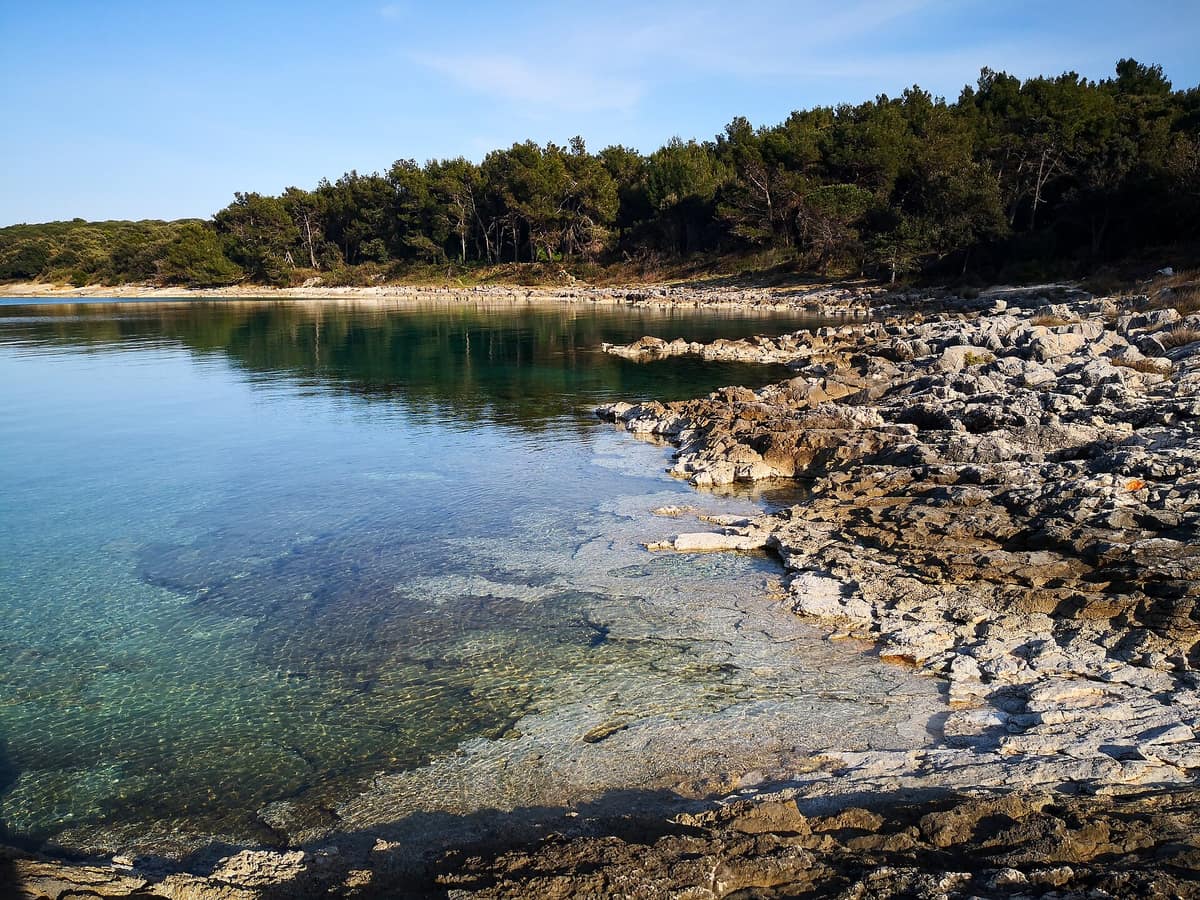
Cape Kamenjak
Donji Kamenjak i Medulinski arhipelag
Istria (Premantura) · Croatia
Photo: Anne2be · CC BY-SA 4.0 · Wikimedia Commons
The southern tip of Istria: an undeveloped peninsula of coves, scrubland, and wild orchids.
Nearly 100 million years ago, dinosaurs roamed through here, and you can still trace their footprints. Donji Kamenjak and the Medulin archipelago form the southern extremity of Istria, about 10 km from Pula: an undeveloped peninsula of white rock, coastal grasslands, and rocky shorelines. Here fossil trackways blend with more than 600 plant species, wild orchids that grow nowhere else north of Istria, and open sea frequented by dolphins.
What makes it unique
On a single peninsula you can walk on dinosaur footprints, wander among orchids found nowhere further north, and look out over seas frequented by dolphins and Posidonia meadows.
The place
Nature
The landscape
The white and grey limestone of the cape dates from the Cenomanian stage of the Late Cretaceous, some 98 to 93 million years ago, when the area lay submerged beneath the Tethys Ocean. Fossils are plentiful along its shores. Preserved in this stone are dinosaur tracks on the islet of Fenoliga and at Cape Grakalovac, holding immense palaeontological value: on Fenoliga alone around 150 prints have been recorded. The site contains tracks of both carnivores and herbivores, mostly aligned in trackways; the longest extends 19.5 m and comprises 39 footprints of a sauropod.
Above the rock shelf, the landscape forms a mosaic of open pine forest, dry grassland, rockrose scrub, garrigue, and bare crags. It was once entirely holm oak woodland, degraded over centuries by human cutting and heavy grazing until rich grasslands developed. These open habitats are protected under the EU Habitats Directive, and keeping them open is a management priority: as grazing has waned, Aleppo pine encroaches, threatening the specialist species that depend on open grassland.
The climate sustains these conditions. The reserve manager describes a dry Mediterranean climate: about 210 mm of rain annually, compared to 872 mm in neighbouring Pula or Medulin.
Wildlife and seasons
Spring and autumn are the periods most strongly recommended by the reserve managers, particularly late spring and early autumn for the fullest experience.
In spring, the dry meadows erupt into bloom. Around 30 species of orchids occur, and two are found exclusively in southern Istria, including Serapias istriaca. Among the threatened flora is Ophioglossum lusitanicum: first recorded in Croatia in the mid-nineteenth century, it went undetected for over a century before being rediscovered in 1974 near Pomer Bay, and since 1994 has been listed as critically endangered in the red book of Croatian flora. Anthemis tomentosa and Cicendia filiformis complete the register of rarities.
In the air, more than fifty species of butterflies take flight; painted ladies and red admirals arrive every year on migration from Africa. The arid climate favours reptiles: the slow worm, the European green lizard, and Italian wall lizards common all year round. Among large serpents are the Aesculapian snake and the four-lined snake, both growing over two metres in length, while the venomous nose-horned viper also dwells here, representing one of the peninsula's two venomous creatures alongside the black widow spider. The golden jackal, wild boar, red fox, roe deer, European badger, and red squirrel complete the mammalian fauna.
Beneath the surface, the common bottlenose dolphin uses the waters off western Istria primarily for feeding, with numerous mothers and calves sighted. On the seabed around the cape, only three living noble pen shells have been found, a species decimated by Mediterranean-wide mortality, while beds of Neptune grass, a protected marine plant, are virtually impossible to restore once destroyed. For mycologists, another reason to visit in spring and autumn: in Donji and Gornji Kamenjak, 97 macrofungal species have been documented, 16 of which were newly recorded for Croatia.
Species
With a page in the atlas
Being mentioned in a source doesn't guarantee sightings: check with the people who manage the area.
Memory and protection
History and conservation
The park management promotes the farming of indigenous livestock, grazing the landscape with Istrian sheep and cattle, as traditional pastoralism directly maintains biodiversity. Near Polje cove, a farmstead preserves the native Istrian boškarin cattle.
The surrounding sea receives equal protection: the western Istrian marine area, encompassing the entire maritime zone of Medulin municipality, forms the largest Natura 2000 marine site in Istria, overseen directly by the cape management authority.
Before you set off
Visiting
How to visit
From Premantura you can reach the reserve by car, bicycle, or boat; pedestrian and cyclist access is free, whereas motor vehicles pay an entrance fee in summer. Cycling is the method recommended by the park authority, as a dedicated bike path keeps away from vehicular tracks: the Orhideja cycle trail traces the entire coastline over 12 km and is of moderate difficulty.
On foot, the dinosaur trail leads out to Cape Grakalovac to one of the few exposed dinosaur footprint sites, dating back 98 million years, while an educational path interprets the natural heritage of the headland. From Školjić cove you can hire a kayak to paddle among the islets of the Medulin archipelago.
The park authority organizes guided tours year-round for international visitors, in English or German, focusing on marine life, dinosaurs, Mediterranean woodland, and orchid-strewn grasslands, and runs volunteer schemes such as the Zelena patrola eco-patrol.
Before you go
You must keep strictly to designated tracks, motorcycles included, and never park on vegetated ground. Camping is prohibited, except for organized groups with written permits, and dogs must be kept on a leash at all times. Picking or collecting strictly protected species, their eggs, larvae, or seeds is forbidden: the authority urges you to take photographs instead. You must exit the protected area before 22 h.
Sea currents around the cape run exceptionally strong, particularly between Cape Kršine and Fenoliga islet: never venture more than 100 metres from the shoreline. If you encounter dolphins, approach slowly and parallel to their course; no more than one boat should be within 100 m, and no more than three within 200 m. Never drop anchor on posidonia seagrass meadows. And on foot, watch where you step: the nose-horned viper and the black widow spider are rarely fatal, but are best left undisturbed.
Check access, rules and visiting conditions in the official information from the managing body before you set off.
Location
Where it is and how far it reaches
Boundary of Donji Kamenjak i Medulinski arhipelag · © EEA, CDDA (CC-BY) The coordinate is estimated; it isn't a verified access point.
Transparency
Sources
The research data with its sources, and the official links for this place, are in the Spanish version of this page. See the Spanish version
Around it
There are no immediate atlas places adjacent, but other coastal areas share similar posidonia meadows and bottlenose dolphins: Port-Cros National Park, National Park of the Tuscan Archipelago, Lastovo Archipelago Nature Park, and La Mola Karstic Plateau and Cliffs.
If you like this place, elsewhere in Europe
Distant places with uncommon wildlife and habitats in common. The most widespread species don't count. Sharing species doesn't imply a corridor or guaranteed presence.
- Kornati National Park
Šibenik-Knin (Kornati Archipelago — Murter)
In common: Pinna nobilis · Posidonia oceanica · Common bottlenose dolphin — wild coast
A labyrinth of nearly ninety barren limestone islands, featuring sheer sea cliffs ("crowns") plunging into the open Adriatic.
JFMAMJJASONDMay – June · September – October · Crowding moderate
- Mljet National Park
Dubrovnik-Neretva (Island of Mljet — Pomena / Polače)
In common: Pinna nobilis · Posidonia oceanica — wild coast, mediterranean forest
The western end of the island of Mljet: Mediterranean forests of Aleppo pine and holm oak embracing two saltwater lakes with an island monastery.
JFMAMJJASONDMay – June · September – October · Crowding moderate
- Port-Cros National Park
Provence-Alpes-Côte d'Azur (Var / Hyères)
In common: Posidonia oceanica · Common bottlenose dolphin — wild coast, mediterranean forest
One of the oldest marine parks in Europe (1963): an island cloaked in Mediterranean forest and posidonia seabed protected for sixty years.
JFMAMJJASONDMay – June · September – October · Crowding moderate
Entry #1057 of the original atlas.