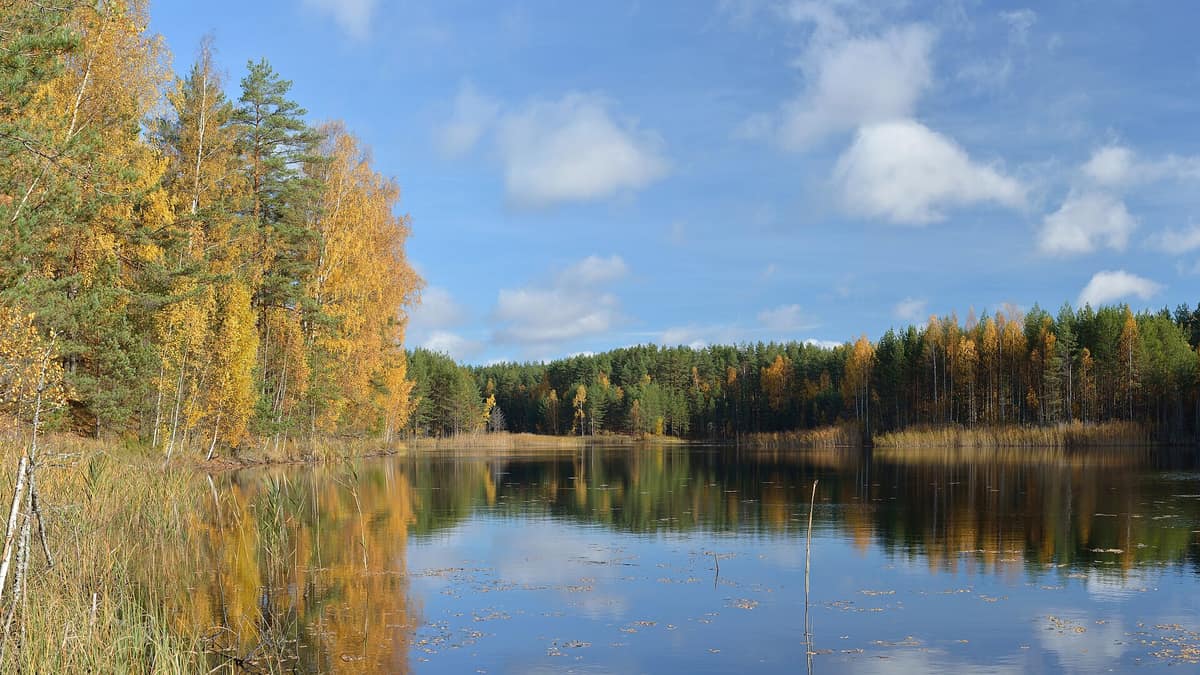
Alutaguse National Park
Alutaguse rahvuspark
Ida-Virumaa (Iisaku / Alajõe) · Estonia
Photo: Ivar Leidus · CC BY-SA 3.0 · Wikimedia Commons
Estonia's youngest National Park (designated in 2018), an immense boreal wilderness of deep taiga and expansive mire complexes bordering Lake Peipus.
Climb the 28 m observation tower at Iisaku, and in clear weather you can glimpse the distant domes of Kuremäe Convent and the blue shimmer of Lake Peipus. In between stretches nothing resembling a town: boundless peatlands, unbroken woodlands, and hardly a soul. This is Alutaguse, a national park in eastern Estonia whose original territory encompassed 44,331 hectares—more than three times the size of Karula. Established on 24 November 2018 by uniting eleven pre-existing nature reserves including Puhatu, Agusalu, Muraka, and Selisoo, it blankets a sparsely inhabited lowland plain. Within that historic boundary, mires covered 54% and forests 42%.
What makes it unique
Ancient relict dune ridges up to 18 m high crowned by veteran pines, encircled by mires in Estonia's youngest national park.
The place
Nature
The landscape
Agusalu is uniquely defined by continental inland dunes—narrow, steep sandy ridges known as kriivad, threading through vast mires and transitional bogs. Some ridges, crowned with ancient Scots pines, rise 18 m above the surrounding peat. The landscape forms a dynamic mosaic with abrupt ecological boundaries.
These sandy ridges owe their existence to the ice. Near the Seljandiku wilderness cabin, an ice-age esker ridge looms, while along the Kotka trail, forested ridges were shaped by the receding waters of ancient Lake Peipus. Nearby lie the mysterious peat-bound islands of Rüütli raba, composed of glacial sediment islands engulfed by growing mire.
In the western sector of Agusalu mire, pine bogs are carpeted with cloudberries and marsh Labrador tea, while cowberries blanket drier hummocks. The fens, transitional mires, and swamp forests of Alutaguse provide habitat for numerous rare native orchid species.
Wildlife and seasons
Alutaguse is undisputed realm of the brown bear, the grey wolf, and the moose: the mature forests surrounding the wetlands are their stronghold. Rare species include the Siberian flying squirrel, willow ptarmigan, and the black stork.
Agusalu has long been prime territory for the white-tailed eagle and the golden eagle, alongside the western capercaillie, willow ptarmigan, owls, and falcons. Along the Poruni River live top-tier category one strictly protected eagles (white-tailed eagle, golden eagle, osprey) alongside willow ptarmigan, with the capercaillie in the second category.
For wildlife viewing, silence is your greatest ally. The Varessaare wilderness hut, on the edge of Muraka bog, sits amidst virtually uninhabited wilderness where quiet observers stand high chances of encountering wild animals. Optimal season: May to October; in winter, cross-country ski trails are groomed near the Iisaku tower.
Species
With a page in the atlas
Being mentioned in a source doesn't guarantee sightings: check with the people who manage the area.
Memory and protection
History and conservation
In 1944, during February and March, intense combat took place along the Seljandiku ridge. Long before, in the nineteen-twenties, botanist Gustav Vilbaste had already campaigned to establish a national park in Alutaguse. A governmental expansion proposal increases Alutaguse from 45,019 hectares to nearly 69,800 hectares to connect fragmented forests and protect flying squirrels and capercaillie, with revised conservation rules entering into force on 3 October 2026.
Before you set off
Visiting
How to visit
Begin in Iisaku. The Flying Squirrel study trail covers just over a kilometre, starting beside the observation tower car park; nine interpretive boards explain squirrel biology, habitat, distribution, and forest ecology. The Iisaku observation tower sits at 94 m above sea level, the second highest natural elevation in Ida-Viru County after the Uljaste esker.
By bicycle, the Agusalu circular route covers roughly 38 km: starting and ending at the tower, it winds through Vaikla, Imatu, and Varesmetsa.
On foot, three main trails await. The Kotka trail (6.7 km) traverses fens, bogs, and sand ridges, totalling 13 km round-trip. From Alliku village, a shorter 1.5 km loop across Rüütli bog can be walked. Kotka trail is accessible by bus to Iisaku; the path begins at the Liivamäe parking area. The Poruni trail follows the Poruni River to the Narva River and back: 10 km round-trip with 12 interpretive panels explaining pristine riparian habitats, exposed geological strata, and wartime history. A 2.5 km circular spur explores old-growth deciduous forest, while a 700 m gravel section accommodates wheelchairs and strollers. The Kurtna trail (9 km) is a circular route with 300 m of boardwalk, passing the shores of 11 lakes in the Kurtna lake district.
For overnight stays, the park offers free wilderness huts: Varessaare hut has bunks for 8 people and lacks a well, so you must bring drinking water. From the Estonia mine crossroads at Väike-Pungerja, a signpost points to the Selisoo bog trail three kilometres away.
Before you go
Best visiting season: May to October. If staying overnight at Varessaare hut, bring sufficient drinking water: there is no well on site.
Check access, rules and visiting conditions in the official information from the managing body before you set off.
Location
Where it is and how far it reaches
Boundary of Alutaguse rahvuspark · © EEA, CDDA (CC-BY) The coordinate is estimated; it isn't a verified access point.
Transparency
Sources
The research data with its sources, and the official links for this place, are in the Spanish version of this page. See the Spanish version
Around it
Alutaguse has no immediately neighbouring sites in the atlas, but shares flying squirrels and mature boreal forest habitats with Liesjärvi National Park and Syöte National Park, the latter also sharing brown bear.
If you like this place, elsewhere in Europe
Distant places with uncommon wildlife and habitats in common. The most widespread species don't count. Sharing species doesn't imply a corridor or guaranteed presence.
- Liesjärvi National Park
Kanta-Häme (Tammela / Somero)
In common: Eurasian flying squirrel — old-growth forest, wetland, lake
Century-old boreal taiga featuring the narrow Kyynäränharju esker ridge meandering like a natural causeway between two lakes.
JFMAMJJASONDMay – October · Crowding very low
- Syöte National Park
Northern Ostrobothnia / Lapland (Pudasjärvi / Taivalkoski)
In common: Eurasian flying squirrel · Brown bear — old-growth forest, wetland
Old-growth mountain taiga and hanging hillside bogs (aapa bogs), refuge for the Siberian flying squirrel (Pteromys volans).
JFMAMJJASONDJune – September · December – April · Crowding low
Entry #368 of the original atlas.