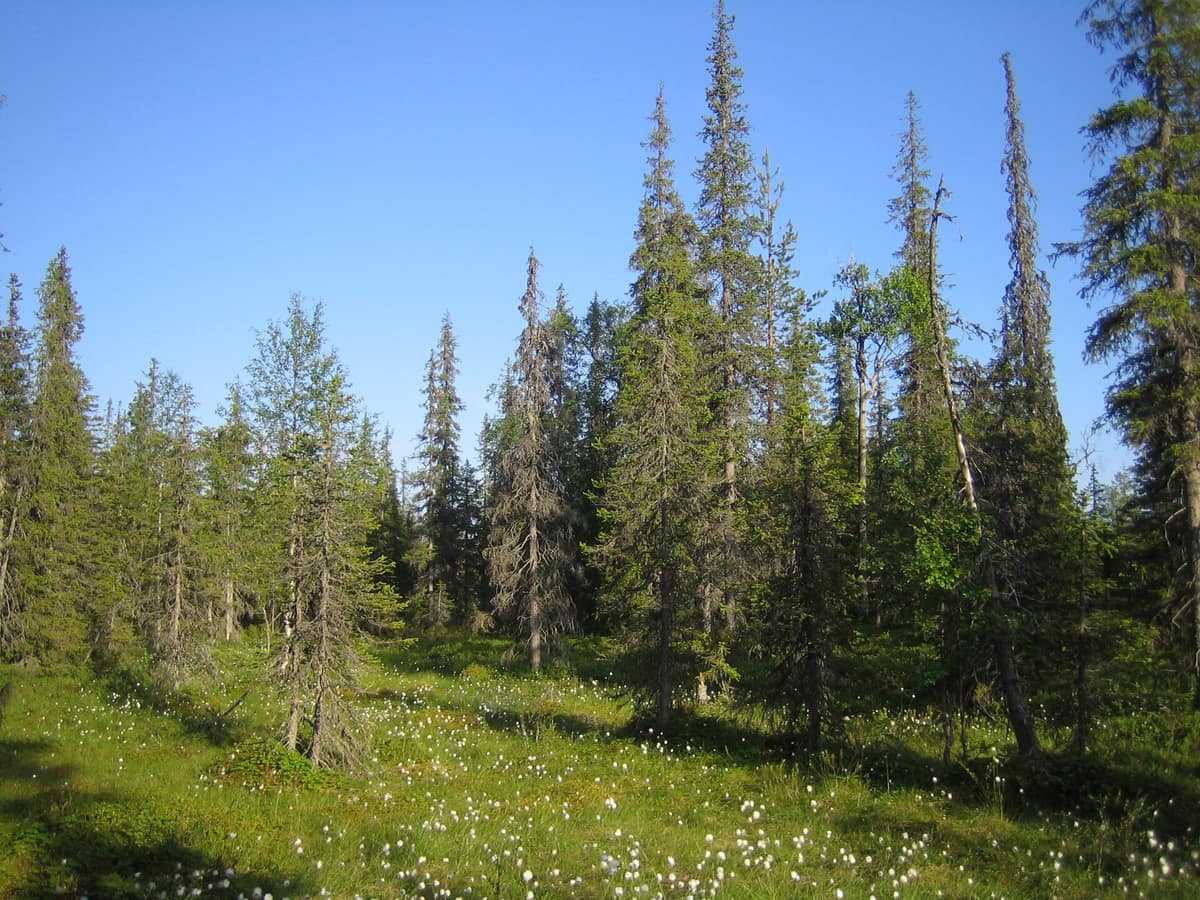
Syöte National Park
Northern Ostrobothnia / Lapland (Pudasjärvi / Taivalkoski) · Finland
Photo: Original uploader was Hujane at fi.wikipedia · CC BY-SA 3.0 · Wikimedia Commons
Old-growth mountain taiga and hanging hillside bogs (aapa bogs), refuge for the Siberian flying squirrel (Pteromys volans).
Six or seven months of winter, with snowfall easily reaching a meter and a half in depth: that is how the annual cycle begins in Syöte. Established in 2000, this 303 km² national park straddles several municipalities, primarily Pudasjärvi and Taivalkoski. Here the rolling fells of northeastern Finland preserve the region's finest virgin boreal taiga, intercut with sweeping aapa mires and hanging hillside bogs. The result is a landscape of stark contrasts: dense spruce forests clinging to slopes opening onto expansive wetland horizons.
What makes it unique
Coexisting in the very same park are hanging slope bogs, exceptionally rare globally yet abundant in Syöte, and up to ten percent of Finland's red-flanked bluetails.
The place
Nature
The landscape
Syöte is not a single contiguous tract, but four separate wilderness areas: Syöte, Maaselkä, Latva-Korte-Kärppävaara, and Salmitunturi. The park takes its name from Iso-Syöte, Finland's southernmost fell, which stands immediately adjacent to the boundary. Its highest point is Pyhitystunturi at 422 meters, offering sweeping panoramas over Lake Kostonjärvi; historically it served as an ancient sacred site.
The fells create pronounced altitudinal vegetation zones. Summit ridges carry stunted northern flora, while protected valleys harbor species typical of more southern boreal zones. A quarter of the park is covered by varied peatlands and mires. Among these, hanging slope bogs stand out: a rare form of aapa mire that forms only in cool, humid subarctic climates. They require vastly more moisture than typical peatlands because gravity continuously drains water downslope, existing only where constant springs and seeps saturate the incline. The steeper the gradient, the thinner the peat layer: thus they are exceedingly fragile, and a single drainage ditch can desiccate them permanently.
Bordering the park, the Pytkynharju esker is a majestic Ice Age landform. A scenic ridge trail runs along its spine, offering views of Romevaara, Pikku-Syöte, and surrounding glacial lakes.
Wildlife and seasons
If you seek a single emblematic species, look for the red-flanked bluetail. The old-growth spruce taiga of Syöte suits it perfectly: statistically, a hiker traversing the park in early summer encounters one singing male every kilometer and a half. Prime listening areas include Romevaara, Ahmavaara, and the Maaselkä sector, particularly along shady spruce slopes laden with standing and fallen decaying timber.
The other signature resident is the Siberian flying squirrel, an eastern taiga specialist for which Syöte represents both the western and northern limit of its European range. It is nocturnal and secretive, but reveals its presence through golden, rice-like droppings scattered beneath mature nest trees. Dependent on large old-growth stands, especially containing mature aspens, it is classified as vulnerable in Finland. In Syöte, a targeted LIFE conservation initiative fenced off ancient aspens and installed artificial nest boxes throughout the forest.
These ancient woodlands also provide refuge for nine threatened wood-decay fungi species (Aphyllophorales) and rare saproxylic beetles dependent on an unbroken continuum of deadwood.
Species
With a page in the atlas
Being mentioned in a source doesn't guarantee sightings: check with the people who manage the area.
Memory and protection
History and conservation
Human presence around Syöte dates back to the Stone Age. At the historic crown-tenant farm of Rytivaara, visitors can experience the pioneer struggles and daily routines of early forest settlers. The park logo features a traditional sauna by a meadow, with smoke rising into hillside spruce woodland.
The primary management ethos is non-intervention, allowing the forest to evolve under natural dynamics without commercial forestry disturbance. Controlled prescribed burnings are conducted periodically, recognizing wildfire as a vital ecological renewal force in boreal ecosystems.
Before you set off
Visiting
How to visit
The park provides more than a hundred kilometers of waymarked trails, ranging from short nature circuits to multi-day wilderness backpacking treks. The regional UKK trail traverses 137 kilometers through the area, while the Pyhityksen polku trail forms a scenic 3,6 km loop. For mountain biking, which enjoys immense popularity here, designated forest routes range from 19 to 54 km. The paddling descent of the Pärjänjoki river covers 22 km. In winter visitors explore on snowshoes or cross-country skis.
For panoramic views, climb the observation tower at Ahmavaara: from its deck unfolds a tapestry of forested hills, peatlands, and frozen winter expanses. It sits two kilometers from the wilderness hut at Ahmatupa and ten from the visitor center. For absolute solitude, extensive trackless tracts with virtually no visitors await in northern Kouva, Maaselkä, Latva-Korte-Kärppävaara, and Salmitunturi.
The Syöte Visitor Centre introduces traditional reindeer husbandry, historic logging heritage, and the ecology of the park.
Before you go
Winter lasts six to seven months, and snow depth frequently exceeds a meter and a half. Mountain biking is strictly limited to designated trails during snow-free months.
Check access, rules and visiting conditions in the official information from the managing body before you set off.
Location
Where it is and how far it reaches
Boundary of Syötteen kansallispuisto · IUCN II · © EEA, CDDA (CC-BY) The coordinate is estimated; it isn't a verified access point.
Transparency
Sources
The research data with its sources, and the official links for this place, are in the Spanish version of this page. See the Spanish version
Around it
Old-growth taiga and flying squirrels connect Syöte to Liesjärvi National Park in southern Finland and Alutaguse National Park in Estonia, both protecting ancient woodlands and peatlands. Alutaguse also shares the brown bear.
If you like this place, elsewhere in Europe
Distant places with uncommon wildlife and habitats in common. The most widespread species don't count. Sharing species doesn't imply a corridor or guaranteed presence.
- Alutaguse National Park
Ida-Virumaa (Iisaku / Alajõe)
In common: Eurasian flying squirrel · Brown bear — old-growth forest, wetland
Estonia's youngest National Park (designated in 2018), an immense boreal wilderness of deep taiga and expansive mire complexes bordering Lake Peipus.
JFMAMJJASONDMay – October · Crowding very low
- Liesjärvi National Park
Kanta-Häme (Tammela / Somero)
In common: Eurasian flying squirrel — old-growth forest, wetland
Century-old boreal taiga featuring the narrow Kyynäränharju esker ridge meandering like a natural causeway between two lakes.
JFMAMJJASONDMay – October · Crowding very low
Entry #596 of the original atlas.