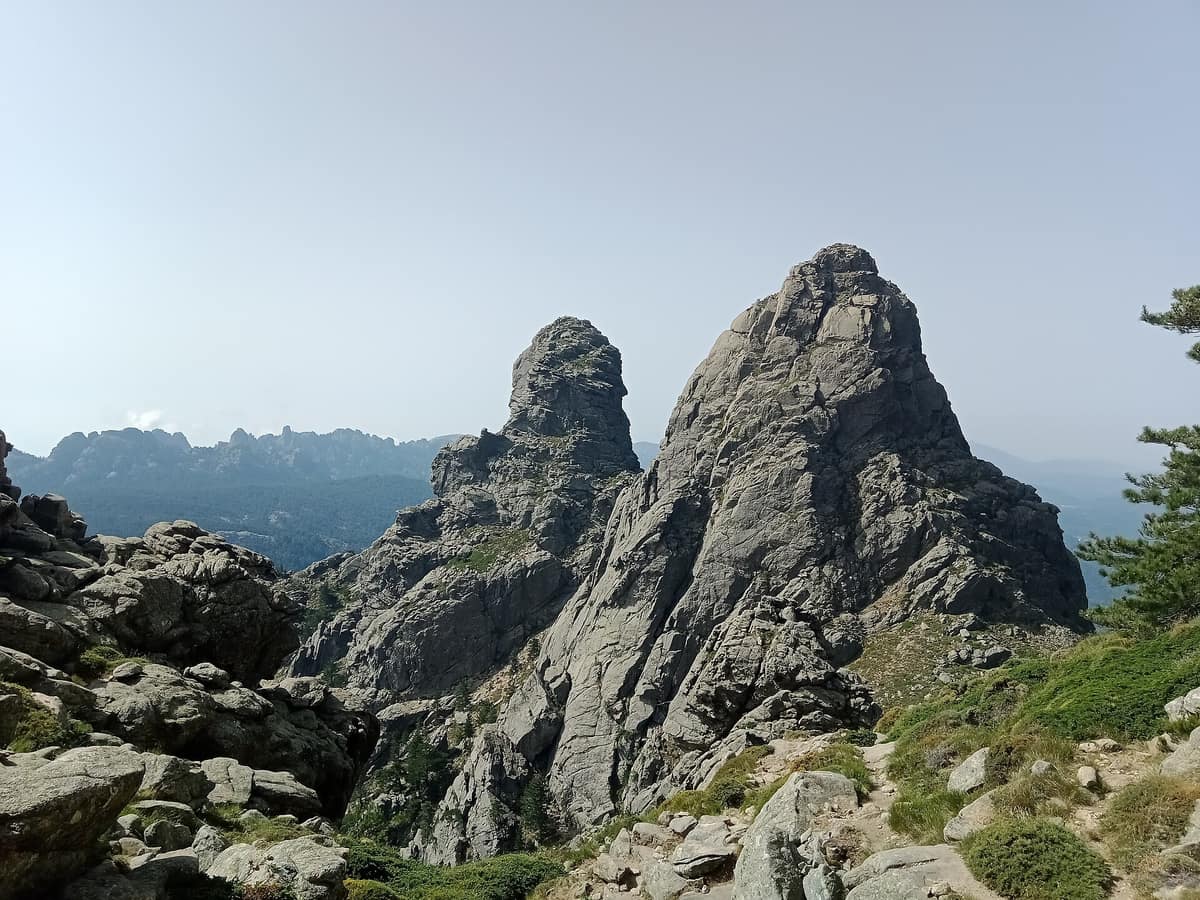
Bavella Massif and Needles
Bavella Massif
Corsica (Zonza / Quenza / Solenzara) · France
Photo: Rémih · CC BY-SA 4.0 · Wikimedia Commons
A wall of red granite towers and pinnacles weathered into surreal hollow forms (taffoni), framed by Corsican black pine.
From the Col de Bavella, at 1,218 metres, the horizon bristles with teeth: jagged pinnacles, sheer rock ramparts, and wind-twisted pine trees. These are the Aiguilles de Bavella, the jagged core of a massif in central Corsica linking the Alta Rocca to the eastern coast. Here the granite is no mere background: it takes centre stage, sculpted by tectonics and weathering into something resembling a petrified sponge.
What makes it unique
Punta di a Vacca, at 1,611 metres, is the only one of the seven Asinau towers accessible to ordinary hikers.
The place
Nature
The landscape
The seven towers of Asinau are the needles proper, forming the core of the massif. The highest, Punta Alta, reaches 1,857 m. The ridge culminates slightly further north at Punta di u Furnellu and Punta Muvrareccia, at 1,899 m, all dominated by Monte Incudine at 2,134 m. The massif is also the catchment of the Solenzara river, the traditional divide between northern and southern Corsica.
The shape of the needles has a geological explanation. In Bavella two types of granite meet. One is coarse-grained, formed from a slow magma ascent; it is whitish and highly susceptible to erosion. The other, composed of very fine crystals with a pinkish cast, cooled rapidly and is exceedingly hard. That contrast, combined with tectonic uplift and weathering, explains the slender pinnacles and crags. Tafoni—cavities of varied shapes and sizes that honeycomb the rock upwards—give the cliffs their sponge-like appearance. Tafoni occur throughout Corsican rock, but reach their finest development in resistant granites.
Wildlife and seasons
The Corsican mouflon lives in these mountains, particularly in the reserves of Monte Cinto and Bavella. Today only two native populations remain in the Cinto and Bavella massifs, though since 2019 a third has been established by releasing animals in the Cagna massif. On the cliffs of Calanca Murata, in the commune of Conca, a biotope protection order safeguards the roosts and habitat of local bat colonies.
Species
With a page in the atlas
Being mentioned in a source doesn't guarantee sightings: check with the people who manage the area.
Memory and protection
History and conservation
The massif forms part of the Regional Natural Park of Corsica, established in 1972, which encompasses the Cirque de Bavella and manages visitor footfall. It is additionally designated as a sensitive natural area, a Natura 2000 site, a classified site, and an inscribed site.
Before you set off
Visiting
How to visit
The GR 20 traverses the massif. Between Monte Incudine and the Col de Bavella, the classic route passes the Asinau refuge at 1,536 m and hugs the foot of the needles through the Rizzanese valley. An alpine variant cuts straight through the needles via the Bocca di u Pargulu at 1,662 m, descending toward Conca across the Foce Finosa and the Paliri refuge. Near the needles stand two refuges: Paliri, south of the needle of the same name, and Asinau, at the foot of Monte Incudine.
From the Col de Bavella, trails also lead to the Trou de la Bombe (Tafonu di Cumpuleddu). For another excursion, the Purcaraccia stream—renowned for its cascading falls and emerald pools—tumbles down the massif toward the Solenzara river; the trail begins about 8 km down the D268 toward Sari-Solenzara. At the pass, just off the road, stands the statue of Notre-Dame-des-Neiges perched on a mound of stones. The Col de Bavella is one of the four major interior mountain passes connecting the two slopes of Corsica, and the southernmost of them.
Before you go
Wild camping is strictly prohibited in the needles. The massif is lower than the Popolasca needles, but far more heavily frequented.
Check access, rules and visiting conditions in the official information from the managing body before you set off.
Location
Where it is and how far it reaches
Boundary of Aiguilles De Bavella · © EEA, CDDA (CC-BY) The coordinate is estimated; it isn't a verified access point.
Transparency
Sources
The research data with its sources, and the official links for this place, are in the Spanish version of this page. See the Spanish version
How it fits into the territory
Calculated from the Atlas boundaries. «Part of» is only stated with an official boundary; an estimated area only means that they overlap.
Part of Corsica Regional Nature Park
Around it
The Troodos National Forest Park shares high mountain landscapes, mature woodland, and wild mouflon with Bavella.
If you like this place, elsewhere in Europe
Distant places with uncommon wildlife and habitats in common. The most widespread species don't count. Sharing species doesn't imply a corridor or guaranteed presence.
- Troodos National Forest Park
Cyprus (Troodos / Platres)
In common: Mouflon — high mountain, old-growth forest
The pine-cloaked peaks of Cyprus, towering above a complete section of ancient oceanic crust lifted from the Tethys seabed.
JFMAMJJASONDApril – June · September – October · Crowding low
Entry #632 of the original atlas.