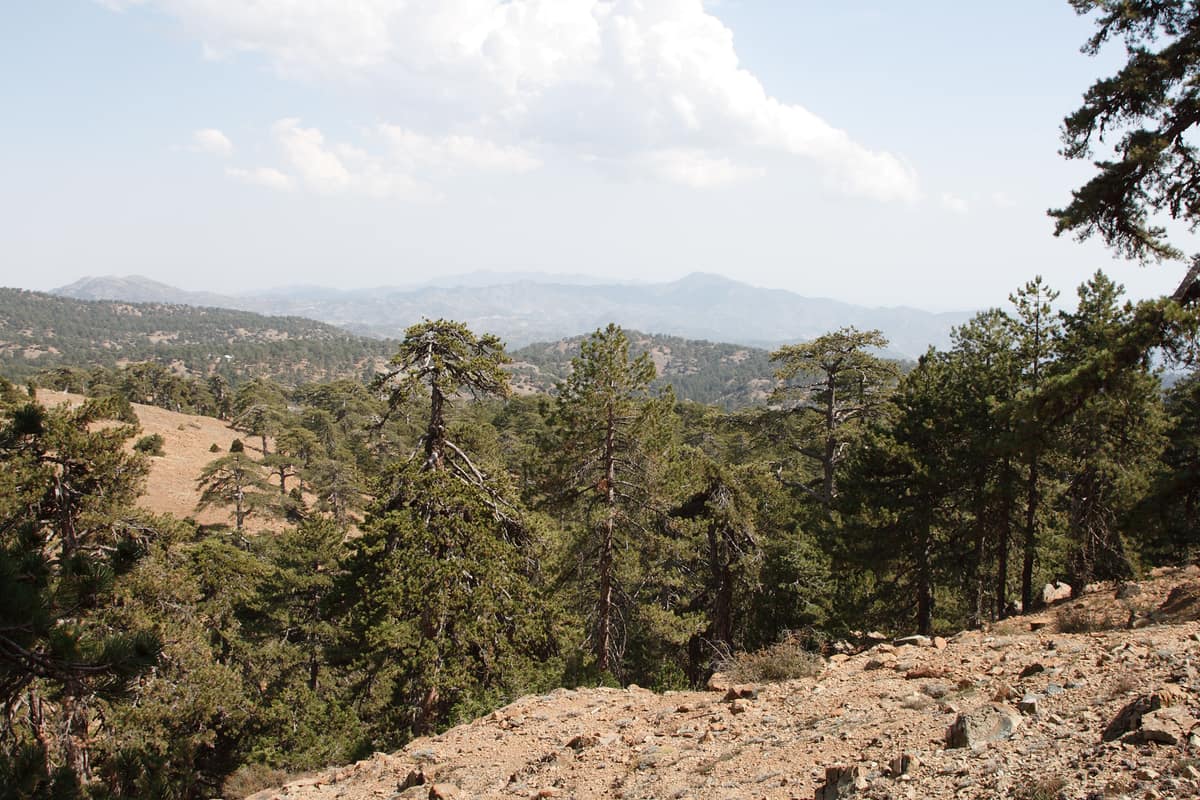
Troodos National Forest Park
Εθνικό Δασικό Πάρκο Τροόδους
Cyprus (Troodos / Platres) · Cyprus
Photo: Dmitry Panov · CC BY 3.0 · Wikimedia Commons
The pine-cloaked peaks of Cyprus, towering above a complete section of ancient oceanic crust lifted from the Tethys seabed.
Millions of years ago, this mountain realm formed the deep ocean floor. The Troodos range, the dominant mountain backbone of Cyprus, emerged gradually from the Tethys Sea when the African and Eurasian tectonic plates collided, and that titanic collision created the island itself. Today the mountains occupy one-third of Cyprus, dominating the southwest, and the Troodos National Forest Park safeguards the highest altitudes: black pine woodlands, ancient junipers, trails circumscribing Mount Olympus, and exposed rock that provided foundational evidence for modern seafloor spreading theory.
What makes it unique
You walk across an intact section of oceanic floor uplifted almost two thousand meters above the Mediterranean.
The place
Nature
The landscape
The scientific revelation lies in what geological erosion has exposed. The oceanic crust was thrust upward without severe deformation, progressively stripping away upper layers to reveal the ancient magma chamber beneath, displaying intact sheeted dyke complexes and petrified pillow lavas. The Troodos Ophiolite is consequently a textbook specimen: an ancient seafloor spreading center from the Late Cretaceous, gradually hoisted aloft by tectonic subduction south of Cyprus. Field observations here provided definitive empirical proof for the seafloor spreading paradigm.
The mountain summit is the living proof. Mount Olympus, locally known as Chionistra, forms the apex of Cyprus at 1.952 m and is composed of ultramafic plutonic rocks, predominantly serpentinized harzburgite belonging to that same ophiolitic mantle.
Conifers rule the heights. Calabrian pine and endemic golden oak dominate lower elevations, while high slopes are clothed in European black pine. The mountain range acts as a major moisture barrier, creating a pronounced rain shadow across the island. At Prodromos, daily average temperatures hover around 4 °C in January and 23 °C in July.
Wildlife and seasons
The range supports numerous endemic plants and animals, most notably the Cyprus cedar, which survives naturally in only five forest stands, primarily at Tripylos. Along hiking trails you can examine distinctive regional flora: golden oak, Troodos sage, and Troodos catmint.
Keep your eyes on the skies above. Avian species recorded across the ridges include Bonelli's eagle, Eurasian jay, common wood pigeon, and chukar partridge, alongside two island endemics: the Cyprus warbler and Cyprus wheatear. Native mammals include the endemic Cyprus mouflon, red fox, European hare, and long-eared hedgehog. Reptiles include the blunt-nosed viper and the rare endemic Cyprus whip snake.
Species
With a page in the atlas
Being mentioned in a source doesn't guarantee sightings: check with the people who manage the area.
Memory and protection
History and conservation
Troodos has been intertwined with Mediterranean history for millennia. Since antiquity its slopes were renowned for copper mining, supplying ores to Bronze Age civilizations across the eastern Mediterranean. The geographer Strabo recorded that one of Olympus's promontories hosted a sanctuary dedicated to Aphrodite Akraia where women were strictly forbidden to enter. During Byzantine times, the mountain interior, safe from coastal pirate raids, filled with frescoed churches and monasteries, evolving into a celebrated center of Byzantine art.
Before you set off
Visiting
How to visit
The park's focal hub is Troodos Square, home to the Environmental Information Centre. Its exhibition hall and cinema explain the geology, flora, and fauna of the range, and an educational botanical and geological trail begins right outside. From November to March it opens Monday to Friday from 09:00 to 14:30 and closes on weekends; from June to August it opens Monday to Friday from 09:00 to 14:30 and on weekends from 10:00 to 16:00.
Four distinct walking trails explore the mountain landscape:
- Persephone: 3 km taking one hour, starting 150 m south of Troodos Square. It winds through dense pine forest for the first two kilometers before reaching Makria Kontarka with panoramic viewpoints. - Kalidonia: 3 km in an hour and a half. Descending along the perennial Kryos Potamos river, it visits the Kalidonia waterfall and finishes at Psilodentro in Pano Platres. - Artemis: a circular 7 km loop taking about two and a half or three hours. It encircles the peak of Olympus at 1.850 m, offering panoramic vistas in all directions and passing two black pines around 500 years old. - Atalante: a circular 14 km circuit taking four or five hours from Troodos Square. It circles Chionistra at 1.700-1.750 m amidst black pines and a venerable 800-year-old foetid juniper, the largest tree on the route, passing an abandoned chromium mine entrance closed since 1982.
Before you go
Opening hours at the Environmental Information Centre vary seasonally, so confirm schedules before ascending. The Cyprus Tourism Organisation rates the Artemis Trail at the easiest difficulty tier.
Check access, rules and visiting conditions in the official information from the managing body before you set off.
Location
Where it is and how far it reaches
Boundary of Troodos · © EEA, CDDA (CC-BY) The coordinate is estimated; it isn't a verified access point.
Transparency
Sources
The research data with its sources, and the official links for this place, are in the Spanish version of this page. See the Spanish version
Around it
Troodos has no adjacent neighbors in the atlas, but shares high-elevation Mediterranean forest habitats with distant massifs. The Bavella Massif and Corsica Regional Nature Park share the mouflon; Sila National Park in Italy shares black pine woodlands.
If you like this place, elsewhere in Europe
Distant places with uncommon wildlife and habitats in common. The most widespread species don't count. Sharing species doesn't imply a corridor or guaranteed presence.
- Bavella Massif and Needles
Corsica (Zonza / Quenza / Solenzara)
In common: Mouflon — old-growth forest, high mountain
A wall of red granite towers and pinnacles weathered into surreal hollow forms (taffoni), framed by Corsican black pine.
JFMAMJJASONDMay – October · Crowding moderate
- Corsica Regional Nature Park
Corsica (Corte / Ajaccio / Bastia / Porto)
In common: Mouflon — old-growth forest, high mountain
Covers more than 40 % of the island of Corsica (375,000 ha), encompassing the backbone of Monte Cinto (2,706 m) and the canyons of the Restonica and Tavignano.
JFMAMJJASONDMay – October · Crowding moderate
- Sila National Park
Calabria (Cosenza / Catanzaro / Crotone / Camigliatello Silano / Lorica)
In common: European black pine — old-growth forest, high mountain
The 'Great Forest of Italy', a colossal highland plateau of centuries-old Corsican pine (Pinus nigra laricio) and giant inland lakes Cecita and Arvo.
JFMAMJJASONDMay – November · Crowding low
Entry #1043 of the original atlas.