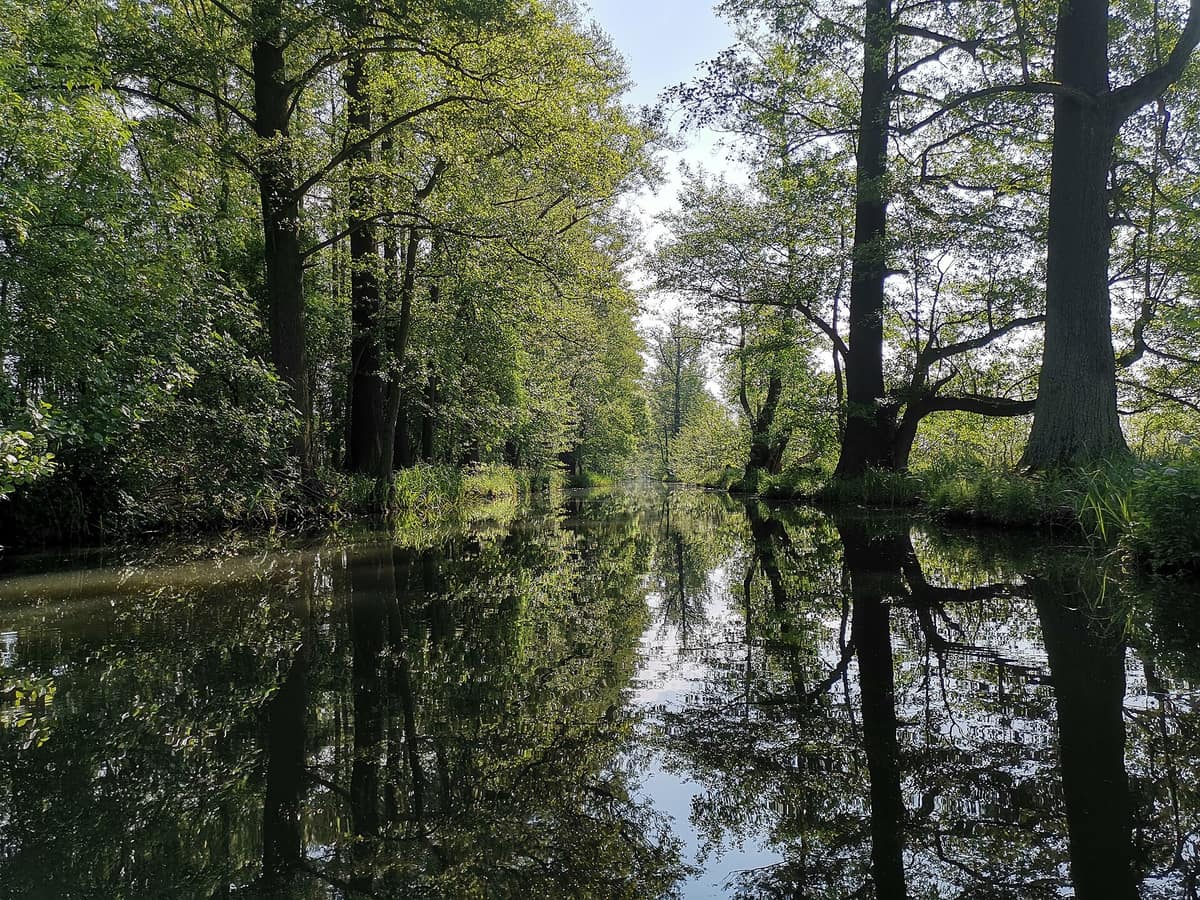
Spreewald Biosphere Reserve
Biosphärenreservat Spreewald
Brandenburg (Lübbenau / Burg) · Germany
Photo: Anne-Karen Voigt · CC BY-SA 4.0 · Wikimedia Commons
Inland river delta of 200 interwoven channels (Fließe) meandering among black alder carrs and traditional Sorbian wet meadows.
Here the River Spree does not flow in a single channel: it frays. Following the last glacial retreat, the waterway branched into an extraordinarily intricate fluvial labyrinth that today spans 1575 kilometres, situated just under one hundred kilometres southeast of Berlin. Where dense primeval riparian woodland once reigned, streams now wind through meadows, small parcels, and carrs, creating a cultural landscape that park rangers describe as both park-like and semi-natural. The Biosphärenreservat Spreewald is designed to be experienced unhurriedly: by canoe, traditional punt (Kahn), bicycle, or on foot.
What makes it unique
A watery labyrinth of streams where punts serve as roads and the otter continues breeding in one of its foremost central European refuges.
The place
Nature
The landscape
Everything stems from minimal topographic gradient. Some ten thousand years ago, as temperatures rose, the near-absence of slope created an inland river delta across the Spreewald. Chronic shallow inundations and oxygen-depleted leaf litter accumulated into thick peat layers, laying down typical fen soils.
Human hands shaped the present mosaic. Early watermills dating from the twelfth and thirteenth centuries impounded flows with weirs, expanding wetland expanses; in the eighteenth century extensive ditch networks were dug to drain arable plots. Cultivation created an intricate tapestry of small meadows, fields, and woodlands interlaced with waterways, where traditional Sorbian land practices such as Horstäcker (elevated plots) and litter meadows are preserved. During the GDR era, intensive drainage reshaped the Spreewald to boost agricultural yields; modern water-retention projects now work to re-stabilise wetland hydrologic regimes.
Protected habitats across the European network include bog woodlands, submerged macrophyte waters, alder-ash carrs, Molinia meadows, alluvial flood meadows, and lowland hay meadows. Sixteen distinct habitats of European conservation priority have been identified. In the waterways, water soldier (Stratiotes aloides) spreads dense floating rosettes of sword-shaped leaves.
Wildlife and seasons
Species safeguarded across Europe include the European fire-bellied toad, moor frog, depressed river mussel, hermit beetle, large white-faced darter, large copper butterfly, pond bat, barbastelle bat, otter, and beaver. The Eurasian otter maintains here one of its vital natural reproductive breeding strongholds in Central Europe, and the Eurasian beaver also thrives.
Noteworthy breeding birds include the white-tailed eagle, osprey, black stork, white stork, common kingfisher, Eurasian hoopoe, and common crane. Conservation managers actively maintain nesting platforms for white storks.
For wildlife viewing, two elevated observation towers operate: at Barzlin between Lübben and Lübbenau, and at Wussegk near Schlepzig. Erected in 2005, both are reachable by land or water, forming waypoints on an interpretive wildlife route linking Burg and Schlepzig alongside European long-distance path E 10. Local outfitters offer specialised bike, punt, and canoe tours to the towers, which are also featured on ranger-led walks.
Species
With a page in the atlas
Being mentioned in a source doesn't guarantee sightings: check with the people who manage the area.
Memory and protection
History and conservation
Conservation began as early as 1938 with the designation of the Kriegbusch nature reserve in the Unterspreewald, followed in 1939 by landscape protection status for surrounding wetlands. In 1990 the Spreewald was declared a biosphere reserve, achieving UNESCO recognition in 1991. The protected area encompasses 23 nature reserves and 7 core wilderness zones; entry to total reserves is restricted to scientific research.
The mission focuses not on abstract wilderness but on living cultural heritage: initiatives like the Spreewaldwiesenprogramm maintain the damp, flowery meadow parcels emblematic of the region.
Before you set off
Visiting
How to visit
The waterways are the thoroughfares. Tourism in the Spreewald boasts over a century of heritage, experienced predominantly from traditional wooden punts. Both seasoned paddlers and novices find rewarding loops among the waterways. To protect vulnerable flora and fauna, wild camping is strictly forbidden; eight certified water-camping bivouacs accommodate touring canoeists.
On dry land, the Moorlehrpfad Raddusch is an interpretive bog boardwalk accessible to walkers and cyclists, the Lehder Rundweg offers a scenic walking circuit, and European trail E10 traverses the reserve. The Kranichtour is among recommended cycling itineraries.
Three visitor centres provide orientation: the Haus für Mensch und Natur in Lübbenau, the Schlossberghof in Burg with its historic herbal garden, and the Alte Mühle in Schlepzig. The Lübbenau centre illustrates how the landscape evolved, which flora and fauna reside here, and how traditional agriculture sustains biodiversity. Park rangers (Naturwacht) conduct guided interpretive excursions.
Before you go
Arriving by public transport is the most ecologically mindful choice: regional trains run along the Berlin-Cottbus line serving Lübben, Lübbenau, Raddusch, and Vetschau. Check operating hours and visitor centre schedules online before planning your journey.
Check access, rules and visiting conditions in the official information from the managing body before you set off.
Location
Where it is and how far it reaches
Boundary of Biosphärenreservat Spreewald · IUCN V · © EEA, CDDA (CC-BY) The coordinate is estimated; it isn't a verified access point.
Transparency
Sources
The research data with its sources, and the official links for this place, are in the Spanish version of this page. See the Spanish version
Around it
Biosphärenreservat Mittelelbe shares water chestnut and alluvial wetland habitats with the Spreewald. Farther afield, Hortobágyi and Parque de la naturaleza Lonjsko polje share extensive wetland networks and populations of otters and storks.
If you like this place, elsewhere in Europe
Distant places with uncommon wildlife and habitats in common. The most widespread species don't count. Sharing species doesn't imply a corridor or guaranteed presence.
- Middle Elbe Biosphere Reserve
Saxony-Anhalt (Dessau-Roßlau / Wittenberg)
In common: Trapa natans — wetland, river corridor, old-growth forest
The largest contiguous complex of alluvial hardwood oak floodplain forests in Central Europe.
JFMAMJJASONDMay – October · Crowding very low
- Hortobágy National Park - The Hungarian Puszta
Hajdú-Bihar / Jász-Nagykun-Szolnok
In common: Trapa natans · Eurasian otter — wetland
Central Europe's largest steppe grassland (80.000 ha) featuring traditional pastoralists and massive crane migrations.
JFMAMJJASONDApril – June · September – November · Crowding low
Entry #247 of the original atlas.