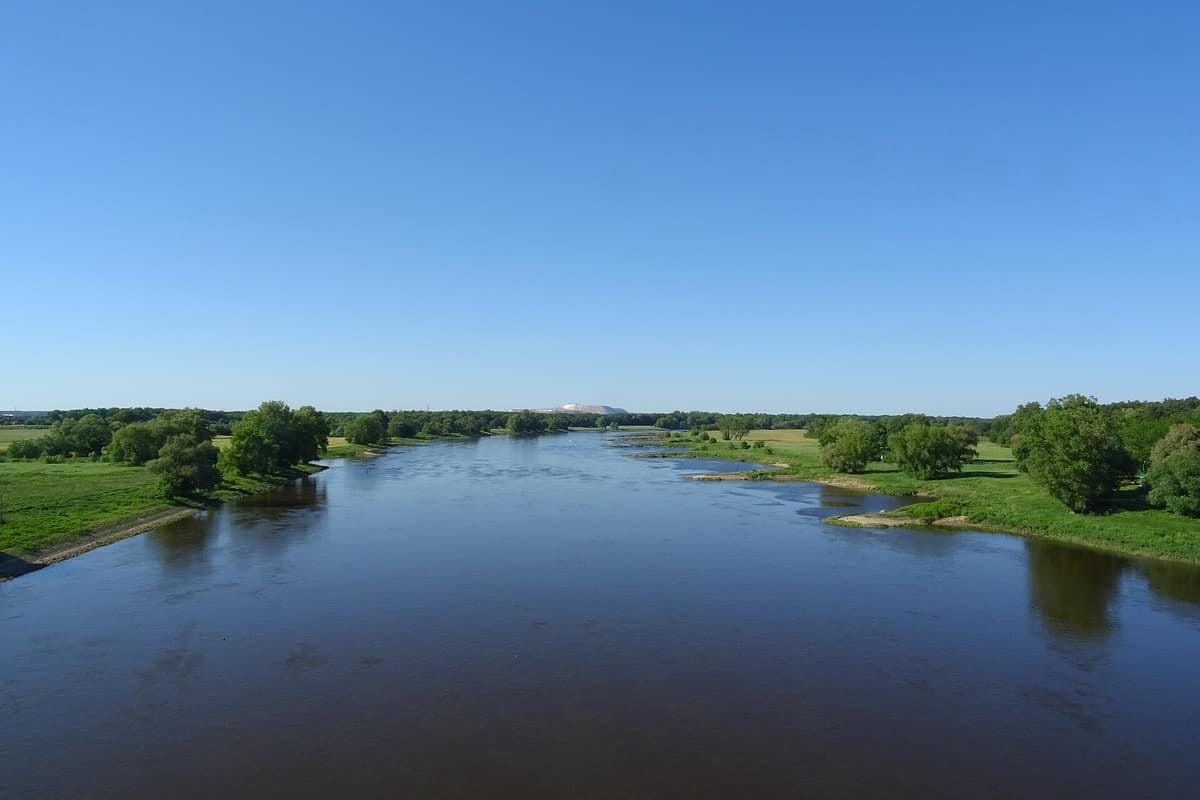
Middle Elbe Biosphere Reserve
Biosphärenreservat Mittelelbe
Saxony-Anhalt (Dessau-Roßlau / Wittenberg) · Germany
Photo: Emillam · CC BY-SA 4.0 · Wikimedia Commons
The largest contiguous complex of alluvial hardwood oak floodplain forests in Central Europe.
The Elbe has not flooded unchecked for centuries, yet along this stretch it still feels wild. Stretching between Lutherstadt Wittenberg, Dessau-Roßlau, Magdeburg, and up to Seehausen, the Mittelelbe Biosphere Reserve follows the course of the river and the Mulde: a mosaic of floodplain forests, wet meadows, oxbow lakes, and inland dunes. Together with the Mulde, Saale, and Havel, the river shapes the history and structure of every habitat in the landscape. And along these waters, the Elbe beaver found its final refuge after the Second World War.
What makes it unique
An immense floodplain where the Elbe beaver rebounded from near-extinction and where historic landscaped gardens form part of the reserve.
The place
Nature
The landscape
A floodplain encompasses all ground inundated by seasonal floods or fluctuating between high and low water levels, and that dynamic pulse is the foundation of everything. It protects the largest connected expanse of floodplain forests in Central Europe. Here the river deposits sandbanks and gravel beds, nourishing soft softwood willow woods along the water's edge and, on slightly higher ground, hardwood forests dominated by pedunculate oak, European ash, and field elm. The inland dunes of the Elbe, shaped by water and wind, rank among the most threatened habitats in Saxony-Anhalt.
Yet the river is no longer entirely untamed. Dykes and reinforced riverbanks halted the free-form meanders that once sculpted the terrain, and the reserve's mission is to safeguard what survives of that primeval diversity. There is even a park built into the riverine landscape: the Dessau-Wörlitz Garden Realm, blending designed nature and culture as a UNESCO World Heritage site. Wörlitz Park, embedded in the reserve, is the oldest English landscape park on continental Europe.
Wildlife and seasons
More than a thousand plant species, over 50 mammals, more than 700 butterflies, around 50 dragonflies, and 200 bees have been recorded here, alongside at least 315 ground beetle species and 125 molluscs.
Birds are the defining spectacle. More than 179 breeding species and at least 100 migratory visitors stage, feed, or winter here, turning observation towers into seasonal waypoints. From September to December, up to 40,000 wild geese roost at the Neolith-Teich pond, among them the rare pink-footed goose, while red-necked grebes and northern shovelers breed on the water. In September and October, from the viewing tower at the crane staging site, some 6 km east of Havelberg, cranes assemble across a Ramsar wetland. In winter, the Wanzer tower looks out over geese, northern lapwings, European golden plovers, and shovelers on the Wrechow polder, and come spring thousands of ducks and geese rest in the Havel lowland en route to northern breeding grounds. From the Gütschow observation hide above Lake Schollen, sharp eyes may catch an osprey fishing. At Neuschollene on spring evenings, the chorus of countless amphibians resonates across the water.
The Elbe beaver, once pushed to the edge of extinction, found its last sanctuary here and its population has rebounded to roughly 1,200 individuals.
Species
With a page in the atlas
Being mentioned in a source doesn't guarantee sightings: check with the people who manage the area.
Memory and protection
History and conservation
Conservation dates back to the Anhalt Nature Conservation Act of 1923, followed in 1927 by early site protections for the Elbe beaver and water chestnut. In 1979 the Steckby-Lödderitz Forest became one of only two biosphere reserves recognised by UNESCO in the GDR. On 20 March 2006 the Mittelelbe Biosphere Reserve was formally designated, encompassing 125,743 ha. In Kliekener Aue, a LIFE project between 1998 and 2002 desilted sections of the Alte Elbe and reconnected an oxbow cut off since the 1930s.
Before you set off
Visiting
How to visit
The Auenhaus visitor centre, set between Dessau and Oranienbaum, was built for Expo 2000 and serves as the reserve's central information point. Its permanent exhibition lets visitors peer into an artificial beaver lodge, offers interactive multimedia exhibits, and explains river and floodplain ecology. Outdoors, an enclosure showcases typical alluvial habitats with interpretive panels, alongside a viewing area for beavers. Behind the centre lies a sensory trail with animal tracks and Braille signage for visually impaired visitors. To the north, the Haus der Flüsse in Havelberg has served since 2015 as the information centre for the lower reaches.
The Auenpfade, the reserve's network of nature trails, range between one and 12 km in length, with illustrated boards explaining local habitats and species. The Kühnauer See trail encircles the lake with 16 panels, offering an easy path for walking or cycling. The Coswig trail follows an Elbe bend with eight panels detailing how human communities used the river over time. The trail across Oranienbaumer Heide, located on a former military training ground opened in 2012, features 13 stations; there, some 800 ha of open heath are grazed year-round by Konik horses and Heck cattle. In the Kliekener Aue, the Werder observation platform looks out across the Alte Elbe oxbow, teeming with waterfowl, while the high river bluff between Coswig and Griebo looks over the meandering valley. At Jerichow, an observation tower and a 2.5 km educational trail trace the Alte Elbe.
If you prefer cycling, the Elbe Cycle Route R2 tracks roughly 360 km of the Elbe through the reserve, and the Fürst Franz Gartenreichtour spans around 60 km. Ranger services offer guided walks, field excursions, and talks throughout the year, and the reserve runs a citizen science biodiversity monitoring programme.
Before you go
Oak processionary moths pose a recurring hazard in the reserve; visitors should never approach infested trees or touch caterpillars. Selected sections of the Auenpfade may be temporarily closed for tree safety.
Check access, rules and visiting conditions in the official information from the managing body before you set off.
Location
Where it is and how far it reaches
Boundary of Flusslandschaft Elbe · © EEA, CDDA (CC-BY) The coordinate is estimated; it isn't a verified access point.
Transparency
Sources
The research data with its sources, and the official links for this place, are in the Spanish version of this page. See the Spanish version
Around it
The Black Elster Floodplain lies some 23 km away. Further across Europe, the Tronçais Forest and the Serra do Courel share stag beetle populations and ancient alluvial woodland with the Middle Elbe.
If you like this place, elsewhere in Europe
Distant places with uncommon wildlife and habitats in common. The most widespread species don't count. Sharing species doesn't imply a corridor or guaranteed presence.
- Persina Marshes
Pleven Province (Belene)
In common: Trapa natans · White-tailed eagle — river corridor, wetland
Nature park embracing the Danube river islands of northern Bulgaria and their dynamic floodplain wetlands.
JFMAMJJASONDApril – October · Crowding very low
- Hortobágy National Park - The Hungarian Puszta
Hajdú-Bihar / Jász-Nagykun-Szolnok
In common: Trapa natans · White-tailed eagle — wetland
Central Europe's largest steppe grassland (80.000 ha) featuring traditional pastoralists and massive crane migrations.
JFMAMJJASONDApril – June · September – November · Crowding low
- Spreewald Biosphere Reserve
Brandenburg (Lübbenau / Burg)
In common: Trapa natans — river corridor, wetland, old-growth forest
Inland river delta of 200 interwoven channels (Fließe) meandering among black alder carrs and traditional Sorbian wet meadows.
JFMAMJJASONDMay – October · Crowding moderate
Entry #246 of the original atlas.