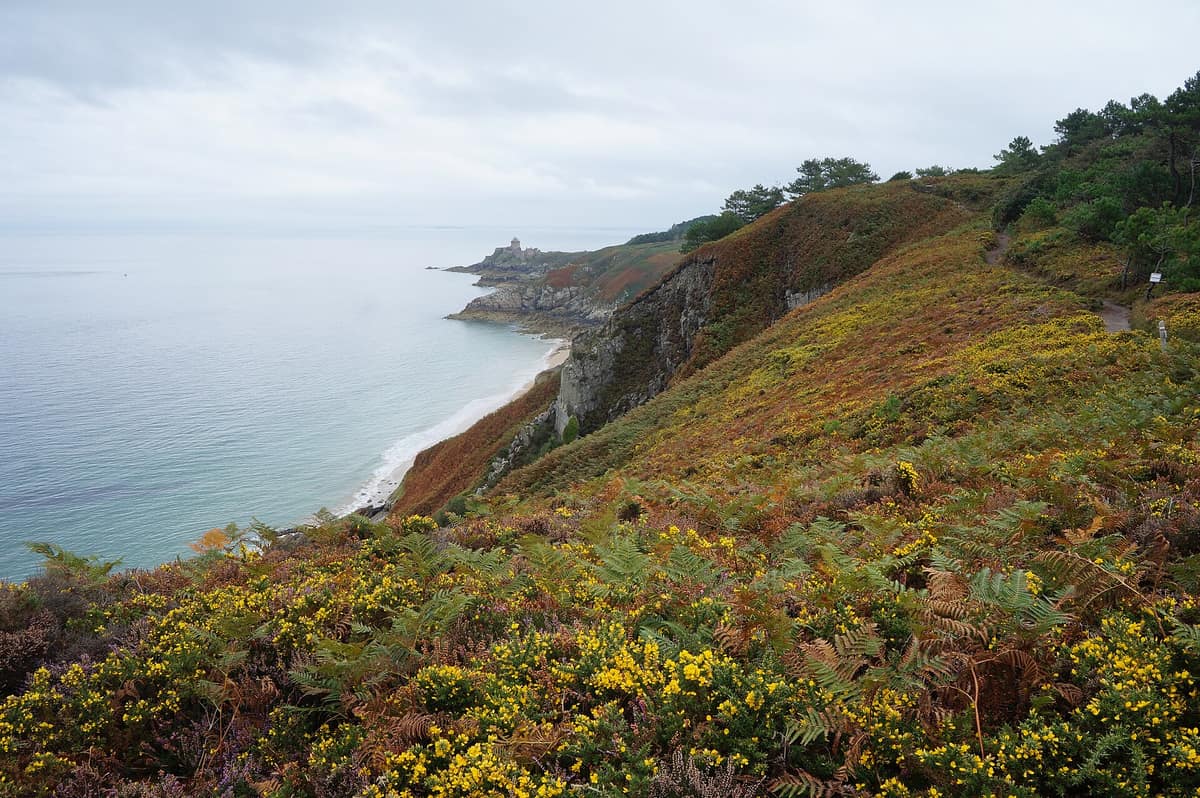
Cap Fréhel
Brittany (Côtes-d'Armor — Plévenon) · France
Photo: Pierre André Leclercq · CC BY-SA 4.0 · Wikimedia Commons
Heather moorlands and pink sandstone cliffs rising over 70 metres sheltering vital seabird breeding colonies.
Wedged between two vast bays, a jagged promontory of pink sandstone projects into the English Channel like a defiant finger. This is Cap Fréhel in Brittany, its sea cliffs plunging some 70 metres into pounding waves. It demarcates the Bay of Saint-Brieuc from the Bay of Saint-Malo, and on clear days the silhouette of Jersey sharpens against the horizon. Above unfolds an exposed windswept moorland, ablaze with pink bell heather and golden gorse; below, sheer red cliffs host raucous seabird colonies throughout summer.
What makes it unique
Between 280 and 336 pairs of common murres nest on these sheer sea cliffs, accounting for roughly 85 % of the French population.
The place
Nature
The landscape
The bedrock explains the coastal architecture. The cape belongs to the Erquy-Fréhel Red Sandstone Series, its distinctive ochre-pink color derived from iron oxide mineral cements bonding quartz grains. Stratified beds lie nearly horizontal, punctuated by vertical dolerite dykes. Ocean breakers carve the sandstone into fractured terraces, pillars, and sea stacks, notably the iconic pinnacle of the Fauconnière.
At the water line the plunging cliffs conceal labyrinthine sea caves known locally in Breton as houles. Explorers can access them on foot at extreme low spring tides or by sea kayak at high water; the Houle de la Banche is the longest. Nineteenth-century folklorist Paul Sébillot recorded local legends populating these cavernous hollows with marine fairies (fées des houles).
Across the clifftop plateau stretches coastal heath: 340 hectares of maritime dwarf-shrub heathland windswept by oceanic gales, maintained through conservation sheep grazing to halt woody scrub encroachment. Maritime grasslands of Brachypodium pinnatum and sea hog's fennel (Peucedanum officinale)—the latter unique in France to this headland—shelter common wall lizards, solitary bees, grasshoppers, and burrowing spiders.
Wildlife and seasons
The summer cliff colonies stage an unforgettable avian spectacle. Crowning the Fauconnière sea stack and nesting along ledges beneath the visitor balustrades are European shag, common murre, and black-legged kittiwake. They are joined by 28 to 31 pairs of razorbill, with northern fulmars dispersed along the gullies, alongside lesser black-backed, herring, and great black-backed gulls nesting on offshore islets.
Seasonal rhythms transform the headland. In spring pelagic cliff-nesters arrive and subtle wild orchids flower among the sward. Late summer brings the delicate azure blossoms of marsh gentian (Gentiana pneumonanthe). In winter the sheltered Baie de la Fresnaye hosts northern wildfowl. The moorlands also serve as a vital coastal migration funnel for passerines like northern wheatears; since mid-summer 2019, a resident pair of red-billed choughs has established itself, marking the first confirmed record for the department.
Species
With a page in the atlas
Being mentioned in a source doesn't guarantee sightings: check with the people who manage the area.
Memory and protection
History and conservation
The historic granite lighthouse, the Vauban tower, was erected in 1701 during the reign of Louis XIV. In the Second World War the German military operated a coastal radar surveillance post here; reinforced concrete bunkers remain hidden beneath the scrub, their damp galleries providing winter bat roosts. A controversial littoral road initiated illegally by a local mayor was successfully halted by environmentalists, and the disturbed heath was fully restored.
The cape has enjoyed national protected site classification since 1967 in recognition of its heathland habitats, rich botanical diversity, and seabird cliffs. The terrestrial moors and offshore waters form a Natura 2000 marine site spanning Erquy to Saint-Cast-le-Guildo; in September 2019 the combined headlands of Erquy and Fréhel were formally designated as France's nineteenth Grand Site de France, welcoming over two million visitors annually.
Before you set off
Visiting
How to visit
Walking is the classic experience. The GR 34 coastal footpath loops around the perimeter of the headland through heather and gorse. The Grand Site is also crossed by the Vélomaritime, part of the EuroVelo 4 European cycle route. Cliff-edge tracks are strictly reserved for pedestrians.
Vehicular access follows coastal roads: from the east past Fort La Latte, or from Sables-d'Or-les-Pins to the west. Without a car, BreizhGo regional bus line 2 from Saint-Brieuc serves Erquy and Plévenon with on-board bicycle racks. Paved access pathways to the lighthouse are accessible to visitors with reduced mobility.
Before you go
Stay on demarcated pathways at all times: shortcuts accelerate severe coastal erosion and trample delicate heath communities. Dogs must remain on leashes. Open fires, overnight wild camping, and camper van stays are strictly forbidden across the protected site. If watching bottlenose dolphins offshore, maintain respectful distances. Consult local tourism offices for seasonal restrictions.
Check access, rules and visiting conditions in the official information from the managing body before you set off.
Location
Where it is and how far it reaches
Boundary of Landes De Cap Frehel Et Abords Du Fort La Latte · © EEA, CDDA (CC-BY) The coordinate is estimated; it isn't a verified access point.
Transparency
Sources
The research data with its sources, and the official links for this place, are in the Spanish version of this page. See the Spanish version
Around it
Far to the west at Brittany's outer extremity, the Pointe du Raz shares northern fulmars, red-billed choughs, and peregrines. The Sept-Îles, Marwick Head, and Hornstrandir share raucous seabird cliffs crowded with razorbills and common murres.
If you like this place, elsewhere in Europe
Distant places with uncommon wildlife and habitats in common. The most widespread species don't count. Sharing species doesn't imply a corridor or guaranteed presence.
- Fair Isle Bird Sanctuary
Scotland (Shetland Islands)
In common: Northern fulmar · Razorbill · Common murre — wild coast, steppe and grassland
The isolated island midway between Orkney and Shetland, historic mecca for migratory vagrant birds and traditional knitwear.
JFMAMJJASONDMay – October · Crowding very low
- Hornstrandir Nature Reserve
Westfjords (Ísafjörður)
In common: Northern fulmar · Razorbill · Common murre — wild coast
An arctic peninsula abandoned in the fifties, without roads, where the arctic fox lives without hunting and without fear.
JFMAMJJASONDJune – August · Crowding none
Entry #1056 of the original atlas.