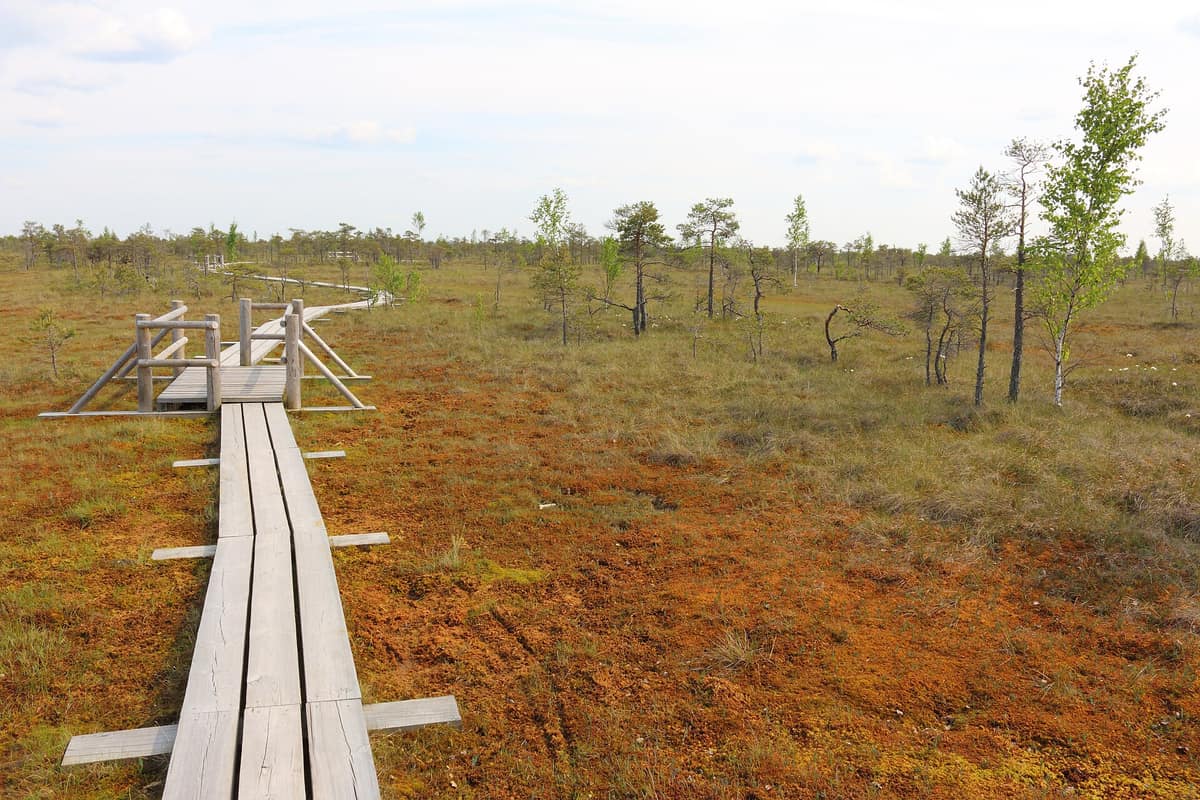
Ķemeri National Park
Ķemeru nacionālais parks
Latvia (Jūrmala / Tukums) · Latvia
Photo: FrDr · CC BY-SA 4.0 · Wikimedia Commons
Raised bogs, swamp forests and coastal lagoons half an hour from Riga, featuring the Great Ķemeri Bog boardwalk.
A peat bog with sulphur springs concealing sunken tanks from the Second World War. Such is the extraordinary landscape united within Ķemeri National Park, west of Jūrmala: forests and bogs, former lagoons of the Littorina Sea converted into lakes, and mineral-rich sulphur springs and muds utilized for centuries for their curative properties. It is the third largest national park in Latvia and was established in 1997.
What makes it unique
A Great Bog traversed on wooden boardwalks, alongside a bird-rich lake, sulphur springs and an inland dune tracing the ancient sea reach.
The place
Nature
The landscape
Half of the park is forested: 57 %, featuring dry pine forests on poor sandy ground along the coast of the Gulf of Riga. Peat bogs account for a quarter, with all three bog types present (fens, transitional and raised bogs), the two largest being the Great Ķemeri Bog and Raganu purvs. The Great Bog, moreover, contains hundreds of tiny pools. The largest lakes, Kaņieris, Dūņieris, Sloka and Valgums, are relict lagoons of the Littorina Sea; Kaņieris is the largest and Aklais ezers stands out for its shallow depth, averaging 0.5 m.
Latvia's peat bogs began forming around 10,000 years ago as the climate warmed following the last glaciation. Here the springs originate from a gypsum stratum and soil bacteria producing hydrogen sulphide: that is why the park harbors so many sulphur springs, almost thirty of them around Ķemeri. In Latvian folklore they were known as the devil's eyes and have been sought for healing since ancient times.
Wildlife and seasons
The raised bog is stark: mosses such as Sphagnum, Eriophorum vaginatum, Calluna vulgaris, Ledum palustre, Andromeda polifolia and sundew, the carnivorous plant found here while absent elsewhere. In Raganu purvs, by the sulphur springs, rich fens harbor diverse mosses, reeds and orchids. Edible wild berries also thrive: cranberries, crowberries, cloudberries and bog bilberries.
For birds, Kaņieris is one of the premier sites in Latvia: nearly two hundred species and, during migration, more than ten thousand waterfowl. The observation tower on the Riekstu peninsula overlooks much of the lake. In the bog breed the Common crane, the wood sandpiper and the European golden plover; the latter two breed exclusively in raised bog habitats. In autumn you can hear cranes calling in the distance from the boardwalk, and meadow pipits and white wagtails are easily spotted. Along the Slocene river live the common kingfisher, the black stork, the Eurasian otter and several water-dwelling bats. The park also counts among its inhabitants the Eurasian beaver, the White-tailed eagle and the Moose.
Species
With a page in the atlas
Being mentioned in a source doesn't guarantee sightings: check with the people who manage the area.
Memory and protection
History and conservation
Prior to the park, a reserve was established in 1957, followed by protection of the Kaņieris bird sanctuary and the Slocene valley in 1977, and the Great Bog in 1987, culminating in the creation of the national park in 1997. In 2005 the Slampe river was re-meandered where it had previously been straightened, and in 2006 the hydrological regime of the Great Bog was restored with a system of dams. Kaņieris is a Ramsar site. Numerous tanks from the Second World War sank into the bog, where the peat reaches two storeys in depth.
Rewilding projects
Before you set off
Visiting
How to visit
Begin with the Great Bog boardwalk, located on the northern edge of the peatland about four kilometres from Ķemeri: it offers two loops, the small loop of 1.4 km and the large loop of 3.4 km, equipped with an observation tower. It is highly sought by photographers at sunrise and sunset. In addition, the local tourist map notes that the Ķemeri wet forest boardwalk is accessible for strollers and wheelchairs.
Other routes include: the Niedrāju boardwalk, 0.6 km long and partly on floating pontoons, revealing shoreline calcareous fen meadows and reedbeds; the Kaņieris hillfort trail, a 1.3 km loop through forest and fen, ending at a viewing platform; the Sēra dīķi trail, 0.8 km across Raganu purvs, where springs form shallow pools; and the 14 km trail to Zaļā kāpa, an inland sand dune ridge stretching several kilometres left behind when the Littorina Sea reached this inland shore.
Before you go
In the strict reserve zone almost all economic activities are prohibited. Before visiting, check with the park management on the condition of the boardwalks.
Check access, rules and visiting conditions in the official information from the managing body before you set off.
Location
Where it is and how far it reaches
Boundary of Ķemeru Nacionālais parks · © EEA, CDDA (CC-BY) The coordinate is estimated; it isn't a verified access point.
Transparency
Sources
The research data with its sources, and the official links for this place, are in the Spanish version of this page. See the Spanish version
Around it
Thirty kilometres away lies Abavas Senlejas Dabas Parks. Sharing similar wetlands, coasts and lakes, cranes, beavers and white-tailed eagles are shared with Słowiński Park Narodowy, while cranes and moose are shared with Store Mosse National Park; closer in character, Kuršių nerijos nacionalinis parkas shares moose, beaver and white-tailed eagle, and Teiču dabas rezervāts shares the crane and golden plover.
If you like this place, elsewhere in Europe
Distant places with uncommon wildlife and habitats in common. The most widespread species don't count. Sharing species doesn't imply a corridor or guaranteed presence.
- Skuleskogen National Park (High Coast of Sweden)
Västernorrland (Höga Kusten / Örnsköldsvik / Kramfors)
In common: Common crane · Moose · Eurasian beaver — wild coast, old-growth forest
The heart of Sweden's High Coast (Höga Kusten), the site of the world's greatest post-glacial isostatic rebound (286 m of land uplift after the ice), featuring the Slåttdalssvackan canyon.
JFMAMJJASONDMay – October · Crowding low
- Vindelfjällen Nature Reserve
Västerbotten (Ammarnäs / Tärnaby)
In common: European golden plover · Moose · Eurasian beaver — wetland, old-growth forest
One of the largest nature reserves in Europe: high-alpine massifs, birch valleys, and the free-flowing Vindel River running wild to the Baltic.
JFMAMJJASONDMarch – April · June – September · Crowding very low
Entry #1031 of the original atlas.