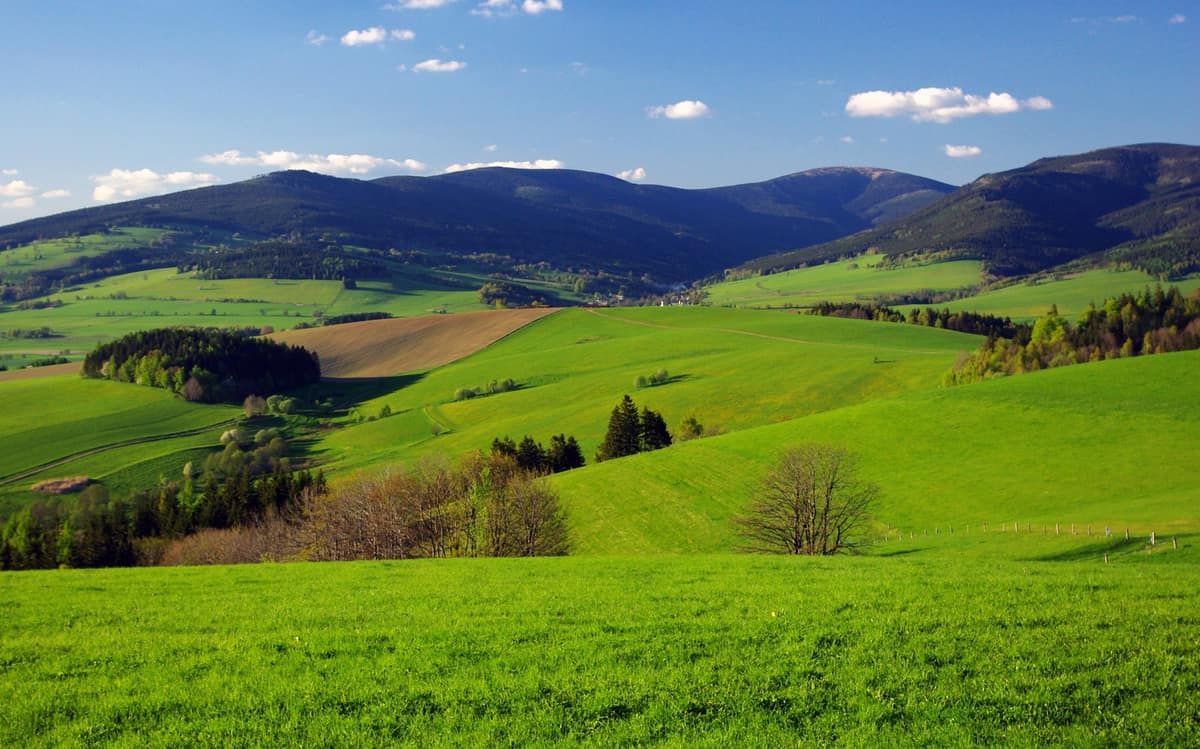
Králický Sněžník - Masyw Śnieżnika
Pardubice / Olomouc (CZ) / Lower Silesia (PL) (Dolní Morava / Międzygórze) · Czechia / Poland
Photo: Marek Stránský · CC BY 3.0 · Wikimedia Commons
Summit of the "Royal Snow" (1.424 m) straddling the triple European hydrological divide of the North, Baltic, and Black Seas.
A raindrop falling on the summit of Trójmorski Wierch has three possible ocean destinations: the Baltic, the North Sea, or the Black Sea. This mountain hub divides its waters between three European seas directly along an international frontier: Králický Sněžník in Czech, or Masyw Śnieżnika in Polish, extends on both sides of the border between Czechia and Poland southeast of Kłodzko. It forms the highest range in the Polish sector of the Eastern Sudetes and ranks as Czechia's third highest, stretching some 16 km from Králíky to the Kladské sedlo pass. Around 200 km² of the massif lie in Poland and 76 km² in Czechia.
What makes it unique
Three seas spring from a single massif whose crest shelters pristine alpine meadows, a unique endemic hawkweed, and luminescent goblin moss.
The place
Nature
The landscape
This is a mountain block carved from ancient metamorphic bedrock. Gneisses and mica schists predominate, yet near Kletno lenses of crystalline marble emerge, where quarrying in 1966 accidentally uncovered Jaskinia Niedźwiedzia (Bear Cave), the most extensive cave system in the Sudetes. Wherever limestone occurs, underground water has dissolved dry ravines, swallow-holes, and resurgences. On the Czech flank, periglacial landforms include blockfields, frost scarps, and karst cavities like Tvarožné díry.
Surface waters put on an equally dramatic display. On the Wilczka stream in Międzygórze, one of the tallest waterfalls in the Sudetes plunges 22 metres down a gorge.
Vegetation zones ascend systematically with elevation. Between 1100 and 1350 m stretch vast mountain spruce forests, frequently retaining an old-growth character; on the eastern ridge lie open high-elevation peat bogs surrounded by bog spruce. From about 1350 m near the summit begins a windswept treeless alpine tundra zone, while above 1250 m alpine grasslands—confined almost exclusively to Śnieżnik's crowning plateau—hold extraordinary conservation value. Deep inside sheltered boulder crevices thrives luminescent goblin moss (Schistostega pennata), unique in Poland.
High altitudes harbour botanical rarities. The bearded bellflower, which in Czechia grows solely in Hrubý Jeseník and Králický Sněžník, has declined markedly over recent decades. The grass Sesleria tatrae survives only on a single marble outcrop on the Polish side, marking its solitary location outside the Carpathians. Finally, the hawkweed Hieracium nivimontis is a strictly local endemic found nowhere else on Earth.
Wildlife and seasons
Do not expect resident large carnivores: brown bears, wolves, and lynx were historically eradicated from the range, although wandering individuals confirmed in recent seasons likely strayed from the Carpathians. In their place, a resident herd of chamois roams Średniak, established here since the late nineteenth century and representing Poland's only wild herd outside the Tatras. On the Czech slopes, chamois are considered an introduced species that dispersed from the neighbouring Jeseníky.
The woodlands and summits harbour rich bird communities. Ravens and the black woodpecker inhabit the forests, alongside the rare Eurasian three-toed woodpecker. The ring ouzel, recognized by its bright white breast crescent, frequents high altitudes, while the alpine accentor nests in the subalpine dwarf scrub. Resident owls include the Eurasian pygmy owl, boreal owl, tawny owl, and Eurasian eagle-owl; turbulent mountain streams host the white-throated dipper. Following the extirpation of the western capercaillie, an active reintroduction program is currently underway.
Amphibians include the fire salamander and alpine newt, while reptiles feature grass snakes and common vipers. Local limestone caves provide winter hibernacula for bats: the Polish landscape park shelters the grey long-eared bat, brown long-eared bat, Daubenton's bat, and greater mouse-eared bat.
Species
With a page in the atlas
Being mentioned in a source doesn't guarantee sightings: check with the people who manage the area.
Memory and protection
History and conservation
Conservation status was established from two national sides. In Czechia, the national nature reserve was proclaimed in 1990 encompassing 1694,67 ha with a protective buffer zone of 1371,24 ha. On the Polish side, the Śnieżnik Landscape Park was established in 1981, with forests covering around 60 % of its area; it protects three designated nature reserves: Śnieżnik Kłodzki, Wilczki Waterfall, and Jaskinia Niedźwiedzia.
The forests reflect a long forestry history. Native mixed old-growth of beech, fir, and spruce was largely replaced by commercial spruce monocultures that later suffered from acid rain; in preserved study plots, old-growth veterans exceed 250 years of age. Before World War II, an alpine biological research station operated in Międzygórze.
Before you set off
Visiting
How to visit
The primary walking route is the Králický Sněžník educational nature trail: 14 km of medium to high difficulty, featuring 17 thematic stops, 685 m of ascent, taking roughly five hours to complete. It begins at the Dolní Morava bus turnaround car park and concludes at the Návrší mountain hut in Stříbrnice, passable in all seasons. The trail is maintained by Lesy ČR and the nature conservation agency AOPK, with tourist information provided by the Staré Město TIC in Dolní Morava. Access is possible by rail to Staré Město followed by bus, or by direct bus from Králíky to Dolní Morava.
On the Polish side, principal trailheads are the scenic villages of Międzygórze and Kletno, granting immediate access to the Wilczka waterfall and Bear Cave. In winter, a designated cross-country ski trail connects Bielice in the Bialskie Mountains to Sienna.
Before you go
Check trail conditions and weather forecasts at the Staré Město TIC before ascending; the educational trail remains open year-round but is classified as medium to demanding in difficulty. Strictly observe national reserve and landscape park regulations: verify local restrictions with the management authorities beforehand.
Check access, rules and visiting conditions in the official information from the managing body before you set off.
Location
Where it is and how far it reaches
Boundary of Králický Sněžník · IUCN IV · © EEA, CDDA (CC-BY) The coordinate is estimated; it isn't a verified access point.
Transparency
Sources
The research data with its sources, and the official links for this place, are in the Spanish version of this page. See the Spanish version
Around it
Hrubý Jeseník lies roughly twelve kilometres to the east and Orlické hory around seventeen kilometres to the west.
What else to explore nearby
Approximate straight-line distance between the edges of each area. It doesn't indicate access, routes or driving times.
- Hrubý Jeseník - Subalpine Tundra and Peaks
Moravia-Silesia (Praděd / Karlova Studánka)
About 12 km away
Moravia's highest mountains, crowned by Praděd and encircled by subalpine meadows and cascading gorge waterfalls.
JFMAMJJASONDJune – October · Crowding low
- Eagle Mountains and Bystrzyckie Range
East Bohemia (CZ) / Silesia (PL) (Deštné / Zieleniec)
About 17 km away
Gentle forested Sudetes ridge protecting raised bogs on the Czech-Polish border.
JFMAMJJASONDMay – October · Crowding very low
Entry #358 of the original atlas.