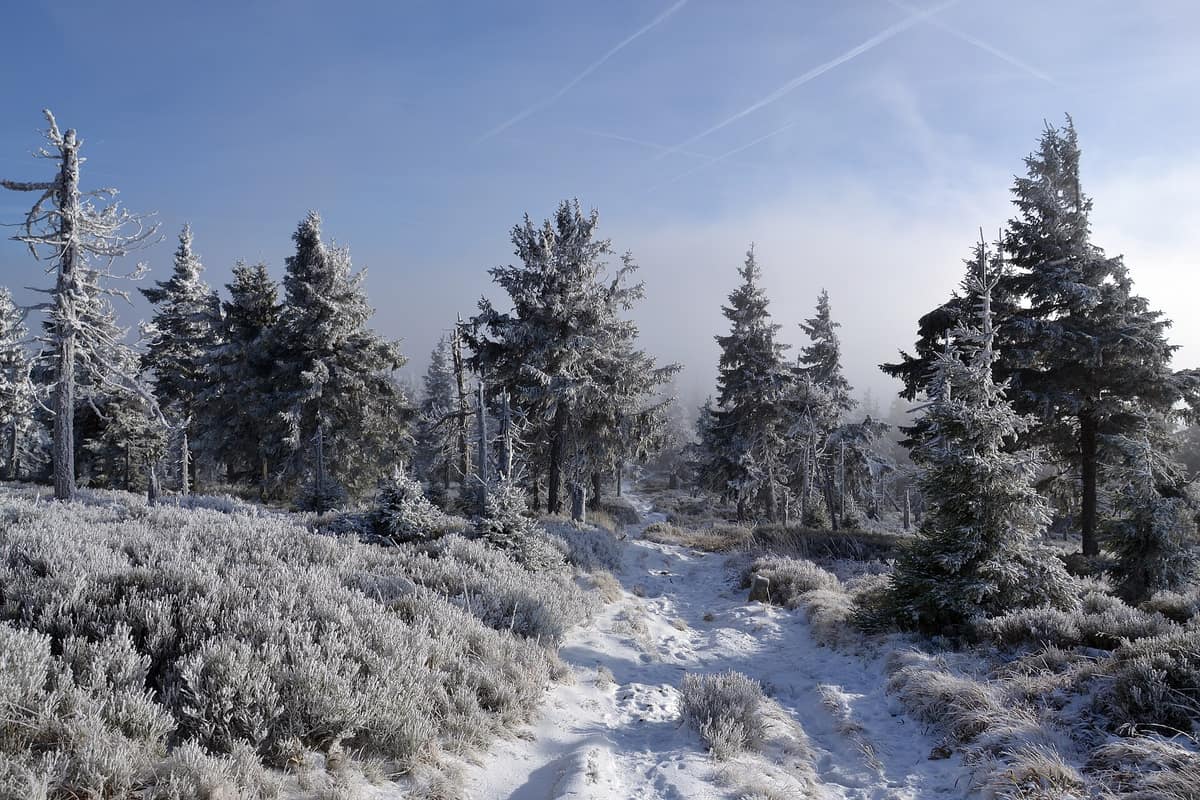
Hrubý Jeseník - Subalpine Tundra and Peaks
Hrubý Jeseník - Subalpine Tundra
Moravia-Silesia (Praděd / Karlova Studánka) · Czechia
Photo: Pudelek · CC BY-SA 4.0 · Wikimedia Commons
Moravia's highest mountains, crowned by Praděd and encircled by subalpine meadows and cascading gorge waterfalls.
Above the Moravian forests lies an arctic-alpine tundra. On the crests of Hrubý Jeseník, the second highest mountain range in Czechia, the loftiest summits preserve a Nordic tundra-like ecosystem harboring relic flora that can only survive beyond the tree line. Here the wind reigns supreme, fog blankets the heights roughly 294 days a year, and snow lingers well into spring. Even so—or precisely for that reason—it stands as one of the most botanically diverse enclaves in the country.
What makes it unique
Velká kotlina is the only place in Jeseníky that hosted a mountain glacier, and its glacial cirque still harbors plants found nowhere else in the world.
The place
Nature
The landscape
It all began with glacial ice. A mountain glacier excavated the cirque of Velká kotlina, cradle of the Moravice River, where remnants of its terminal moraine remain evident. What the glacier left unfinished, severe frost weathering shaped: during the Pleistocene epoch, bitter cold shattered the bedrock to leave Petrovy kameny, a prominent tor at 1 447 m surrounded by patterned polygonal ground. In the Middle Ages, locals dreaded the crags, believing witches convened here.
Then came snow, which continues its relentless sculpting today. Heavy drifts accumulate on the leeward slopes and unleash recurrent avalanches, preventing closed forest canopy from establishing. This creates the open niche where specialized herbs flourish: subalpine springs, high-altitude peat bogs, wind-swept alpine grasslands, snowbed hollows, and tall-herb communities. Thus, a compact territory of 1 km² can assemble astonishingly divergent habitats.
Climate completes the picture. The mean annual temperature in the Praděd reserve is barely 1,3 °C, with sub-zero temperatures recorded on the summits even in July and August. Atop Praděd, snowpack persists on average from 30 November to 19 April, surviving in sheltered ravines until July. Wind-still calm occurs on only about 5,5 days each year.
Wildlife and seasons
If you want to see rare flora, Velká kotlina is the destination. Around 360 vascular plant species are documented, including 57 protected species. Two are strict local endemics: Plantago atrata subsp. sudetica and Dianthus carthusianorum subsp. sudeticus. Near Petrovy kameny grow two additional endemics, Poa riphaea and Campanula gelida. The Siberian bellflower was discovered here in 1826, refound around 1947, and, following decades of searching, rediscovered again in 1976; Gentiana verna is critically endangered in Czechia. Bryophytes and lichens number several hundred species.
Among invertebrates, the most renowned is a springtail: the genus Jesenikia was first described in Velká kotlina. The butterfly Erebia sudetica is endemic to these summits, threatened by the spreading dwarf mountain pine. Among birds, the peregrine falcon nests on rock ledges; bluethroats and Eurasian dotterels have been recorded; and the western capercaillie and black grouse are rare, declining inhabitants. Mammals include the threatened Eurasian lynx; the introduced chamois, like the red deer, damages fragile flora by overbrowsing, so herds are kept small. Common toads, alpine newts, viviparous lizards, and common vipers also dwell here.
Species
With a page in the atlas
Being mentioned in a source doesn't guarantee sightings: check with the people who manage the area.
Memory and protection
History and conservation
The summit landscape is partly the product of human history. Švýcárna, the oldest refuge in the reserve, was constructed in 1829 for Swiss-style dairy cattle herding, a pastoral tradition that maintained the floristic diversity of high-altitude grasslands. Today encroaching dwarf mountain pine is selectively culled to restore open alpine habitats. Cattle grazing returned to Švýcárna in 2012, followed by sheep in 2015. Between 1919 and 1922 the Czechoslovak military used Vysoká hole and Velká kotlina as an artillery firing range, causing severe damage. The original stone viewing tower on Praděd collapsed on 2 May 1959, shortly before scheduled repairs.
The Praděd National Nature Reserve was established on 14 December 1990 by merging earlier state reserves, and with 2 031,40 ha it stands as the largest of its kind in Czechia. Conservation biologists now agree that broader swaths require mowing and controlled grazing. Between 2024 and 2029 the administration plans to mow and pasture 50 hectares of alpine grasslands annually.
Before you set off
Visiting
How to visit
The Velká kotlina educational trail begins in Karlov pod Pradědem, follows blue trail blazes, and finishes at Ovčárna beside the Moravice River. It is a demanding hike of six kilometres featuring interpretative stops on botany, zoology, and geology, guided by the endemic springtail Jesenikia filiformis discovered here. Built in 1971 by the protected landscape administration, it was refurbished in 1988 and took its current design in 2011. Some 45 freshwater springs issue from the cirque, the Moravice spring being the most copious.
If you prefer alternative routes, additional nature trails explore the slopes: one circling Mount Keprník and another following wild torrents, waterfalls, and primeval spruce stands. High above, at 73 m up the Praděd transmission tower, an enclosed viewing deck overlooks, in clear weather, Mount Sněžka, Lysá hora, and, on rare occasions, the High Tatras.
Before you go
Throughout the protected landscape area, wild camping and lighting fires outside designated sites are strictly prohibited. Within national nature reserves you may not step off marked trails, climb rocks, or launch hang gliders or paragliders, and gathering plants or capturing wildlife is banned. The cirque of Velká kotlina is the most active avalanche terrain in Jeseníky, and the requirement to remain on marked trails applies year-round, including for winter ski-tourers.
Check access, rules and visiting conditions in the official information from the managing body before you set off.
Location
Where it is and how far it reaches
Boundary of Jeseníky · IUCN V · © EEA, CDDA (CC-BY) The coordinate is estimated; it isn't a verified access point.
Transparency
Sources
The research data with its sources, and the official links for this place, are in the Spanish version of this page. See the Spanish version
Around it
Králický Sněžník Massif lies about 12 km away, representing another national nature reserve that strictly prohibits departing from marked trails.
What else to explore nearby
Approximate straight-line distance between the edges of each area. It doesn't indicate access, routes or driving times.
- Králický Sněžník - Masyw Śnieżnika
Pardubice / Olomouc (CZ) / Lower Silesia (PL) (Dolní Morava / Międzygórze)
About 12 km away
Summit of the "Royal Snow" (1.424 m) straddling the triple European hydrological divide of the North, Baltic, and Black Seas.
JFMAMJJASONDJune – October · Crowding low
If you like this place, elsewhere in Europe
Distant places with uncommon wildlife and habitats in common. The most widespread species don't count. Sharing species doesn't imply a corridor or guaranteed presence.
- Bucegi National Park - Western Slopes
Dâmbovița, Argeș, and Prahova Counties
In common: Alpine newt · Vipera berus · Western capercaillie — high mountain, old-growth forest
Dramatic conglomerate cliffs rising toward the plateau of the Babele and Sphinx wind-sculpted rock formations.
JFMAMJJASONDJune – October · Crowding low
- Retezat National Park
Hunedoara County (Hațeg)
In common: Vipera berus · Western capercaillie · Peregrine falcon — high mountain, old-growth forest, glacial landscape
The realm of the granitic and glacial Retezat, with over 80 crystal tarns and the Gemenele scientific reserve.
JFMAMJJASONDJune – October · Crowding low
- Maritime Alps Natural Park
Piedmont (Cuneo / Valdieri / Entracque)
In common: Black grouse · Peregrine falcon · Chamois — high mountain, old-growth forest, glacial landscape
United with France's Mercantour National Park, it forms a massive cross-border Alpine-Mediterranean wilderness crowned by Mount Argentera (3.297 m).
JFMAMJJASONDJune – October · Crowding low
- Vanoise National Park
Auvergne-Rhône-Alpes (Savoie)
In common: Black grouse · Chamois — high mountain, glacial landscape
France's first national park (1963), created to save the Alpine ibex: glaciers, alpine grasslands, and one of the Alps' greatest ibex populations.
JFMAMJJASONDJune – September · Crowding moderate
Entry #357 of the original atlas.